
Consecration of the Aaronic Priesthood

Study of the consecration of Aaron and his sons to the priesthood. Types of Christ abound, along with principles for our service as New Testament priests.
Having completed the instructions for the priests’ clothing in Exodus 28, the Lord now gives Moses instructions for consecrating the priests to their high and holy office. Principles abound for us as New Testament priests.
Leviticus 8 is an important parallel passage to Exodus 29. In Exodus 29, the instructions for the consecration of the priests are given; in Leviticus 8, they are carried out.
Key words in this chapter are ‘consecrate’, ‘consecrated’, ‘hallow’, ‘hallowed’, ‘sanctify’ and ‘sanctified’. God is setting apart these men for sacred service. They were to be surrendered entirely to the service of God.
In our last message, we considered the four steps involved in the consecration of the priesthood.
- Cleansing (Vs. 1-4)
- Clothing (Vs. 5-9)
- Atoning (Vs. 10-20)
- Anointing (Vs. 21)
We will now continue our study of the offerings.
The Consecration Offerings (Vs. 10-37)
Several sacrificial offerings are made to consecrate the priests. Each offering points to Christ, the perfect sacrifice. Many types of Christ are needed because of the many beautiful dimensions of His character and work.
- The Sin Offering (Vs. 10-14)
- The Sweet (Burnt) Offering (Vs. 15-18)
The Surrender (consecration) Offering (Vs. 19-21)
The ram was slain and its blood applied to the right ear, thumb and big toe (Vs. 20).
- The salvation picture. The whole person was to be cleansed and consecrated by the blood. Christ cleanses our hearing, our actions, and our goings so that we can offer acceptable service to God.
- The surrender picture. The application of the blood speaks of the complete surrender of the whole life to God for His service. The blood sets us apart as special.
- The priest’s ears were to be consecrated to God, open and obedient to God’s instructions, and to refuse the impure and unclean.
- The priest’s hands were to be consecrated to God to be used, not in the service of sin but in holy service to God. The right hand signifies strength and skill (Ex. 15:6, Ps. 137:5). We are to give God our best in service.
- The priest’s feet were to be consecrated to God to do His bidding, to move in the direction of fulfilling God’s will. We are to use our feet to carry the good news of salvation (Rom. 10:15).
The Sign (wave/heave) Offering (Vs. 22-37)
A lot of detail/emphasis is given to this aspect of the consecration offering. Let’s study the details and how they beautifully portray our Lord Jesus Christ.
- The wave offering was made up of portions from the consecration offering and, therefore, was a part of the consecration offering (Vs. 22). The fat represented the best of the offering. The inner parts that were offered remind us that our Lord’s sacrifice came from His heart.
- The bread (See Vs. 2) was used for this part of the consecration offering (Vs. 23). The bread speaks of Christ as the bread of life.
- The bread was unleavened (Vs. 2), speaking of Christ’s sinless life. This unleavened bread was waved before God symbolising the perfection of Christ’s life before the Father.
- The cakes and wafers were oiled. Oil typifies the Holy Spirit. Christ’s life was anointed with the fragrance and power of the Holy Spirit.
- The offering portions and the bread were then placed in the hands of Aaron and his sons and waved before the LORD (Vs. 24)
- The priest’s hands were filled with the offerings of the LORD, symbolising their consecration to service. The words ‘consecrate’ and ‘consecration’ in this chapter are fascinating in Hebrew. The word literally means “to fill the hand”. It is made up of two Hebrew words, “to fill” and “the hand”, and is a reference to the offerings that would fill the hands of the priests. It sheds light on what it means to be consecrated to Christ’s service. To be consecrated is to have your “hands full” of things to do for the Lord. If you feel like you have “your hands full”, that is a good thing if they are full for the Lord!
- The waiving of the offering before the LORD symbolised the acceptance of that offering by God. It typifies the truth of the Father’s acceptance of His Son’s sacrifice.
- The offering was then taken from their hands and burnt on the altar for a burnt offering for a sweet savour to the Lord (Vs. 25). Christ’s sacrifice was a sweet savour to the Father. Christ’s sacrifice perfectly satisfied God’s just demands.
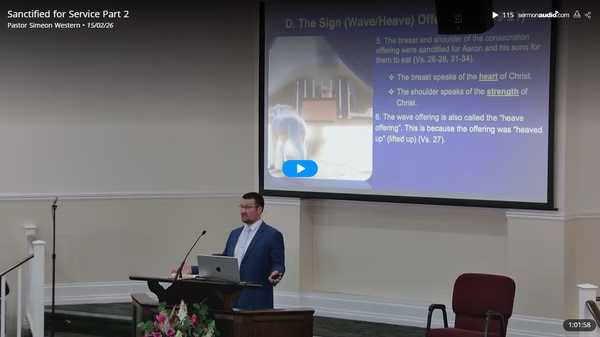
- The breast and shoulder of the consecration offering were sanctified for Aaron and his sons for them to eat (Vs. 26-28, 31-34).
- The breast speaks of the heart of Christ. The priests were to eat this portion. As we feed on the Word of Christ, we learn of His heart, and as the Word influences our lives, we begin to reflect His heart. As New Testament priests, we need to have Christ’s heart.
- The shoulder speaks of the strength of Christ. Christ’s sacrifice was a powerful sacrifice. Our strength for priestly service comes from Him! We live and serve by the life of Christ working through us.
- The wave offering is also called the “heave offering”. This is because the offering was “heaved up” (lifted up) (Vs. 27). The Hebrew word is translated “lifted up” multiple times in the Old Testament (E.g., Gen. 7:17, 14:22, 39:15,18, 41:44; Ex. 7:20, 14:16, Deut. 17:20, 1 Sam. 2:7-8, 1 Kings 11:27, 1 Chr. 15:16, 25:5, 2 Chr. 5:13, Ex. 9:6, Job 38:34). Also translated “exalted” (e.g., 1 Kings 14:7), “offer” & “offer up” (e.g., Ex. 35:24, num. 15:19, 31:52), “take up” (Lev. 6:10), “gave” (e.g., 2 Chr. 35:8-9) Christ was lifted up for us on the cross. He was suspended between earth and heaven, providing reconciliation between sinners on earth and a Holy God in heaven.
- John 3:14-17 “And as Moses lifted up the serpent in the wilderness, even so must the Son of man be lifted up: That whosoever believeth in him should not perish, but have eternal life. For God so loved the world, that he gave his only begotten Son, that whosoever believeth in him should not perish, but have everlasting life. For God sent not his Son into the world to condemn the world; but that the world through him might be saved.”
- John 12:32-33 “And I, if I be lifted up from the earth, will draw all men unto me. This he said, signifying what death he should die.”
- On a practical level, the heave offering reminds us that priestly service involves lifting a load for the Lord!
- The period of the consecration was 7 days (Vs. 35-37). This period was for the consecration of both the priests and the altar. The number seven signifies completion/perfection. Christ’s sacrifice is completely sufficient to save and sanctify us.
The Daily Offerings (Vs. 38-46)
The Particulars for the Daily Offerings (Vs. 38-42)
There was to be a morning and evening offering comprised of:
- A lamb – Christ is the Lamb of God. John 1:29 “The next day John seeth Jesus coming unto him, and saith, Behold the Lamb of God, which taketh away the sin of the world.”
- A meal offering – this was made of fine flour and mingled with a hin (approx 4 litres) of beaten oil. The fine flour speaks of the sinless perfection of Christ’s character. The meal offering was baked or fried, which speaks of Christ’s sufferings. The oil speaks of the Spirit of God (1 Sam. 16:13; Is. 61:1), which Christ has without measure (Jn. 3:34). The meal offerings also depict Christ as the Bread of Life and the believer abiding in Christ and feeding on Christ for spiritual life (Joh. 6:35; 15:5).
- A drink offering – this consisted of a hin of wine. The red grape juice pictures the blood of Christ. The drink offering was poured out before the Lord. Our Lord Jesus poured out his life’s blood for our redemption.
The Picture of the Daily Offerings
- The Typical lessons
- The Lambs were the basis of God’s relationship with Israel. Without the lambs, there could be no fellowship with God. Apart from Christ’s atoning sacrifice, fallen man has no saving relationship with God. The Lamb reconciles and God the man.
- The offering of the lambs was daily and continual (Vs. 38). Christ offered Himself once. “For by one offering he hath perfected for ever them that are sanctified” (Heb. 10:14).
- The morning and evening sacrifices point to the time of Christ’s suffering. Christ was crucified at the third hour or 9 am (Mr. 15:25), which was the time of the morning sacrifice, and he died at the ninth hour or 3 pm (Mk. 15:34), which was the time of the evening sacrifice.
- The daily lamb sacrifices were burnt offerings (Ex. 29:42; Nu. 28:3, 6). The burnt offering signifies Christ as the sinless Man completely devoted to God and accepted by God (Mt. 3:17; 17:5; Joh. 8:29).
- The daily lamb sacrifices were sweet savour offerings (Ex. 29:41; Nu. 28:6, 8). The burnt offerings, meal offerings, and peace offerings of Leviticus 1-3 are “sweet savour” offerings unto God (Le. 1:9, 13, 17; 2:2, 9, 12; 3:5, 16). A sweet savour offering is that which pleases God (“an odour of a sweet smell, a sacrifice acceptable, wellpleasing to God,” Php. 4:18). These offerings depict the sweet savour that Christ is before the Father, both in His life and in His death. See Eph. 5:2, “Christ … hath given himself for us an offering and a sacrifice to God for a sweetsmelling savour.” Christ pleased God on our behalf.
- The practical lesson
- Start the day with the Lord, finish the day with the Lord and walk with the Lord in between! We need daily reminders of Christ the Lamb. Think much on Christ each day!
- Offer spiritual sacrifices daily in supplications, service and songs.
The Promises connected to the Daily Offerings (Vs. 43-46)
God promised to:
- Meet with his people (Vs. 42b-43)
- Sanctify the tabernacle, the altar and the priesthood (Vs. 44)
- Dwell amongst His people (Vs. 45)
- Be their God (Vs. 45b, 46a)
- Note that this list of wonderful promises comes right after the description of the offerings. God would meet with His people, dwell with His people, sanctify His people and be His people’s God on the basis of the sacrifices. Without the sacrifices, there could be no fellowship with a Holy, Righteous God. Because of Christ’s sacrifice, we can have a personal relationship with God.
Conclusion
The priests needed to be cleansed and anointed. If we would be powerful, useful New Testament priests, we need the Application of the Blood and the Anointing of the Spirit. Sanctified service is service done in the power of the blood and the power of the Spirit.
Sermon 51 in Exodus Series
Sermon Audio Id: 2142610029808