
Consecration of the Aaronic Priesthood

The consecration of Aaron and his sons to the priesthood. Types of Christ abound, along with principles for our service as New Testament priests.
Having completed the instructions for the priests’ clothing in Exodus 28, the Lord now gives Moses instructions for consecrating the priests to their high and holy office. Principles abound for us as New Testament priests.
Leviticus 8 is an important parallel passage to Exodus 29. In Exodus 29, the instructions for the consecration of the priests are given; in Leviticus 8, they are carried out.
Key words in this chapter are ‘consecrate’, ‘consecrated’, ‘hallow’, ‘hallowed’, ‘sanctify’ and ‘sanctified’. God is setting apart these men for sacred service. They were to be surrendered entirely to the service of God.
Let’s consider the four steps involved in consecrating the priests to their office. There was to be:
Cleansing (Vs. 1-4)
The Preparation before their Cleansing (Vs. 1-3)
God outlines the materials Moses would need to consecrate Aaron and his sons.
- One young bullock. Christ was sacrificed when he was “young” and in His prime.
- Two rams without blemish. Rams were valuable. Christ is precious and pure (without blemish).
- Unleavened bread.
- Unleavened cakes tempered with oil.
- Unleavened wafers anointed with oil.
- Note: The bread, cakes and wafers were to be made from wheat. They were all to be unleavened. Christ, as the bread of life, is totally without sin and corruption.
- Note: All of the above speak of various aspects of the Person and Work of our sinless Lord Jesus. We are consecrated by Christ!
The Place of their Cleansing (Vs. 4a)
They were cleansed with water at the “door” of the tabernacle. They could not enter God’s presence to serve in the tabernacle until they had first been cleansed.
- The door speaks of Christ – “I am the door” (Jn. 10:7, 9). Outside of Christ, there is no cleansing! The place to be washed from your sin is at the feet of Jesus.
- The water speaks of the washing of the Word – “Now ye are clean through the word which I have spoken unto you” (Jn. 15:3); “…the washing of water by the word” (Eph. 5:26);
- The water speaks of the washing of the blood – “…but ye are washed…” (1 Cor. 6:11); “…and washed us from our sins in his own blood.” (Rev. 1:5)
- The water speaks of the washing of regeneration – “Not by works of righteousness which we have done, but according to his mercy he saved us, by the washing of regeneration, and renewing of the Holy Ghost;” (Tit. 3:5)
The Public nature of their cleansing
The whole congregation was present for this solemn occasion (Lev. 8:3). When you get cleansed by Christ, it’s a public thing. Your baptism does not cleanse you, but it is a public testimony of your cleansing.
The Picture of their Cleansing
- This was a once-off cleansing. Daily cleansing of the hands and feet in the laver would be necessary for service, but the washing of the whole man was a once-off event. In like manner, you need the cleansing of salvation (the whole person). From that moment on, you are a priest of God, set apart forever for God (“perpetual statute” Vs. 9). Daily cleansing from the defilements of sin and the world is needed for service (hands and feet) (1 Jn. 1:9).
- Challenge: Have you been cleansed by Christ?
Clothing (Vs. 5-9)
This beautifully pictures two dimensions of our salvation. We are cleansed by the blood, and our sin debt is erased. Then we are clothed in the righteousness of Christ.
Aaron’s Clothing (Vs. 5-7)
Aaron typifies Christ, our High Priest.
- The clothing speaks of our Lord’s High Priestly office. He is clothed in righteousness and purity. He is the Servant of Jehovah. He bears the names of His people on His shoulders and upon His heart. He is the Heavenly, Holy Man, the sinless, spotless sacrifice. He is King of kings and Lord of lords.
- The anointing speaks of the ministry of the Holy Spirit in Christ’s life.
- The Name Messiah (Hebrew) or Christ (Greek) means Anointed (Is. 11:1-3)
- Christ was conceived by the Holy Ghost (Matt. 1:18, 20; Lk. 1:35)
- Christ was anointed by the Holy Ghost (Is. 61:1; Lk. 4:18; Acts 10:38)
- Christ was full of the Holy Ghost (Lk. 4:1)
- Christ ministered in the Power of the Spirit (Lk. 4:14)
- Christ possessed the Spirit without measure (Jn. 3:34)
- Note: Aaron was anointed with oil before the blood was shed and applied. This signifies that Jesus was sinless and had no need of an atonement for Himself. On the other hand, the sons of Aaron, typifying Christ’s priestly people, could not be anointed until they had first been cleansed by the blood (Le. 8:13-24).
- “Aaron alone was anointed before the blood was shed; he was clad in his robes of office and anointed with the holy oil before ever his sons were clothed or anointed. The reason for this is obvious. Aaron, when spoken of by himself, typifies Christ in His own peerless excellency and dignity; and, as we know, Christ appeared in all His own personal worth and was anointed by the Holy Ghost previous to the accomplishment of His atoning work. In all things He has the pre-eminence (Col. 1:18). Still, there is the fullest identification afterwards between Aaron and his sons, as there is the fullest identification between Christ and His people. ‘The Sanctifier and the sanctified are all of one’ (Heb. 2:11). The personal distinctness enhances the value of the mystic oneness” (C.H. Mackintosh, Notes on the Pentateuch, p. 340).
The Priests’ Clothing (Vs. 8-9)
As studied in the previous chapter, the clothing of the priest symbolised:
- Salvation – clothed in righteousness (the coats).
- Service – set apart to serve (the girdle).
- Sanctification – set apart to be special and holy (the bonnets).
- Challenge: Have you been cleansed and clothed by Christ?
Atoning (Vs. 10-20)
Several sacrificial offerings are made to consecrate the priests. Each offering points to Christ, the perfect sacrifice. Many types of Christ are needed because of the many beautiful dimensions of His character and work.
The Sin Offering (Vs. 10-14)
Christ was our substitute and sin bearer. He was made sin for us (2 Cor. 5:21).
- A young bullock was offered (Vs. 1, 10a). Our Lord was sacrificed in His prime at the age of 33. A bullock is a creature of strength. Our Lord’s sacrifice was powerful and potent.
- Aaron and his sons laid their hands on the head of the bullock before it was slain, symbolising the transfer of their sin and guilt to the innocent one who would die in their place as a substitute (Vs. 10b). Our sins were placed on Christ at the cross. “All we like sheep have gone astray; we have turned every one to his own way; and the LORD hath laid on him the iniquity of us all.” (Is. 53:6) “The laying on of hands signifies repentance and faith, which is the means of receiving Christ’s salvation. The sinner must symbolically place his hands on Christ, admitting that he is a sinner deserving of God’s judgment and believing that Christ, the innocent, sinless Substitute, paid the full punishment that we deserve.” (Cloud)
- The bullock was slain, and its blood was shed (Vs. 11a). The sacrifice had to die. In like manner, Christ died and shed His blood for our sins. Heb. 9:22 “And almost all things are by the law purged with blood; and without shedding of blood is no remission.”
- The bullock was slain “before the Lord” (Vs. 11b). In like manner, Christ died “before the Father”. His sacrifice was significant and valuable to God. When Christ died, God the Father saw “the travail of his soul” and was “satisfied” (Is. 53:11)
- The blood was applied with the finger to the horns of the altar (Vs. 12a). Horns signify strength and authority in the Bible (See Ps. 75:4-5, 89:24, 92:10, 112:9) and therefore speak of the power and efficacy of the blood. There is power in the blood!
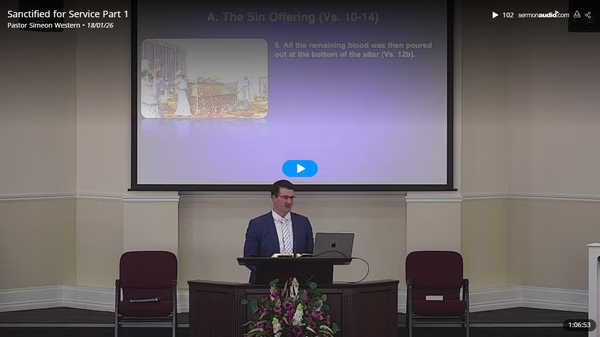
- All the remaining blood was then poured out at the bottom of the altar (Vs. 12b). We are reminded that our Lord Jesus poured out His life’s blood on the cross so we could be saved from sin. Isaiah prophesied that he “poured out his soul unto death” (Isa. 53:12).
- The inner organs were to be burnt on the altar (Vs. 13). This reminds us that Christ’s sacrifice for our sins came from within, from His heart. His sacrifice came from a heart of love – love for His Father and love for us as guilty sinners. His whole being was offered for us – Spirit, Soul and Body.
- The flesh, skin and dung were burnt with fire outside the camp (Vs. 14).
- Speaks of the seriousness of sin. The fire speaks of judgment. Christ bore the Holy wrath of God against sin on our behalf. He endured the fires of suffering on the cross for us.
- Speaks of the removal of sin. Because of the death of the sin offering, sin can be taken away and burnt up, reduced to ashes. What a glorious blessing to see all my sins consumed at Calvary!
- Reminds us that Christ suffered for us “without the gate”. Heb 13:11-13 “For the bodies of those beasts, whose blood is brought into the sanctuary by the high priest for sin, are burned without the camp. Wherefore Jesus also, that he might sanctify the people with his own blood, suffered without the gate. Let us go forth therefore unto him without the camp, bearing his reproach.” Christ was rejected by His own people, Israel, and crucified outside of the city of Jerusalem as a common criminal.
The Sweet (Burnt) Offering (Vs. 15-18)
This offering was the first of the two rams (See Vs. 1). Commenting on the sin and burnt offerings, David Cloud notes, “The sin offering and the burnt offering represent the two-fold aspect of Christ’s atonement. The sin offering signifies the man-ward aspect, which is the payment of man’s sin debt through Christ’s blood and death (Ro. 5:9-10). The burnt offering signifies the Godward aspect, which is Christ’s complete devotion to the Father (Joh. 4:34; 18:11) and the Father’s complete acceptance of Christ and His Sacrifice (Mt. 3:17; 17:5).”
- The ram was “without blemish” (Vs. 1), a reminder of Christ’s sinless nature. He was the sinless sacrifice for our sin.
- Aaron & his sons lay their hands on the head of the ram again (Vs. 15), symbolising the transfer of their sin and guilt to the ram as a substitutionary sacrifice. The offering became their substitute.
- The ram was slain; its blood was shed and then sprinkled around about upon the altar (Vs. 16).
- Christ had to die, and He had to shed His blood. The wages of sin is death (Ro. 6:23), and without the shedding of blood there is no remission of sin (Heb. 9:22). We are justified by His blood and reconciled by His death (Ro. 5:9-10).
- The sprinkling of the blood “round about” upon the altar signifies the vastness and reach of Christ’s atoning work. The sprinkling round about signifies the power of the blood to save men of all nations: east, west, north, and south. It signifies the preaching of the gospel to every creature (Mr. 16:15).
- The ram was then cut into pieces, its insides washed, then burnt in its entirety upon the altar (Vs. 17-18).
- The ram’s inwards and legs were washed and placed with the head upon the altar. This signifies Christ’s complete holiness and sinless perfection. He was perfect in every way: in his actions (the legs), in his thoughts (the head), and in his affections (the heart and other inner organs).
- Note the emphasis on the “whole ram” being burnt on the altar. Christ offered His whole person as a sacrifice for our sins. No part of His being was held back. He was completely surrendered and yielded to the Father’s plan.
- The burnt offering depicts Christ’s complete devotion to God and God’s acceptance of Him. It signifies Christ offering “himself without spot to God” (Heb. 9:14). Christ’s offering was a sweet- smelling savour to the Father. His sacrifice perfectly satisfied the demands of a Just and Holy God. Everything about Christ’s life and work is fragrant, sweet and perfect. Eph. 5:2 “And walk in love, as Christ also hath loved us, and hath given himself for us an offering and a sacrifice to God for a sweetsmelling savour.”
The Surrender (consecration) Offering (Vs. 19-21)
This offering was to be made with the second ram (See Vs. 1). Christ was totally surrendered and yielded to the Father’s will. He laid His life down willingly. Our lives are to be totally devoted and yielded to the service of God. Our service is made acceptable in Christ. The consecration offering reminds us that our service, however sincere, needs to be perfected in Christ. It is because of Christ that our service can be accepted before God.
- This ram was also “without blemish” (Vs. 1). Christ is sinless and spotless.
- The ram was called “the ram of consecration” (Vs. 22). The words ‘consecrate’ and ‘consecration’ in this chapter are fascinating in Hebrew. It literally means “to fill the hand”. It is made up of two Hebrew words, “to fill” and “the hand”, and is a reference to the offerings that would fill the hands of the priests. It sheds light on what it means to be consecrated to Christ’s service. To be consecrated is to have your “hands full” of things to do for the Lord. If you feel like you have “your hands full”, that is a good thing if they are full for the Lord.
- Aaron & his sons again lay their hands on the head of the ram (Vs. 19). This is the third mention of this symbolic act. Have you laid your hands on the head of Christ, the perfect Lamb? Have your sins been transferred to Him? Will you touch Christ by faith right now?
- The ram was slain and its blood applied to the right ear, thumb and big toe (Vs. 20).
- The salvation picture. The whole person was to be cleansed and consecrated by the blood. Christ cleanses our hearing, our actions, and our goings so that we can offer acceptable service to God.
- The surrender picture. The application of the blood speaks of the complete surrender of the whole life to God for His service. The blood sets us apart as special.
- The priest’s ears were to be consecrated to God, open and obedient to God’s instructions, and to refuse the impure and unclean.
- The priest’s hands were to be consecrated to God to be used, not in the service of sin but in holy service to God. The right hand signifies strength and skill (Ex. 15:6, Ps. 137:5). We are to give God our best in service.
- The priest’s feet were to be consecrated to God to do His bidding, to move in the direction of fulfilling God’s will. We are to use our feet to carry the good news of salvation (Rom. 10:15).
- “The ear indicates that all the faculties of the head will be devoted to Him, the thumb that all actions performed will be devoted to Him, and the toe that all footsteps taken will be devoted to Him. Here is total consecration, total separation to His service alone.” (J. Grant)
- The blood and anointing oil were then to be sprinkled upon the priests and their garments (Vs. 21)
The Sign (wave/heave) Offering (Vs. 22-35)
A lot of detail/emphasis is given to this particular offering. We will study this offering in the next message.
Anointing (Vs. 7, 21)
Anointed with Oil (Vs. 7, 21)
- The oil typifies the Person and work of the Spirit in the Bible.
- The sprinkling of the oil reminds us that the Spirit of God is the Agent of the New Birth. He is the One who regenerates us the moment we repent and believe on Christ. This is what it means to be “born again” (Jn. 3:1-7)
- The ministry of the Holy Spirit in our lives is vital for our high calling as New Testament priests.
- We need the indwelling of the Spirit for salvation (Jn. 3:6, 14:17, Rom. 8:9, 11, 1 Cor. 3:16)
- We need the filling of the Spirit for sanctified living (Eph. 5:18). E.g., for church life, family life and work life.
- We need the enduing of the Spirit for service (Lk. 24:49; Acts 1:8). Note that the term “filling” is also used for the empowerment of the Spirit (Acts 4:31).
- The oil was sprinkled over the whole man. How we need the sweet fragrance and power of the Spirit all over our service as New Testament priests. How we need the touch of His power on our ministry for the Lord.
Anointed with Blood (Vs. 21)
Notice that the blood and the oil were applied simultaneously.
- The cleansing of the blood is essential for our salvation. Without it, we cannot be set apart as priests of God.
- The cleansing of the blood is essential for service. The blood of Christ makes our service clean and holy before God. When you serve, ask God to sprinkle the blood of Christ and the oil of the Spirit over it!
- The Spirit of God is the agent of the New Birth (typified in the oil), and He is the One who applies the cleansing blood to our hearts.
- The Spirit of God indwells the believer at the moment of his cleansing/conversion (Eph. 1:13). Note the words “heard…believed…sealed” in Ephesians 1:13. “The two participles (heard & believed) show contemporaneous time with the main verb ‘sealed’. This means that the “sealing with the Holy Spirit” happens when we hear and believe.” (Hester) In other words, they received the Holy Spirit and His sealing work the moment they were saved. They did not need a second experience after salvation for this to happen (e.g., speaking in tongues, the laying on of hands by a preacher, etc.).
- The priests needed to be cleansed and anointed. If we would be powerful, useful New Testament priests, we need the Application of the Blood and the Anointing of the Spirit. Sanctified service is service done in the power of the blood and the power of the Spirit.
Conclusion
- Have you been cleansed and clothed by Christ? He is our sin bearer, substitute and sacrifice.
- Are you offering sanctified service to God? Are you praying for God’s power on your service? Are you fully consecrated and yielded to Him?
Sermon 50 in Exodus Series
Sermon Audio Id: 1152671413246