


Christ’s focus seems to now be on preparing the 12 for his impending death and for their future ministry. In these verses we have a dialogue that takes place between Christ and His disciples concerning His Person and coming crucifixion. This forms a basis for the Lord to outline His demands for true discipleship. In short, there was a cross for Christ but also a cross for His disciples as well. The cross stands at the heart and center of true discipleship. It is one thing to confess Christ in truth (salvation) but God would have us to go on and embrace the cross in a life of consecration. This passage teaches us what true discipleship is according to Christ.
To be a disciple you must embrace three truths found in the text:
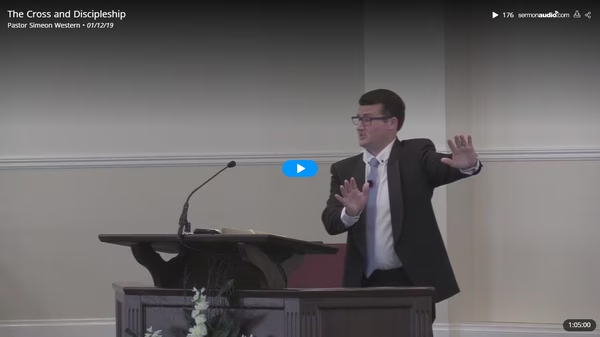
The Person of Christ (Vs. 27-30)
A proper understanding of the Person of Christ is essential to a proper understanding of the cross of Christ. Christ asks His disciples two questions. He asks them concerning…
The People’s View of Himself (Vs. 27-28)
- The place of the question (27a) – Caesarea Philippi, about 25 miles (40 kms) north of Bethsaida. A significant location religiously and politically. The dialogue between Christ and His disciples takes place while they are “by the way”.
- The point of the question (27b) – Christ asks the disciples concerning the opinion of the general populace as to who He is. Note the words “I am”. “He asks them to identify His Person, not what He did but who He was.” (Hiebert)
- The answer to the question (Vs. 28) – the people had discerned something of Christ’s supernatural, prophetic character. They put Him on the same level as one of the Old Testament prophets or as John the Baptist. While these views expressed some truth concerning the Person of Christ, they did not go far enough as they fell short of an acknowledgment and acceptance of His Messiahship.
- Challenge: Each man at some point must come face to face with this question – who is Jesus Christ? The answer to that question has eternal consequences.
The Disciple’s View of Himself (Vs. 29-30)
- The confession (Vs. 29)
- Peter acts as spokesman for the disciples. This was a truth they had already embraced concerning Christ but Christ wanted a public confession as He would now begin teaching them in a deeper way concerning His impending death on the cross.
- The title ‘Christ’ means ‘anointed’ and is a reference to Jesus’ Messiahship.
- Matthew adds, “the Son of the living God” (Matt. 16:16). Peter recognized Christ as the Son of God and therefore acknowledges His Deity and Divinity.
- Christ’s commendation (Matt. 16:17) “And Jesus answered and said unto him, Blessed art thou, Simon Barjona: for flesh and blood hath not revealed it unto thee, but my Father which is in heaven.” 1 Corinthians 12:3 says, “no man can say that Jesus is the Lord, but by the Holy Ghost.”
- Christ’s command (Vs. 30)
- This command was likely on account of the expectations of the people of a political Messiah (See John 6:14-15). The thought of a suffering Messiah was not in their thinking and Christ would not allow anything to stand in the way of Him going to the cross and fulfilling God’s plan for the redemption of mankind. The following verse (31) reveals that this was the theme on Christ’s heart and mind.
- Luke doesn’t even begin a new sentence here so Christ’s command is closely linked with his announcement concerning the cross (Luke 9:21-22).
- Hiebert: “For them to go out and broadcast the fact that He was the Messiah would simply raise false hopes among the people who were expecting an earthly Messiah who would fulfil their political hopes.”
The Purpose of Christ (Vs. 31-33)
Christ’s Instruction about the Cross (Vs. 31)
There were four things Christ said ‘must’ take place:
- He must suffer – note the word ‘many’. His suffering would be great and diverse. Christ did not just suffer in one area for our redemption, suffering was inflicted upon His whole Person – spirit, soul and body.
- He must be rejected – the religious leaders particularly mentioned. This was literally fulfilled when Christ was condemned by the Jewish Sanhedrin.
- He must be killed – Christ would be brutally killed on a Roman cross.
- He must rise again – the cross would not be the end of the story. Christ would rise in triumph and victory over death!
- Note: This is the Gospel in a nutshell – the death, burial and resurrection of Jesus Christ (1 Cor. 15:3-4).
Peter’s Objection to the Cross (Vs. 32)
- Peter’s motivation – Peter clearly motivated by natural affection.
- “…Be it far from thee, Lord: this shall not be unto thee.” (Matt. 16:22)
- Interestingly the phrase “be it far” comes from a Greek word with the root meaning of ‘mercy’. It has the sense, “Lord, be propitious to thyself”, or “spare thyself” (Gill). “Lord, not that; pity Thyself; have mercy upon Thyself; anything but that!” (Morgan)
- The phrase “this shall not be unto thee” is “the strongest kind of negation, as if Peter would not let it happen.” (Robertson)
- Natural affection has its proper place but if uncrucified, it can become and obstruction to the will of God.
- The self-life hates the cross. Peter’s response to the cross revealed something in him that needed to go to the cross. Self says, “side step the cross, avoid the pain, preserve yourself!” The drive for self-preservation is often an obstruction to the Calvary road. It can be an obstruction in our own lives and the choices we make and we can become an obstruction in the lives of others in our misguided attempts to stop them from going to the cross the Lord has for them.
- “The moment we say “I will not allow my obedience to Christ to cause suffering to those I love”, we have left the Calvary road.” (The Glory of the Cross, I. Western)
- Galatians 5:24 “And they that are Christ’s have crucified the flesh with the affections and lusts.”
- “…Be it far from thee, Lord: this shall not be unto thee.” (Matt. 16:22)
- Peter’s mistake
- Peter had an emotional reaction to the will of God and became governed by the self-life rather than the Holy Spirit. Peter’s example highlights how a believer can swing between speaking total truth and total error depending on whether he is being controlled by the Spirit or by the self-life.
- “Peter here appears in a new character; a minute ago speaking under inspiration from heaven, now under inspiration from the opposite quarter.” (Bruce)
Christ’s Admonition about the Cross (Vs. 33)
Christ issues a searing rebuke to correct Peter’s wrong counsel. Christ rebukes…
- The Silent Sympathisers – Christ “turned about and looked on his disciples”. No doubt this was intended that they might also feel the force of the rebuke. Very likely they shared a similar opinion to Peter. You can almost see them nodding their heads and saying a few quiet “Amen” to themselves as they overhear Peter rebuking the Lord. At this time, the disciple’s thoughts were more consumed with the crown than the cross.
- The Sinister Source – “rebuked Peter, saying, Get thee behind me, Satan” The source of Peter’s error was twofold. It came from…
- Self – Peter was his own worst enemy. His self-life had reared its ugly head. The phrase “for thou savourest not” highlights Peter’s error. Peter’s thoughts were being dominated by man’s wisdom rather than God’s. Peter was living “in the small conceptions of the immediate.” (Morgan)
- Satan – in that moment of weakness, Satan was able to lodge a dart in Peter that he then passed on to the Lord.
- MacLaren: “He (Christ) hears in Peter’s voice the tone of that other voice, which, in the wilderness, had suggested the same temptation to escape the Cross and win the crown by worshipping the Devil.”
- F.B. Meyer: “How soon Peter fell from his high estate! Beware! The voice that bids us spare ourselves is Satan’s. Self-pleasing ends in destruction. Self-denial and self-sacrifice are the divine path to life. Let us be more eager to lose ourselves than to find ourselves; more set on the cross than on the glory…We do not choose or make our cross; Christ gives each a little bit of His true Cross to bear as He pleases.”
The Principle of Christ (Vs. 34-38)
The Requirements of True Discipleship (Vs. 34)
Christ outlines three requirements of discipleship in this verse. A true disciple must…
- Deny himself – this is the complete opposite to the natural man and the ways of the world. We are called upon to die to the hyphenated sins of the self-life such as self-promotion, self-defence, self- preservation, self-love, self-importance, self-centredness, self- praise etc… “The disciple must no longer make his own interests and desires the supreme concern of his life. He must ‘turn away from the idolatry of self-centeredness’ (Cranfield).” (Hiebert)
- Take up his cross
- Note carefully the word ‘his’. This is a very individual matter. You must bear the cross that Christ has for you.
- MacLaren: “To slay the life of self is always pain, and there is no discipleship without crucifying ‘the old man.’ Taking up my cross does not merely mean meekly accepting God-sent or men- inflicted sorrows, but persistently carrying on the special form of self-denial which my special type of character requires.”
- Luke adds the word ‘daily’ to the formula. “This willingness to accept the cross must characterize the disciple every day.” (Hiebert)
- Follow Christ
The Reasons for True Discipleship (Vs. 35-38)
There are two key truths that should motivate us to accept Christ’s terms of discipleship:
- Self-preservation leads to self-destruction (Vs. 35-37)
- “whosoever will” = stresses that the choice is a matter of the individual will (Hiebert).
- ‘lose’ = to destroy. Self-preservation, side stepping the cross God has for me has destructive consequences for my Christian life.
- Challenge: How many Christians end up shipwrecking their Christian lives simply because they would not dare to die. They heeded the subtle whisper of the Serpent, “save thyself.”
- MacLaren: “The man who lives absorbed in the miserable care for his own wellbeing is dead to all which makes life noble, sweet and real. Flagrant (blatant) vice is not needed to kill the real life. Clean, respectable selfishness does the work effectually. The deadly gas is invisible and has no smell. But while all selfishness is fatal, it is self-surrender and sacrifice ‘for my sake and the gospel’s,’ which is life giving.”
- “He is no fool who gives what he cannot keep to gain what he cannot lose.” (Jim Elliot)
- Vs. 36-37 – “the issues are now broadened to include on and all.” Illustration: God brings out the scales. On the one side, He puts the whole world. On the other side, a human soul. (Phillips)
- Shame of Christ’s words in this life leads to shame in Christ’s presence at His coming (Vs. 38)
Conclusion
- Are you saved? Have you confessed Christ in salvation (Rom. 10:9-10)?
- Dear saint, what cross is Christ asking you to take up? Will you follow Christ on the Calvary road or will you listen to self and Satan and try and side step the cross?
Sermon 33 of 59 in Mark Series
Sermon Audio Id: 1130191013122183