


Exposition of Psalm 14.
Subtitle: The Exceeding Sinfulness of Man
The Author of the Psalm: The preface to the Psalm reveals that David was the author of this Psalm. There is no reference to the time period in which this Psalm was written but there is a reference to ‘captivity’ that seems to point to a time of difficulty in David’s life. Or it may have been prophetic of Israel’s future captivity and liberation.
The Structure of the Psalm: The Psalm divides into two main sections:
- Vs. 1-4 – deals with the depravity of man.
- Vs. 5-7 – deals with Jehovah being a refuge for His people.
- A summary expository idea would be: “The righteous may have to live in a godless and corrupt world that seeks to destroy them, but there is coming a glorious day of reckoning when God will destroy the wicked and deliver his people.” (Allen P. Ross)
This Psalm is a powerful Psalm for our nation and our times with the rise in militant atheism.
It is also one of the key passages in the Bible that teaches the doctrine of the total depravity of man. It is repeated, with a few slight variations in Psalm 53. In Romans 3 it forms a very important part of the Apostle Paul’s argument concerning the universal sinfulness of the human race. If you want to understand just how wicked mankind is, read and study this Psalm. And remember this was a song sung by God’s people in ancient times!
We will study the Psalm under three headings.
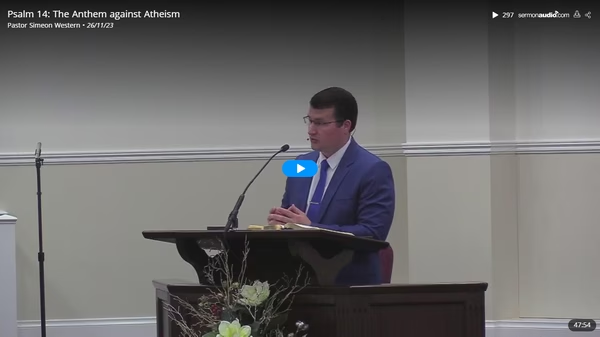
The Delusion of the Atheist (Vs. 1)
The man described in this verse is both a professing and practicing atheist. The two things go hand in hand!
The Badness of Atheism (Vs. 1a)
- The individual who denies God is called a ‘fool’. The word ‘fool’ here refers primarily to moral perversity. “The chief characteristic of the fool is the heart-felt decision to live a godless life, as if there were no God.” (Ross)
- The word ‘fool’ is the Hebrew word ‘nabal’ at its root has the sense of “to fade or wither”; it has the idea of fading, dying, or falling away, as a withered leaf or flower. It takes our thoughts back to Psalm 1 and the contrast between the believer who flourishes as a tree planted by the rivers of water versus the ungodly who are like withered chaff driven away in the wind. Abigail’s first husband was named ‘Nabal’ and he is a living illustration of the meaning of the word. He was a foolish and ungodly man.
- It is both foolish intellectually and morally to deny God’s existence.
- It is foolish intellectually.
- Psalm 19:1 “The heavens declare the glory of God; and the firmament sheweth his handywork.”
- Romans 1:20 “For the invisible things of him from the creation of the world are clearly seen, being understood by the things that are made, even his eternal power and Godhead; so that they are without excuse:”
- It is foolish morally. This thought is developed in the second part of the verse.
- “How impotent the malice! How mad the rage which raves and foams against Him in whom we live and move and have our being! How horrible the insanity which leads a man who owes his all to God to cry out, “No God!” How terrible the depravity which makes the whole race adopt this as their hearts’ desire, “no God”! (Spurgeon)
- It is foolish intellectually.
The Belief of Atheism (Vs. 1b)
- Atheist brashly claim they are not believers but in reality, they have a belief system! The key tenet of their religion is that there is no God!
- Their belief is an exercise in self-deception – “said in his heart”. It is something held to in the heart of a rebellious individual who is seeking freedom from any accountability to a Supreme Being. We are reminded of the deceitfulness and depravity of the heart – “The heart is deceitful above all things, and desperately wicked: who can know it?” (Jer. 17:9).
The Behaviour of Atheism (Vs. 1c)
The wicked conduct is at the same time both the cause and the consequence of the atheist’s assertion “there is no God”. It is the motive behind their claim God does not exist. If there is no God, then they feel free to indulge in their abominable activities. It is also the predictable results of their belief system.
Beliefs affect behaviour. One’s creed influences one’s conduct. Often the worst moral offenders are those who claim there is no God. The worst atrocities against human life, at least in modern history, have been committed by atheist regimes.
They are characterized by:
- Corruption – “they are corrupt”. The word means “to decay”. The word ‘corrupt’ is a very strong word which means “ruin, devastate, corrupt.” (Ross) It is used three times to of the complete corruption of the human race prior to the flood (Gen. 6:11-12) and of the LORD’s destroying Sodom and Gomorrah (Gen. 13:10). Here it refers to moral and spiritual corruption. Their morals are rotten! Have you ever smelt a rotting carcase? It is a putrid and offensive smell. What an awful sin stench there is in a world that is decaying morally and spiritually at an alarming rate. No surprise when the majority in our nation at best lives as if God does not exist or worse, outrightly claims God does not exist.
- Abomination – “they have done abominable works”. Atheism and abomination go hand in hand. It is no coincidence that the nations in the world that are sinking into the abyss of Sodom’s abominations are the nations that have turned their back on God and the Bible. Illustration: During the same sex marriage debate in 2017, some of the most aggressive responses I received to our letter box drop were from atheists.
- Omission – “there is none that doeth good”. This will be repeated again in verse 3. Man in his natural, depraved state, cannot produce anything that is truly good in the sight of a Holy God. Any “good” thing he does is tainted somewhere by sin (e.g., wrong motives and attitudes such as pride and self-glory).
The Depravity of the World (Vs. 2-4)
The scope of the indictment from Heaven’s courtroom is now widened to encompass all of humanity. It is not only those who deny God who are wicked and depraved but the whole world.
The Indictment of Mankind’s Depravity (Vs. 2a)
- God’s perfect Omniscience is vividly portrayed in the picture of God looking down from heaven upon humanity. His Divine judgment of man’s character is according to His perfect knowledge. His Omniscience, Omnipotence and Omnipresence guarantee it!
- Hebrews 4:13 “Neither is there any creature that is not manifest in his sight: but all things are naked and opened unto the eyes of him with whom we have to do.”
- Proverbs 15:3 “The eyes of the LORD are in every place, beholding the evil and the good.”
The Iniquity of Mankind’s Depravity (Vs. 2b-3)
Observe how sinful men are called “workers of iniquity” in verse 4. Look at damning evidence presented concerning these practitioners of perversity. The unsaved world is marked by:
- Total disregard for God – “seek God” (Vs. 2b). Mankind in his natural, sinful state, does not seek God.
- Psalm 10:4 “The wicked, through the pride of his countenance, will not seek after God: God is not in all his thoughts.”
- Romans 3:11 “There is none that understandeth, there is none that seeketh after God.”
- Total departure from God – “They are all gone aside” (Vs. 3a) Sin is going your own way.
- Isaiah 53:6 “All we like sheep have gone astray; we have turned every one to his own way; and the LORD hath laid on him the iniquity of us all.”
- Proverbs 16:25 “There is a way that seemeth right unto a man, but the end thereof are the ways of death.”
- Matthew 7:13 “Enter ye in at the strait gate: for wide is the gate, and broad is the way, that leadeth to destruction, and many there be which go in thereat:”
- Total defilement before God – “they are all together become filthy” (Vs. 3b)
- Isaiah 64:6 “But we are all as an unclean thing, and all our righteousnesses are as filthy rags; and we all do fade as a leaf; and our iniquities, like the wind, have taken us away.”
- Only the blood of Christ can wash away the stain and stench of our sin – “…Unto him that loved us, and washed us from our sins in his own blood,” (Rev. 1:5).
- Total depravity before God – “there is none that doeth good, no, not one” (Vs. 3c).
- The statement of verse 1 is repeated but with “no, not one” at the end. This is a hard truth for even a saved person to come to terms with as from the human perspective it appears that mankind is capable of good works. But from God’s perspective there is nothing truly good that originates from mankind’s sinful nature. All is tainted by sin.
- Listen to Romans 3:9-18 “What then? are we better than they? No, in no wise: for we have before proved both Jews and Gentiles, that they are all under sin; (10) As it is written, There is none righteous, no, not one: (11) There is none that understandeth, there is none that seeketh after God. (12) They are all gone out of the way, they are together become unprofitable; there is none that doeth good, no, not one. (13) Their throat is an open sepulchre; with their tongues they have used deceit; the poison of asps is under their lips: (14) Whose mouth is full of cursing and bitterness: (15) Their feet are swift to shed blood: (16) Destruction and misery are in their ways: (17) And the way of peace have they not known: (18) There is no fear of God before their eyes.”
- “The human race is accused by God of total depravity. Total depravity means that even the best men are tainted with sin. Sin is like leprosy: a leper may appear to be well and whole; his leprosy may be hidden at first, but the disease is entrenched in his body and it contaminates his very touch.” (John Phillips)
The Ignorance of Mankind’s Depravity (Vs. 4)
Their ignorance is demonstrated in their:
- Persecuting of God’s people (Vs. 4a)
- Their description – “Have all the workers of iniquity no knowledge? They are called “workers of iniquity” highlighting that sin is the habit/practice of their lives. Their total ignorance is highlighted in this question from Almighty God. Ignorance of the truth is the most tragic form of ignorance. There are people in the world who are full of the world’s wisdom and yet know nothing about Divine things.
- Their devouring – “who eat up my people as they eat bread”. These persecutors exhibit the character of their master the devil who is a roaring lion (1 Pet. 5:8). They have no consciousness of the enormity of their crime against God in their persecution of His people. They devour God’s people as they would a piece of bread. Church history ancient and modern bears testament to the truth of this verse. C.H. Spurgeon writes, “As pikes in a pond eat up little fish, as eagles’ prey on smaller birds, as wolves rend the sheep of the pasture, so sinners naturally and as a matter of course persecute, malign, and mock the followers of the Lord Jesus.”
- Ignoring of God’s Person (Vs. 4b).
- Their lives are further characterized by an absence of calling upon God – “and call not upon the LORD”.
- While many would say they are not atheists by profession, the Bible makes it clear that all live like atheists in practice. They live life without true reference to God and His truth.
- No wonder salvation involves calling on the Lord in repentance and faith! (Rom. 10:13)
The Doom of the Wicked (Vs. 5-6)
The wicked eventually run into the wrath of God! They are gripped with sudden fear when they realize:
God is Resident with His People (Vs. 5)
- “great fear” = literally, “they feared a fear.” The sense in the Hebrew is of “an undefinable, horrible, mysterious dread that creeps over them. (Spurgeon) “The idea is, that they were in great terror or consternation. They were not calm in their belief that there was no God. They endeavoured to be. They wished to satisfy themselves that there was no God, and that they had nothing to dread. But they could not do this. In spite of all their efforts, there was such proof of his existence, and of his being the friend of the righteous, and consequently the enemy of such as they themselves were, as to fill their minds with alarm. People cannot, by an effort of will, get rid of the evidence that there is a God. In the face of all their attempts to convince themselves of this, the demonstration of his existence will press upon them, and will often fill their minds with terror.” (Barnes)
- “God is in the generation of the righteous” = God is with His people and will deal justly and righteously with the unrepentant in His time. What a fearful thing it must be for the sinner to stand before God’s throne and in that moment have all the lies he has built around him his whole life collapse as he realizes that the God of the Bible is real after all.
God is the Refuge of His People (Vs. 6)
- “ye have shamed the council of the poor” = they despised the wisdom of the lowly believer (“blessed are the poor in spirit”) and particularly sneered at his trust in God. “Though fools themselves, they mock at the truly wise as if the folly were on their side. Their special point and butt of their jest seems to be the confidence of the godly in their Lord. What can your God do for you now? Who is that God who can deliver out of our hand? Where is the reward of all your praying and beseeching? Taunting questions of this sort they thrust into the faces of weak but gracious souls, and tempt them to feel ashamed of their refuge.” (Spurgeon) Now they find to their horror that they were in grave error!
- “because the LORD is his refuge” = God was and is the refuge of His people against the attacks that come from the devil and the world of unbelieving men.
The Desire of the Righteous (Vs. 7)
This stanza of the Psalm contains the heart cry of the Psalmist in light of the suffering of the saints in the sinful world he has just described. There is a sudden note of hope and happiness.
Salvation (Vs. 7a)
It is fitting that a Psalm that deals so pointedly with the blackness and darkness of man’s sin should end with the hope of salvation and the ring of redemption. Salvation is the ONLY answer/solution for the depravity of man. As New Testament believers we can say:
- The Saviour has come (the past)!
- Salvation came out of the Heavenly Zion (Heb. 12:22) when the Lord Jesus Christ left heaven to come to earth to save sinners.
- Salvation was accomplished in the earthly Zion when the Lord Jesus Christ died on the cross for sin just outside Jerusalem, was buried and rose again the third day.
- The Saviour is coming (the future)!
Liberation (Vs. 7b)
- The Person who Brings Freedom – “when the LORD bringeth back the captivity of his people”. Only God has the power to break the chains of sin that bind the sinner and set him free. John 8:36 “If the Son therefore shall make you free, ye shall be free indeed.”
- The Praise that comes from Freedom – “Jacob shall rejoice, and Israel shall be glad.” The Psalmist anticipates great joy in response to the Lord’s marvellous workings. Joy is the fruit of freedom in Christ!
Conclusion
Only God’s power can save such depraved, wicked sinners. Will you come to Christ for salvation?
For those of us who are saved, our hearts should be filled with joy and thanksgiving that we have been lifted out of such a pit of corruption.
Sermon 17 in Heaven’s Hymnbook (the Psalms)
Sermon Audio Id: 112623549266196