


In this message we pause at this point in the Genesis record to consider some important questions as follows:
1. Who was Cain’s wife?
2. Why did the Patriarch’s live so long?
3. What is the Purpose of the Genealogy?
4. Who are the sons of God in Genesis 6?
The period from the Fall to the Flood, has been commonly called the age of conscience. This period commenced with one family (Adam’s) and ended some 1600 or so years later with one family (Noah’s).
In our last lesson we traced the development of two family lines – the ungodly line of Cain and the godly line of Seth. The ungodly line of Cain was known for its pursuit of secular advancements in contrast to the godly line of Seth which is noted in several places for its spiritual pursuits. In Cain’s family, we see moral and spiritual decline. In Seth’s family, a humble faith and walk with the One True God.
In this message we want to pause and take the opportunity to answer several questions that arise from the study of these passages. God willing in our next message we will commence the exposition of the passages that deal with Noah’s flood.
We will consider four questions in today’s message:
Where Did Cain Get His Wife From? (Gen. 4:17)
One of the most frequent questions asked is “if God made Adam and Eve as our first parents, where did all the people come from?” Or as it is commonly asked, “where did Cain get his wife?”
The Explanation
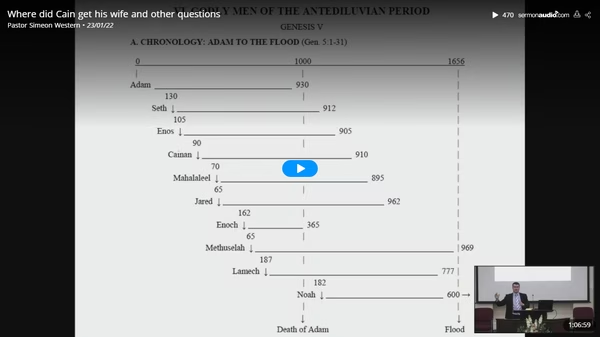
- The simple answer is that Cain married one of his sisters. Genesis 5:4 informs us that Adam and Eve “begat sons and daughters”. Genesis 3:20 states categorically that Eve “was the mother of all living”. That rules out the proposal that there were other people on earth God made from which Cain chose a wife. The Bible is clear that we all trace back to Adam and Eve. Since Adam lived to 930 years it is likely that he had many children.
- Prior to the Mosaic covenant, this was allowed. Other examples are:
- Noah’s grandchildren would have married brothers and sisters, or first cousins as there were no other people after the flood (Gen. 7:21-22; 1 Pet. 3:20).
- Abraham married his half-sister (Gen. 20:2, 12).
- Isaac married Rebekah, the daughter of his cousin Bethuel (Gen. 24:15, 67).
- Jacob married his cousins Leah and Rachel.
The Objections
The objections to this proposal fall into two categories – moral and biological.
- The moral objection – doesn’t this represent incest and therefore is immoral?
- Morality is defined by the Creator. It is true that marriages with close relations was forbidden by God but that was under the Mosaic covenant, approximately 2,500 years after God created Adam and Eve. Marriages with close relatives is now forbidden.
- Lev. 18:9 “The nakedness of thy sister, the daughter of thy father, or daughter of thy mother, whether she be born at home, or born abroad, even their nakedness thou shalt not uncover.”
- Lev. 18:11 “The nakedness of thy father’s wife’s daughter, begotten of thy father, she is thy sister, thou shalt not uncover her nakedness.”
- Some contest that this makes God inconsistent in His moral laws. This is not true. There were certain moral laws that have been in place since the beginning of time (e.g., it is wrong to murder). These laws were imprinted on the heart of man even before Sinai and the giving of the law. Other laws were put in place as time passed for man’s good and benefit as human civilisation progressed and other problems on account of sin and the curse arose.
- Dr. Don Batten in The Creation Answers Book, explains it in a very helpful manner:
This sometimes causes people to ask if that makes God inconsistent – isn’t He changing His standards? Imagine a shepherd looking after his flock on an open meadow. There are no wild animals around, and the only danger to the sheep is at one end of the meadow, where there are some cliffs from which they could fall down. So the shepherd builds a fence, but only around the cliffs. That fence represents a law, a “Thou shalt not”. There is no need to fence the rest of the meadow.
Some time later, wolves move into the district. Now there is a new danger to the sheep; if they stray beyond the sight of the shepherd, they risk being killed and eaten. So a new set of rules is called for, a new “Thou shalt not,” and the shepherd now puts a fence around the entire meadow.
The shepherd’s standards have not changed; his loving care for the flock is the same as always. But times have changed, and a new law is called for in order to express that loving care.
In the same way, having permitted intermarriage between close relatives in order to commence humanity from one man (and one woman who also came from that one man), a point was reached where God clearly chose to institute a new law which was, like in the case of the sheep, a benefit to them, for their own protection.”1
- The biological objection – isn’t it unwise to marry a close relative due to the likelihood of having deformed offspring?
- This is true for us today and reinforces the wisdom of God’s command as given under Moses in Leviticus 18. God knew about the problems of copying mistakes (mutations) in DNA long before modern genetics.
- The question then arises, well what about the practice of marrying close relatives before the Mosaic legal code? The study of genetics provides some clues for solving this perceived dilemma:
- God made Adam and Eve perfect which means they started with no genetic defects.
- This means their children would have had very few genetic defects.
- The long age spans of our pre-flood ancestors indicate they were also much more mutation free than we are now. Mutations in the human genome accumulate and multiply over time.
- “It seems that only by the time of Moses, mutations had accumulated to such a degree that brother-sister marriages involved a significant risk of defective offspring. So for our good, God prevented such unions.”2
- Illustration: Dog inbreeding diagram (refer slide).
- DNA Discovery now supports the argument that all human beings trace back to one man and one woman.
- Eve is called the “mother of all living”. In other words, this means that all human beings trace back to this first human couple. Interestingly, modern DNA discovery confirms that all people originate from a common ancestor. Sarfati explains, “Most of the DNA we inherit from our parents comes from the nucleus. But the ‘powerhouse’ organelles of our cells, the mitochondria, have their own limited set of DNA. This DNA is generally inherited only through the mother’s line, because it seems that the sperm cells can’t pass it on, although there is some debate about this. In the 1980s, geneticists analyzed mitochondrial DNA from all around the world. They came to a startling discovery (for evolutionists): the similarities indicate that all people on earth are descended from a single human female. Even evolutionists have called her ‘Mitochondrial Eve’…Evolutionists claimed that they had clear proof against the biblical account, because ‘Mitochondrial Eve’ supposedly lived about 200,000 years ago. However, recent evidence shows that mitochondrial DNA mutates far faster than previously thought. If this new evidence is applied to ‘Mitochondrial Eve’, it indicates that she would have lived only 6,000-6,500 years ago. Of course, this is perfectly consistent with the biblically indicated age of the “mother of all living”, but an enigma for evolution/long age beliefs.”3
- Interestingly, there is a parallel account with males: evidence from the Y-chromosome is consistent with all people being descended from a single man. He is referred to as ‘Y-chromosome Adam’.4
- Think about it. What makes more sense? We are all descendants from an original pair of human beings or we evolved out of pond scum?!
Why Did The Patriarchs Live So Long? (Gen. 5)
The Length of their Lifespans
- As the chart shows, our antediluvian ancestors lived much longer than we do today.
- Noting that they all “begat sons and daughters”, even into their later years, we can get a sense for the size of the pre-flood population. In their classic book, The Genesis Flood, Dr. John C. Whitcomb and Dr. Henry M. Morris suggest the population to have been approx… one billion by the time of the flood. They state that “the present rate of world population increase is…approximately 2 per cent per year.” By computing the population of the earth during the pre-flood days at only 1.5 per cent, they arrive at the one billion figure.5 This is a very conservative estimate. The population could have been much higher than this given the longevity of the people in the pre-flood era.
The Logic of their Lifespans
- Some scoff at the idea of such long-life spans. It should be noted that ancient myths put lifespans of ancient peoples in terms of thousands of years rather than hundreds compared with the Bible’s much more realistic lifespans of hundreds of years.
- Safarti explains, “There were much longer lifespans claimed in extrabiblical sources. The most famous is the Sumerian King List, from Sumer in Mesopotamia, dated to 2,000 B.C. This has eight kings with an average reign of 30,150 years totaling 241,200 years, compared to the average lifespan of the biblical patriarchs of 858 years and a sum of 8,575 years for their full lives.”
- There are at least two reasons for the longevity of the patriarchs:
- Biological – as explained above, there were much fewer mistakes in the human genome at this point in history. This would mean the aging process would take much longer.
- Environmental – the pre-flood environment was very different to the post-flood environment as explained in our messages on Genesis 1 (the firmament). After the flood, the environment became a lot harsher and more inhospitable to life.
What Is The Purpose Of The Genealogy? (Gen. 5)
Some Important Points about the Genealogy
- The Genesis 5 genealogy is vital for tracing the Messianic line from Adam to Christ. This is demonstrated in Luke’s genealogy of Christ (Luke 3:23-28). Take note of the names from Genesis 5 in Luke’s genealogy.
- The Genesis 5 genealogy reveals the antediluvian patriarchs would have had ample opportunity for corroboration of the events recorded in the early chapters in Genesis due to the generational overlap. Adam dies in Lamech’s 56th year. That means that only Noah and his sons from the pre-flood civilization would not have known Adam.
- The Genesis 5 genealogy reveals that early record keeping was a part of early, pre-flood civilization. “This is the book of the generations of Adam” (5:1) This was probably an ancient scroll or clay tablet.
Some Important People in the Genealogy (Gen. 4:25-5:32)
There are 10 generations recorded in this Genealogy from Adam to Noah. Let’s survey this godly line. Four names will stand out in particular:
- Seth – the provision of faith (Gen. 4:25-5:8).
- Enos – the organization of faith (4:26).
- Cainan-Jared – the continuation of faith (Gen. 5:12-20).
- Enoch – the illustration of faith (Gen. 5:21-24).
- Noah – the preservation of faith (Gen. 5:25-32)
- Methuselah (Vs. 25-27). His name means “when he dies, it shall be sent” a clear reference to the coming flood. Methuselah dies the same year as the flood. Methuselah was 187 when Lamech was born and lived 782 more years, dying at 969. His record lifespan a testament to the longsuffering of God.
- Lamech (Vs. 28-31). His name means “warrior” or “conqueror” but unlike the wicked Lamech in Cain’s line, he was righteous. He had his Seed son (Noah) at age 182. He lived another 595 years after fathering Noah. He died at 777, the lowest recorded lifespan to date. He was outlived 5 years by his father (Methuselah). Importantly we note that by the time we reach Lamech, the account of man’s sin and God’s subsequent curse upon the ground was well preserved. Adam was alive until Lamech’s 56th year which means Lamech likely knew Adam and would have had opportunity to hear Adam’s account of beginnings as recorded in the first 4 chapters firsthand.
- Noah (Vs. 32). His name means ‘comfort’. His father Lamech was given insight from God to discern that his son Noah would become a significant man of God.
Who Were The Sons Of God In Genesis 6?
There are two main viewpoints on this:
Viewpoint 1: Fallen Angels
- Points in favor of this view.
- Old Testament Evidence.
- The phrase “sons of God” is only found 3 other times in the Old Testament, all in the Book of Job. They all refer to angels without exception. Job is the oldest Book in the Bible chronologically.
- Whenever angels materialize in the Old Testament, they have the appearance of men. Seemingly they can also imitate at least some human functions such as eating as in the case of the angels that visited Abraham before destroying Sodom.
- New Testament Evidence. There are two passages in the New Testament that refer to demonic activity in the pre-flood world.
- 2 Peter 2:4. Peter uses three examples from the early chapters of Genesis – the rebellious angels, the old world of Noah’s day and the cities of Sodom and Gomorrah. This group of demons is now incarcerated in a section of hell. The Greek word translated ‘hell’ in this verse is ‘tartaros’. Peter seems to regard Tartarus as a place of preliminary detention for these angels rather than the final place of punishment. It should be noted that it simply states that these angels “sinned” and doesn’t elaborate as to what that sin was specifically. It is unlikely to be a reference to the fall of Satan and his demons as many of them still roam the world freely whereas this group of angels is incarcerated and awaiting future judgment.
- Jude 1:6. Jude references the same group of angels, adding some additional detail.
- Passively – “kept not their first estate”. “Kept not” denotes a specific failure on their part to guard or preserve something. (Hiebert) The phrase “first estate” means beginning, dominion, position. So they failed to protect the position God had ordained for them.
- Actively – “left their own habitation”. They ‘left’ which means to depart or forsake. The word ‘habitation’ means place of dwelling, home or house.
- Note: The sin of these fallen angels is further highlighted by the example that follows in verse 7. Jude 1:7 “Even as Sodom and Gomorrha, and the cities about them in like manner, giving themselves over to fornication, and going after strange flesh, are set forth for an example, suffering the vengeance of eternal fire.” In the case of the Sodomites, they went after strange flesh in that they pursued relations with those of the same gender. In the case of the angels they pursued human flesh which was contrary to them.
- Summary: These angels deliberately abandoned their proper place to invade another sphere. They failed to keep the station and function assigned to them by God. Because they are bound, these angels must be distinguished from other fallen angels who are now unbound and active against mankind (Luke 8:31; Rom. 8:38; Col. 2:15). (Hiebert)
- Church history evidence. This interpretation was the common one amongst both ancient Jewish and Christian writers. This does not make it true but is a point worthy of consideration. The Herald of Hope has a convincing article in favor of this view.6
- Old Testament Evidence.
- Points in opposition to this view.
- The principle objection is found in Christ’s words in Matt. 22:30 “For in the resurrection they neither marry, nor are given in marriage, but are as the angels of God in heaven.”
- Proponents of this view will answer this by noting that the verse refers to godly angels in heaven, not fallen angels on earth. They further argue that angels always materialize as men in the Bible and seem to be able to engage in some bodily functions such as eating (Gen. 18:8 – Angels eat with Abraham).
- That said, this interpretation raises some serious questions. Can fallen angels really produce offspring with a human being? Nowhere in the Bible are they said to possess such a function. Were the offspring half man and half angel?
Viewpoint 2: Intermarriage between the Cainites and Sethites
- The points in favour of this view.
- The context of Genesis 6 is the two family lines – the godly line of Seth and the ungodly line of Cain. The argument is that this represents a breakdown in separation between the two family groups. The “sons of God” are therefore interpreted as being the godly line of Seth and the “daughters of men” the Cainite women.
- This interpretation seems to fit much of the natural wording of the chapter itself. It certainly seems to describe marriages between literal men and women.
- Christ’s words in the New Testament appear to rule out angels being able to marry and carry out a biological function.
- The points in opposition to this view.
- This view takes the New Testament concept of one being a “son of God” and applies it here in Genesis 6. This is somewhat of a strain considering the fact that within the Old Testament context, the phrase “sons of God” are only ever used of angels outside of Genesis 6 as discussed above.
- This view ignores the evidence from 2 Peter 2 and Jude 1:6 that clearly speak of a group of pre-flood angels that have been incarcerated by God for a special sin, awaiting the judgment of God. There seems to be little to no attempt to explain the identity of this group of angels or their sin. The argument that they represent the angels of the original fall is untenable as previously explained.
Viewpoint 3: A hybrid of the two
- This view combines elements of both whilst seeking to resolve some of the difficulties.
- In this view, real men marry women but under the influence and possession of demonic spirits. Thus we have an explosion of demonic activity just prior to the flood and an attempt by Satan to interfere with human sexuality in order to produce ungodly offspring and thereby thwart the seed of the woman from producing the promised Messiah.
- This allows the “sons of God” to be fallen angels, although they accomplish their perverted purposes through actual men. It removes the ghastly concept of fallen angels entering into physical union with women which runs into some difficulty with Christ’s comment on angels not marrying or giving in marriage in the Gospels. This was some kind of demonic interference with human reproduction.
- This view also incorporates the two New Testament passages (2. Peter 2 and Jude 7) which speak of this group of fallen angels.
- Dr. Henry Morris proposes this view in his classic commentary, “The Genesis Record”.
Is this a separation issue?
- Without diminishing the importance of this passage or the need to study it diligently to arrive at a conclusion, I do not believe it should be a test of fellowship between believers. There are good, doctrinally sound, fundamental men on both sides of this debate who are in unity on other fundamental doctrines.
- We have to remember we are looking back in time at the pre-flood civilization that was wiped out in the global flood. God in His sovereignty and wisdom has chosen not to give us any more details or explanation of these matters than what is revealed in the Scriptures.
- At the end of it all, God’s Word is clear that He destroyed the earth with the flood because of the depravity of mankind. If there was demonic activity (and I believe there was), it was accomplished with cooperation on the part of man, thus adding to the enormity of his crimes against God. The demon spirits involved were also judged for their part in corrupting the pre-flood world. They are being held in a remand center, a place of torment, awaiting final judgment.
- One great benefit of chapters such as Genesis 6 is they encourage the use of sound principles of Bible interpretation and encourage a more diligent and careful study of the Scriptures.
Conclusion
The challenge for us is to walk with God, as men like Enoch and Noah did of old, in a world that is increasingly like the days of Noah. See Matthew 24:36-42.
References
- Cited by Jonathan Sarfati, The Genesis Account, pp. 427-428.
- Sarfati, p. 427.
- Sarfati, p. 385.
- Ibid, p. 386.
- Cited by John Butler in Noah the Ark Builder, p. 13.
- https://www.heraldofhope.org.au/the-sons-god-were-giants/ – Viewed 22/1/.22.