


These two chapters have to do with the seven vial judgments. Chapter 15 sets the scene and the tone and chapter 16 records the actual pouring out of the vials themselves. It is time for what has been anticipated in the cup of wine (14:10), the harvest (14:14-16) and the wine press (14:17-20). In this sermon we study the preparation for the vials in chapter 15 and the first three vials in chapter 16.
We now reach the final series of judgments – the seven vials. Here the undiluted cup of God’s wrath is poured out on the world (Rev. 14:10). A vial is a shallow saucer or bowl, not a glass tube such as those used today in scientific laboratories. The vial judgments resemble God’s plagues on Egypt recorded in Exodus but on a much larger scale.
The wrath of God is the key theme of these chapters.
- Rev. 15:1 “for in them is filled up the wrath of God.”
- Rev. 15:7 “…seven golden vials full of the wrath of God”
- Rev. 16:1 “…pour out the vials of the wrath of God upon the earth.”
- Rev. 16:19 “…the cup of the wine of the fierceness of his wrath.”
David Cloud: “Revelation 15-16 conclude the chronological events of the Great Tribulation or Daniel’s 70th week, which began to be described in Revelation 6.”
We will study the two chapters under the following two headings:
- The Preparation for the Vials of Wrath (Rev. 15:1-8)
- The Pouring out of the Vials of Wrath (Rev. 16:1-21)
The Preparation for the Vials of Wrath (Rev. 15:1-8)
The Scene in Heaven (Vs. 1-2)
A scene in heaven precedes the bowl series as happened with the seals (Rev. 4-5) and the trumpets (8:26). John sees…
A Sign (Vs. 1)
- “seven angels” = they are the instruments God will use to pour out his wrath. This explains the pictures of the previous chapter of both the Son and the angel with a sharp sickle. The judgments come from Christ, from the throne, but the angels are His instruments to carry out the judgments.
- “seven last plagues” = the fact these are referred to as the ‘last’ plagues clearly reveals the previous two series of seven (seals and trumpets) were also plagues. God’s wrath started with the opening of the first seal but it now reaches its climax. The phrase “filled up” has the idea of ‘completed’. “In them the anger of God “will have been completed” or “will have reached its ultimate goal,” when the seven plagues are over.” (Thomas)
A Sea (Vs. 2a)
- “of glass” = the same sea as the one mentioned in 4:6 “And before the throne there was a sea of glass like unto crystal…”
- “mingled with fire” = this glass like foundation upon which the throne of God sits, reflects the flash and radiance of God’s glory emanating from the throne. In the context of this passage, the appearance of fire points to the judgment of God about to be poured out. God’s fiery wrath is about to be unleashed in all its Holy fury! God is a consuming fire (Deut. 4:24; Heb. 12:29).
The Saints (Vs. 2b)
- John sees the martyrs from the tribulation standing before the throne. On earth, it appeared that the Antichrist had been the victor (13:7 “And it was given unto him to make war with the saints and to overcome them”).
- “victory over” = comes from the same Greek word as the one used in Rev. 13:7. From man’s perspective, the beast was the overcomer but in reality, the saints were the true overcomers. They now stand in victory before the throne of God about to witness the final destruction of the kingdom of Antichrist and his followers.
The Singing in Heaven (Vs. 2b, 3-4)
The lyres for their singing (Vs. 2b)
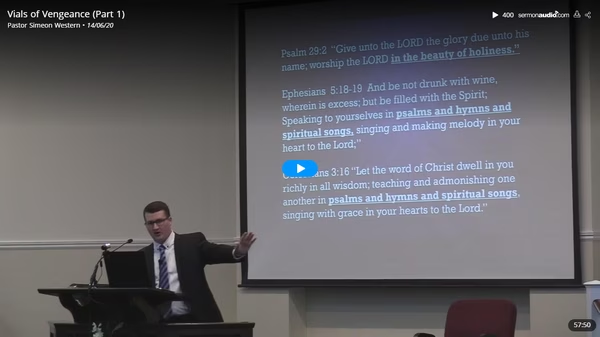
- There are musical instruments in heaven that are a part of worship close to the throne of God. God loves spiritual, beautiful, sacred music.
- The use of musical instruments a blessing in the worship of God and something God commends in His Word. Psalm 33:2 “Praise the LORD with harp: sing unto him with the psaltery and an instrument of ten strings.” Psalm 150:4 “… praise him with stringed instruments and organs.”
The lyrics of their singing (Vs. 3-4)
- The titles of the songs (Vs. 3a)
- The Song of Moses – a reference to the song in Ex. 15:1- 19. Theme is victory.
- The Song of the Lamb – likely the song recorded in Revelation 5:9-14. It “celebrates the ultimate victory over sin and the forces of the dragon that is based on the sacrifice of the Lamb of God.” (Thomas)
- The themes of the songs (Vs. 3b-4)
- The Greatness of God – “great and marvelous”
- The Genuineness of God – “just and true” (repeated in 16:7 & 19:2).
- The Glory of God – “glorify thy name”
- The Godliness of God – “thou only art holy”
- The Governance of God – “all nations shall come and worship”
- Note: The focus of this song is God-centered rather than man-centered! The overcomers do not sing about their victory (Vs. 2) but of God’s victory. While a song of testimony or a song of prayer is Scriptural in the church age, the more we focus on God in our worship, the closer we get to heavenly worship.
- PLEASE NOTE! This is not carnal, party music! Nothing here even slightly resembles the modern praise and worship movement that looks and sounds more like a nightclub or a disco than genuine, holy worship.
The Seraphs in Heaven (Vs. 5-8)
The temple (Vs. 5 & 8)
- ‘temple’ = this is the inner sanctuary, the holy of holies.
- “tabernacle of the testimony” = description based on O.T. language. The earthly tabernacle was patterned after the heavenly temple.
- “filled with smoke” (Vs. 8) = the same cloud of glory that filled the tabernacle (Ex. 40:34-25) and Solomon’s temple (2. Chr. 5:13-14). A frequent picture in the O.T. (E.g. Isaiah 6:1-4). “Smoldering fires of indignation are here at the point of erupting into punishment issuing from an arsenal of Divine wrath.” (Thomas)
The angels (Vs. 6)
- “came out of the temple” = the judgment originates from the throne of God.
- “pure and white linen…golden girdles” = their attire resembles that of Christ (Rev. 1:13). The white speaks of their holiness and the gold of their authority from God to execute the judgments.
The vials (Vs. 7)
- “seven golden vials” = The imagery is based on the bowls found in the O.T. temple (1 Kings 7:50; 2. Kings 12:13; 25:15). The heavenly temple is the source of these bowls of wrath.
- “full of the wrath of God” = these bowls are full to the brim with the righteous, hot anger of God.
- “who liveth for ever and ever” = the judgments are all the more fearful and awesome when you pause to consider the Judge Himself who will mete out those judgments. What an awesome and fearful sight! The scene is now set for the pouring out of the judgments that comes next in chapter 16.
The Pouring Out of the Vials of Wrath (Rev. 16:1- 21)
Vial 1: Sores (Vs. 1-2)
The source of the judgments (Vs. 1).
- “a great voice out of the temple” = the voice of God (See 15:8 & Vs. 17). The word ‘great’ appears more in this chapter (11 times) than anywhere else in any other chapter of the N.T.
- “saying to the seven angels” = they act at the direction of God. The judgments come from the throne.
The substance of the judgment (Vs. 2)
- Putrid sores – ‘noisome’ means “noxious to health; hurtful; injurious & destructive” (Webster).
- Painful sores – ‘grievous’ means afflictive, painful, hard to bear.
- Thomas: “These are bad, unpleasant, agonizing ulcers that refuse to go away.”
- Illustrations: They are probably something like the boils that Job experienced of the plague of boils that came upon Egypt.
- Note: It is of interest that even now, there are certain sores and diseases associated with immoral sin.
Vial 2: Seas (Vs. 3)
The scope of the judgment (Vs. 3a)
- The ‘sea’ is a reference to the seas of the world, a universal judgment (Compare with Rev. 8:8).
The specifics of the judgment (Vs. 3b)
- ‘blood’ = like God’s judgment upon the Nile river in the first Egyptian plague (Ex. 7:20-25) and the second trumpet judgment (Rev. 8:8), the waters of the seas will be turned into blood but now on a much larger, world-wide scale.
- “of a dead man” = The consistency of the blood resembles that of the blood of a dead rather than a living person. “The substance will be decayed and have a foul odor that makes it loathsome. It will no longer be fluid, but thickened and congealed.” (Thomas)
- “ever living soul dies in the sea” = the death of all sea life. Imagine the scale of the devastation! Imagine the stench of all that rotting flesh!
- Cloud: “This will have massive consequences. All sea life upon which man is dependent for his food and livelihood will be gone; all jobs associated with harvesting the sea life will be gone. The top five fish producing countries alone (China, Peru, India, USA, Indonesia) harvest 70 billion tons of fish annually. According to 2001 figures, China consumes almost 73 billion pounds of fish per year, Japan 18.4 billion, America 13.8 billion, Indonesia 10.7 billion, and Russia 6 billion (www.aboutseafood.com).”
Vial 3: Streams (Vs. 4-7)
The destination of this vial (Vs. 4)
- “rivers and fountains of water” = covers inland, fresh water.
- So, between the 2nd and 3rd vial, all the earths water is affected.
- David Cloud writes, “The consequences of this will be massive, as these are major sources of water for multitudes of people. The United States has 250,000 rivers covering 3.5 million miles, and over 60% of America’s drinking water comes from rivers. The Mississippi River, for example, is the source of drinking water for 18 million people who live in 70 cities and towns along its banks, including Minneapolis-St. Paul, Cincinnati, Omaha, St. Louis, and New Orleans. 400 million people live in the Ganges River basin in India an are dependent upon the river for their lives. 50 million people live in the Rhine River basis area in Western Europe and many of them are dependent upon the river for water. At least one-third of Britain’s drinking water comes from rivers. The city of London gets 90% of its water from the Thames and Lee rivers. The Yangze River in China supplies water to hundreds of millions of people, including those who live in almost 200 cities along its shores, including Shanghai, and provided 25% of Beijing’s water in 2010. The Nile River, which flows for 4,100 miles through Africa and empties into the Mediterranean, supplies water for tens of millions of people. It is the main source of drinking water for the 13 million inhabitants of Cairo. Much of the land through which the Nile flows is desert, so the river is the only source of water. The mighty Amazon River in South America flows through six countries and has 1,000 tributaries, providing water for tens of millions.”
The defense of this vial (Vs. 5-7)
- A testimony from the Angel (Vs. 5-6)
- “Thou art righteous” = God’s judgments are just and perfect in every way. We must never entertain thoughts that God’s judgments are somehow unfair or unbalanced. This is a reoccurring theme in these chapters. (See Rev. 15:3 and 16:7)
- “For they have shed the blood” = the reason why God’s judgments are righteous. The punishment meted out by God fits the crime committed (lex talionis). It is the “eye for an eye and a tooth for a tooth” principle of Divine justice.
- “they are worthy” = this wicked world will be deserving of every bit of God’s judgment that is given!
- Wiersbe: “In God’s government, the punishment fits the crime. Pharaoh tried to drown the Jewish boy babies, but it was his own army that eventually drowned in the Red Sea. Haman planned to hang Mordecai on the gallows and to exterminate the Jews; but he himself was hanged on the gallows, and his family was exterminated (Es. 7:10; 9:10). King Saul refused to obey God and slay the Amalekites, so he was slain by an Amalekite (2 Sam. 1:1- 16).
- A testimony from the Altar (Vs. 7)
- A second voice from the altar picks up the refrain and affirms the testimony of the angel.
- “true and righteous are thy judgments” = they are perfectly in line with Divine Truth and Divine Justice. Perfect justice will be given by the Perfect Judge of the Universe.
Conclusion
- Saint, time is running out for you to serve the Lord!
- Sinner, time is running out for you to repent and receive Christ! Receive God’s gift of salvation today before it is too late.
Sermon 26 of 38 in Revelation Series