


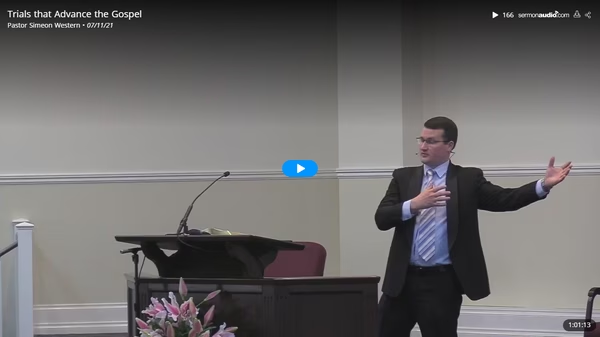
Paul explains to the Philippian church how that his imprisonment was being used of God for the furtherance of the Gospel. Rather than Paul’s trial hindering the progress of the Gospel, it was actually being used by God to advance the Gospel cause! God can do the same in our trials if we respond right.
In this section, the Apostle Paul encourages the Philippian believers that rather than his trial being a hindrance to the progress of the Gospel, it was actually being used of God to advance it in an amazing way. A wonderful encouragement to every believer that God can use a seemingly hopeless situation to fulfill His grand and glorious purposes if we will respond right.
Someone referred to this section as “The fortune of misfortune.”
In this message, we will consider this report under 4 headings.
The Account of the Gospel’s Advance (Vs. 12)
Paul’s Trial (Vs. 12a)
- “I would ye should understand, brethren” = evidently the believers were distressed on account of Paul’s imprisonment and so he takes steps to encourage them. He wants them to know that his imprisonment hasn’t been in vain.
- “the things which happened unto me” = these things are recorded in the Book of Acts (i.e., his arrest, journey to Rome and imprisonment). We refer to these things as the circumstances of life that come our way as we follow the Lord. Things happen in our lives that are outside of our control. These circumstances are not random and pointless for the child of God. They are all a part of God’s Providential workings in our lives to accomplish His purposes.
Paul’s Testimony (Vs. 12b)
- “fallen out” = lit. “have come”; means “have come to result” (Wuest).
- “unto the furtherance” = the preposition ‘unto’ indicates purpose, goal, or result. The word ‘furtherance’ literally means “to cut toward.” It was a military term used of engineers who would prepare a road for the advancing army by removing obstructions such as rocks and trees. “Paul saw the beginning in what some called an end, and he walked through open doors which others concluded to be closed and locked.”
- “of the Gospel” = the Gospel and its advancement was the consuming passion of Paul’s life. Rather than wallowing in self-pity over his trial, the Apostle Paul seized the opportunities for Christ and His Gospel. Paul was viewing his circumstances from the Divine perspective. “Paul did not find his joy in ideal circumstances; he found his joy in winning others to Christ.” (Wiersbe) There is no greater task on this earth than to be engaged in the furtherance of the Gospel!
- F.B. Meyer: “He came to Rome a prisoner, his passage paid as a convict by the Roman Government; and the hatred of his enemies was the breath of the Almighty that wafted him to his chosen destination.”
- Challenge: Do we look at trials and difficulties as opportunities for the Gospel?
- Illustrations: Mrs. Spurgeon’s books fund. Fanny Crosby’s hymns.
The Areas of the Gospel’s Advance (Vs. 13-14)
Paul now gives two examples of how the Gospel was being advanced – “so that”. The Gospel was advancing both inside and outside the prison. The word ‘bonds’ occurs in both verses. Paul was chained but the Gospel was not! “The same God who used Moses’ rod, Gideon’s pitchers, and David’s sling, used Paul’s chains. Paul was bound but the Word of God was released through Him.” (Wiersbe) Paul could testify during his final imprisonment in his final Epistle to Timothy – “Wherein I suffer trouble, as an evil doer, even unto bonds; but the word of God is not bound.” (2 Tim. 2:9)
The Impact upon Unbelievers (Vs. 13)
- The Palace – “in all the palace” (Vs. 13a)
- “my bonds in Christ” = Paul’s imprisonment was not because he was a criminal. It was on account of his attachment to Christ and this news spread within the palace.
- ‘palace’ = comes from the Greek word ‘praetorium’. Appears it was the soldier’s residence as well as that of other Roman government officials. The Praetorian guard was made up of 9 to 10 thousand elite soldiers who served Caesar personally. These soldiers received double pay and special privileges. Paul’s imprisonment put him in touch with this elite force and it wasn’t long before Paul and the Gospel he preached was the talking point in the soldiers’ barracks.
- During Paul’s two years of house arrest, he was chained to a soldier. These guards were changed every six hours so in a 24- hour period Paul could potentially have had 4 different guards to witness to. Considering the fact that Paul’s first imprisonment was for a period of 2 years, he would have had many opportunities to present Christ to these soldiers.
- Illustration: Richard Wurmbrand as he wrote his confessions in prison.
- At the end of the Epistle, Paul even sends greetings from members of Caesar’s household (4:22) implying that there were Christian converts within the very household of the Roman Emperor.
- The City – “all other places”
- Paul’s witness in Rome was like a spreading flame. It was Gospel ember rain blown across Rome by the wind of the Spirit.
- Never underestimate how much God can use even one person for the spread of the Gospel.
The Impact upon Believers (Vs. 14)
- The Example inspiring their Courage (Vs. 14a)
- “many of the brethren in the Lord” = a large number of the Christians in Rome were positively impacted by Paul’s testimony in prison.
- “waxing confident” = comes from the Greek word meaning “to persuade”. They had been (perf. Tense) persuaded to be bold by Paul’s testimony. They now had inner confidence to be a witness.
- “by my bonds” = the source of the encouragement. They had been inspired by Paul’s godly example. Do we encourage or discourage other Christians in the Gospel ministry?
- The Effect of their Courage (Vs. 14b)
- “much more bold to speak” = the outward manifestation of their inward confidence. Their inner boldness led to the opening of their lips in testimony for Christ.
- “the word” = the Word of God; specifically, the Gospel.
- “without fear” = there is nothing like fear to silence the Christian. Boldness to speak is something that comes from the Holy Spirit but it is not uncommon for God to use the example of a bold Christian to help inspire that boldness.
- The believers at Rome must have said something like, “If Paul can be outspoken for Christ as a prisoner of the Roman Empire, then how much more can those of us who still walk free!”
- F.B. Meyer: “The man who works for Christ when everything is against him stirs up those who have no such difficulties. They who dare to speak for God, even to death, are the means of stirring others to heroic defense of the Gospel.”
The Associates of the Gospel’s Advance (Vs. 15- 17)
Paul now elaborates further on these brethren who were now speaking boldly for Christ. He reveals that there were actually two groups/categories of believers within the ‘many’ who were preaching Christ. Different motives were behind these two groups. There were those who preached:
From a Carnal Motive (Vs. 15a, 16)
- Their Carnal Motive (Vs. 15a, 16a) We should note that while their motive was wrong, their message was right. It is totally inconceivable in light of Paul’s other writings, even within this very Epistle, that he would endorse the preaching of a false Gospel. They are included in the “brethren” of verse 14. “The cause of their preaching was at fault, not its content.” (Gromacki)
- The words that describe their motive (3 words)
- ‘envy’ = means jealousy. These men were jealous of the Apostle Paul and his ministry success and popularity.
- ‘strife’ = the outward expression of inward envy. It means ‘wrangling’, ‘contention’. There was a fleshly spirit of rivalry with these men.
- ‘contention’ = they preached Christ ‘of’ (Greek word ‘ex’ meaning “out of”) contention. This word is related to the word ‘rivalry’ as both words come from the same Greek stem. It means “to canvas for office, to get people to support you.” (Wiersbe) It refers to a “self-seeking partisanship, a factious, selfish spirit.” (Wuest) Gromacki adds, “contention places attention upon the cause of personal rivalry which is selfish ambition.”
- Note: Some people in ministry, though they may preach the right Gospel, are carnal in their motives. They constantly view things in terms of personalities, popularity and power struggles. This spirit has no place in the Gospel ministry! We are not in some sort of competition! The ministry of the Gospel is not about us, it’s about Christ!
- Challenge: Can you rejoice in someone else’s success in the Gospel ministry or does it irritate you? This test might help you identify whether your motives are pure in your service. We need to constantly check the motives behind our ministering. Self can get so easily tangled up in our service for the Saviour.
- The word that summarizes their motive (Vs. 18).
- Paul uses the word ‘pretence’ in verse 18 to describe the preaching of this same group. He also says in Vs. 16 that their preaching was not of sincerity (“not sincerely”) which means pure, chaste, undefiled.
- The same Greek word is translated ‘cloke’ twice in the N.T. It speaks of one who hides his true motives and character under a cloke that makes him appear to be something other than what he really is.
- Webster defines the words as “A holding out or offering to others something false or feigned; a presenting to others, either in words or actions, a false or hypocritical appearance, usually with a view to conceal what is real, and thus to deceive.”
- The words that describe their motive (3 words)
- Their Carnal Objective (Vs. 16b)
-
- They hoped that their actions would bring more distress to the Apostle Paul in prison. “The word ‘affliction’ literally means ‘friction’. They hoped to aggravate Paul, hoping he would become jealous as they increased their following.” (Gromacki) When you go through a trial be prepared that some believers will try and kick you while you are down!
- Exactly how they intended their actions to negatively affect the Apostle is not spelled out. Perhaps they hoped that by going around and preaching “the Gospel Paul preaches” that it would serve to further inflame the Roman authorities against Paul. Likely it had something to do with their jealousy. Jealous people hope that the people they are jealous towards will get jealous of them when they attain a perceived advantage.
-
From a Spiritual Motive (Vs. 15b, 17)
The spiritual group were motivated by:
- Good will (Vs. 15b) – Their hearts were towards the Apostle and they were prepared to step up to the plate.
- Love (Vs. 17) – how much nobler to be motivated by love in the ministry rather than envy and division. They were motivated by love for Christ and love for the Apostle Paul.
- This group knew that Paul was in prison in defense of the Gospel. The word ‘set’ was a military term used of a soldier on guard duty. The word ‘defense’ is the Greek word ‘apologia’ which means a verbal defense. I.e., like the verbal arguments presented in a court room by a lawyer on behalf of his client. The same word is used in 1 Peter 3:15 “But sanctify the Lord God in your hearts: and be ready always to give an answer (apologia) to every man that asketh you a reason of the hope that is in you with meekness and fear:”
- Like Paul, we should be prepared to both proclaim and defend the Gospel. Jude 1:3 “Beloved, when I gave all diligence to write unto you of the common salvation, it was needful for me to write unto you, and exhort you that ye should earnestly contend for the faith which was once delivered unto the saints.”
- Truth (Vs. 18) These people were genuine as indicated by Paul’s use of the word ‘truth’ in contrast to those who ministered in ‘pretence’. Both the content and the motivation of the message was true.
The Attitude to the Gospel’s Advance (Vs. 18)
Paul had:
A Spiritual Mindset (Vs. 18a)
- Very simply, Paul has spiritual eyes to see the bigger picture. For Paul, the most important thing was the proclamation of the Gospel, not personality conflicts. He could see some good being achieved by those who were proclaiming the right Gospel with the wrong heart motive. Paul knew the power of the Gospel (Rom. 1:16).
- Paul had learned by God’s grace to see everything from His perspective.
A Spiritual Response (Vs. 18b)
Paul had a spiritual response to a carnal provocation. Our responses say much about our spirituality!
- Paul’s rejoicing in the present – “I therein do rejoice”
- Paul’s resolve for the future – “yea, and will rejoice”.
- Only God can give you joy in the face of the jealous actions of other Christians!
Conclusion
- What trial are you going through now? Would you yield to God’s purposes and allow Him to use that trial to further the Gospel?
- What motivates you to minister for the Lord? Is it the love of Christ or the love of self?
- What are you doing to help further the Gospel cause? Are you involved in both the spread and the defense of the Gospel?
Sermon 5 of 17 in Philippians Series
Sermon Audio Id: 116211132371405