


In Mark chapter 5 we see Christ’s power in 3D – over Demons, Death & Disease. Christ has just returned from the Eastern side of the lake where he delivered the maniac of Gadara from demon possession. Upon arrival on the sea shore, the crowds quickly assemble together to Him. The next scene opens dramatically with the approach of Jairus, a ruler of the synagogue who came to Christ with a great need. The name ‘Jairus’ is the Greek form of the Hebrew name ‘Jair’. For example, Mordecai was the son of a man called ‘Jair’ (Esther 2:5) The theme of faith is central to this account as revealed in the words of Christ recorded in Vs. 36 – “Be not afraid, only believe.”
Let’s consider 4 lessons about Jairus’s faith in this sermon.
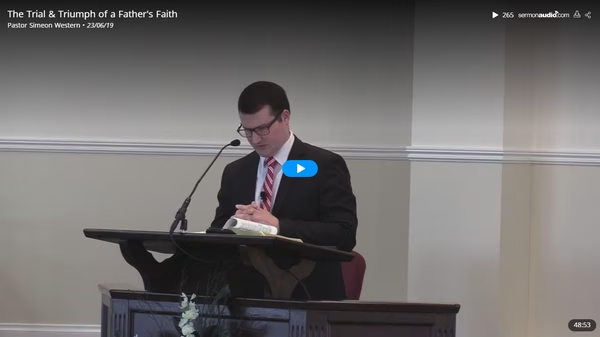
The Plea of His Faith (Vs. 21-24)
The Humility of his Plea (Vs. 22)
- He had an exalted position (Vs. 22a)
- He was a ruler of the synagogue in Capernaum which made him an individual of importance. The “rulers” were a “board of elders who were over the affairs of the local synagogue.” (Hiebert). There duties were to select the readers or teachers in the synagogue and to see that all things were done with decency (See Acts 13:14-15) (Wuest).
- Most of the Jewish religious leaders rejected Christ but Jairus was an exception. He found in Christ something he could not find in the empty forms and ceremonies of legalistic Judaism.
- He adopted a lowly posture (Vs. 22b)
- This was an act of worship – “and worshipped him” (Matt. 9:18)
- This was an act of reverence – he was acknowledging that Christ was superior to him
- When we come to Christ in a time of trial, our first step needs to be to worship at His feet.
- Job’s Example: “Then Job arose, and rent his mantle, and shaved his head, and fell down upon the ground, and worshipped, And said, Naked came I out of my mother’s womb, and naked shall I return thither: the LORD gave, and the LORD hath taken away; blessed by the name of the LORD.” (Job 1:20- 21)
The Fervency of his Plea (Vs. 23)
- The expression of the fervency (Vs. 23a)
- God honours fervent praying (James 5:16)
- Is there any heart and passion in our praying?
- The motivation of the fervency (Vs. 23b)
- His daughter was at death’s door. The phrase has the idea of being “at the last gasp.” This trial drove Him to the feet of Jesus.
- The grief was heightened by the fact it was his only daughter (Lk. 8:42)
- Challenge: There is a lesson we discern here for parents. Our children enter this world spiritually dead. They lie “at the point of death” and there is NOTHING we can do in our own power to raise them to spiritual life. But there is one thing we can do. We can lay hold of the feet of our Saviour and plead with Him to touch their lives with His power! While each of our children have to make their own personal decision for Christ, the faith of the parent is an important channel of blessing to the child. If this father had not come to Christ and exercised faith, his child would never have been raised to life again!
- The supplication of the fervency (Vs. 23c)
- The Victory of his Plea (Vs. 24)
The Proving of His Faith (Vs. 35-36)
The Cause of the Delay (Vs. 25-34)
- Another woman had a desperate need and came to Christ in faith. This delayed their arrival at Jairus’s house. This delay would accomplish 2 important things in Jairus’s life:
- He would witness a powerful miracle that was received by faith in the healing of the woman with the issue of blood that would serve to strengthen his own faith in the power of Christ (Vs. 34)
- The delay meant that the situation with his daughter would worsen, becoming a platform for an even greater display of God’s power. The darker the situation, the more glory Christ received when He moves in Might and Power.
- Principle: In God’s infinite wisdom He sometimes delays the answer to our urgent prayers. We often grapple with this experience as we feel that our need warrants immediate attention. We feel perplexed when it seems the Lord is giving attention to other people’s needs while delaying to address ours. But faith is tested and strengthened by such delays.
The Consequence of the Delay (Vs. 35)
- “thy daughter is dead” = his precious daughter had died. “The worse the situation, the better it is to magnify the great power of our Lord in His miracle working.” (Butler)
- “why troublest thou the Master any further” = this question contains an assumption. The assumption is that death took the little girl beyond the reach of Christ’s power.
- Illustration: The death of Lazarus (John 11)
- Vs. 6 – Christ’s intentional delay
- Vs. 21 – Martha’s anguish and confusion
- Vs. 40 – Christ’s exhortation to faith
The Comfort in the Delay (Vs. 36)
- Cease from Fear (Vs. 36a)
- “be not afraid” = fear had obviously gripped Jairus’s heart on account of the news. In essence, Christ was saying “stop being afraid”
- Fear is the natural human reaction to circumstances that seem to bring us to an impossible situation.
- Phillips: “Faith and fear pull in different directions.”
- Continue in Faith (Vs. 36b)
- “only believe” = present imperative. “He was to continue believing, even in the presence of death. “Be believing.” The command was for a continued, sustained faith.” (Butler) Luke adds, “and she shall be made whole” (Vs. 50)
- Jairus had exercised a measure of faith in Christ up to this point. He believed Christ could heal his daughter. Now his faith needs to be strengthened and increased to believe what he thought was impossible.
- This means he was to turn his focus back to Christ. He was to anchor his faith in the promise of Christ. Fear looks at the circumstances, faith looks at the Saviour. Fear looks at the problem, faith looks at God’s power.
- Hebrews 11:6 “But without faith it is impossible to please him…”
The Protest against His Faith (Vs. 37-40)
Faith must face the challenge of unbelief. Jairus would face this upon his arrival home with the mourners.
The Sorrow of the Mourners (Vs. 37-38)
- Their journey to the scene of mourning (Vs. 37)
- Peter, James and John form Christ’s inner circle within His disciples. This is the first instance where these three are favoured in this way (see also 9:2; 14:33).
- Christ took the minimum number of witnesses required to verify an event under the Old Testament law (Deut.17:6).
- Their arrival at the scene of mourning (Vs. 39)
- ‘tumult’ = a noisy, clamorous uproar, commotion. “Shrill and piercing cries filled the air.” (Hiebert) There was weeping and wailing, commotion and crying.
- Matthew 9:23 “And when Jesus came into the ruler’s house, and saw the minstrels and the people making a noise”
- “It appears from Matthews reference that those making the tumult were principally paid mourners. The use of such hired mourners was expected as evidence of esteem for the one who had died.” (Hiebert)
The Scorn of the Mourners (Vs. 39-40a)
- Christ challenges the mourners with a question followed by a startling statement. It is not a sin to mourn the death of a loved one but in this case, it revealed a lack of faith in the Lord Jesus who had been called upon to come and heal the little girl.
- “the damsel is not dead but sleepeth” = Christ speaks figuratively
- Christ used similar language in connection with the death of Lazarus (John 11:11-14).
- “It is not the sleep of the soul; its activity ceases not; but the sleep of the body, which lies down in the grave, still and silent.” (Henry) (See Rev. 6:9-11 as evidence against “soul sleep”)
- This is a Christian view of death distinct from the hopelessness of the world. At death, the spirit immediately goes into the presence of God in heaven (2 Cor. 5:8); the body rests in the grave, awaiting the coming resurrection where the soul will be reunited with the body (1 Thess. 4:13-18). “What He wished especially to do was to put a meaning upon death more worthy of those who believe in God than that suggested by such unbridled expressions of hopeless grief.” (Thompson)
- This statement also reveals the power of Christ. He holds the keys of hell and of death and to resurrect someone from the dead is as simple to Him as waking someone out of sleep.
- “they laughed him to scorn” = impf. tense – they laughed repeatedly. They mocked Christ knowing “she was dead.” (Lk. 8:53) The natural man received not the things of the Spirit of God (1 Cor. 2:14).
The Separation of the Mourners (Vs. 40b)
- “put them all out” = comes from a strong word meaning “to cast out”. Their unbelieve meant they were ejected from the house and missed seeing the miracle performed. Only the parents and the 3 disciples would witness this miracle.
- “Unbelief shuts us out from many special and spiritual blessings.” (Butler)
The Performance in Response to His Faith (Vs. 41-43)
Christ’s Contact with the Damsel (Vs. 41a)
- “took the damsel by the hand” = the Saviour takes a hold of the little girl’s lifeless hand
- Christ took hold of the hand of Peter’s mother in law and “lifted her up” (Mark 1:31) Praise God that if you are saved you can testify, “Love lifted me”!
Christ’s Call to the Damsel (Vs. 41b)
- Mark records Christ’s words in Aramaic and then translates them into Greek for his readers.
- ‘damsel’ = a term of tender affection
Christ’s Cure of the Damsel (Vs. 42)
- Luke 8:55 “And her spirit came again…”
- “the damsel arose and walked” = powerful evidence of her healing
- Note: What a powerful illustration of salvation. We were “dead in trespasses and sins” (Eph. 2:1) but Christ came and “quickened us” (Eph. 2:5), made us alive again! He lifted us up and gave us new life!
Christ’s Care of the Damsel (Vs. 43)
- “commanded that something should be given her to eat” = reveals something of the tender love our Saviour has for little ones.
- Challenge: Your attitude towards children reveals a lot about how Christlike you are.
Conclusion
- Parents, do we pray earnestly for the Saviour’s working in our children’s lives? Do we pray for their salvation?
- Are you dealing with a trial at the moment? Look to Christ and His promises.
- Are you saved? Have you experienced Christ’s healing touch in your life? He can raise you to spiritual life.
Sermon 22 of 59 in Mark Series
Sermon Audio Id: 62119354422577