


The Lord Jesus declared that John the Baptist was the greatest man born of women (Matt. 11:11; Luke 7:28). In this lesson, we will study an overview of how John the Baptist was trained and prepared for the calling of God with particular emphasis upon the role his parents played in His upbringing.
The Lord Jesus declared that John the Baptist was the greatest man born of women (Matt. 11:11; Luke 7:28).
We will note a number of important, formative influences operating in John’s early life.
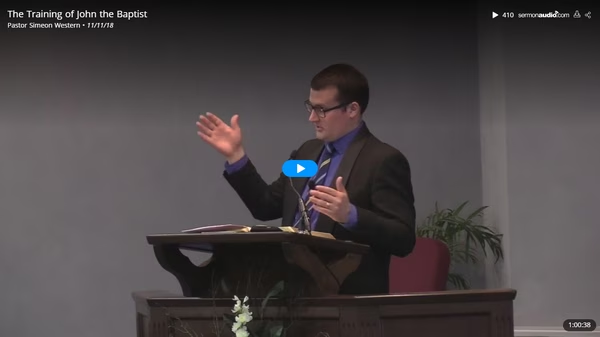
The Prenatal Development of John
A Miraculous Conception (Vs. 7, 18)
- Zacharias and Elisabeth carried a significant and painful trial – they had no child. For an Israelite, this was a great reproach (Vs. 25, 58). Scripture presents children as an unqualified blessing not a curse to be banned and avoided!
- This painful trial had been a frequent matter for prayer for this couple (Vs. 13). The answer to their heart’s cry was delayed until it became humanly impossible. This would create an occasion whereby God could demonstrate His power in a greater way and also bring John the Baptist into the world according to God’s perfect timetable
- “It is not impossible that prayers that we have ceased to pray, and are in despair about, will yet return to us with words, “Thy supplication is heard,” endorsed on them in our Father’s handwriting.” F.B. Meyer
- God did a miracle for Zacharias and Elisabeth, similar to the miracle that He did for Abraham and Sarah with the conception and birth of Isaac.
A Mother’s Voice (Vs. 39-45)
- Scripture reveals long before modern studies were completed, that babies can hear in the womb.
- Current studies reveal that babies begin hearing sounds from approx. 18 weeks old in the womb. “The most significant sound your baby hears in the womb is your voice. In the third trimester, your baby can already recognize it. They will respond with an increased heart rate that suggests they are more alert when you’re speaking.”1
- Research also indicates that babies begin early language development from their mother’s speech during the last 10 weeks of the pregnancy.2
- Elisabeth spoke Spirit-filled words with a loud voice (Vs. 41-42). What kind of words does your baby hear in the womb? What are the first sounds that enter their newly formed ears? Do they hear mum singing or praying? Do the hear the sounds of a Spirit-filled voice or the sounds of a flesh-dominated voice (e.g. anger, carnality) Do they hear pounding, worldly music or Psalms, hymns and spiritual songs?
The Spirit’s Touch (Vs. 15)
- The hand of God was upon John from his earliest moments. Like everyone else, he would have to come to a personal experience of salvation but his life was under God’s gracious influence from the womb.
- Do we pray and seek for God’s Divine influence upon our children from their earliest moments?
The Parental Development of John
John was privileged to be born into a godly home to godly parents who would play a significant role in preparing him for God’s calling upon his life. Observe 7 attributes of this godly couple.
Saved Parents (Vs. 6)
- Note they were righteous “before God”.
- This is the starting point for successful parenting. How can we help our children to know God if we do not know Him ourselves?!
Submitted Parents (Vs. 6)
- ‘walking’ = the pattern of their lives
- “all the commandments” = they followed the Lord fully and were submitted to him in every area of their lives. No partial obedience!
- ‘blameless’ = not faultless but above reproach.
- Challenge: If we are going to require obedience from our children, we need to be obedient to the Lord ourselves! Children are quick to detect hypocrisy in the home. When a challenge is given from the pulpit, what sort of conversation do they hear in the car on the way home?
Serving Parents (Vs. 5, 8)
- Both Zacharias and Elisabeth had a godly heritage.
- At this time in Israel, the priesthood was largely corrupt due in part to its being controlled by wicked King Herod. But there was still a godly remnant dotted amongst the corrupt ranks of self-motivated religious practitioners who yearned for the coming of the promised Messiah (e.g. Simeon, Anna, Mary, Joseph)
- John’s parents served the Lord in sincerity and truth. What is our level of commitment to the service of the Lord? Do our children know that the work of God is priority 1 for mum and dad?
Supplicating Parents (Vs. 13)
- The altar of incense is a picture of prayer in the Word of God. David prayed in Psalm 141:2 “Let my prayer be set forth before thee as incense; and the lifting up of my hands as the evening sacrifice.”
- Zacharias’ official offering up of the incense was a picture of the prayers that ascended up before the throne of God from this couple regularly. It was while Zacharias was praying that God revealed the special news to him about John.
- To be raised in a home to praying parents is inestimable blessing. Does the atmosphere of prayer pervade our homes? Do our children every see mum or dad on their knees? Do they hear them pray over them when they are tucked into bed at night?
Surrendered Parents (Vs. 15-17; 60-63)
- Surrendered concerning his naming (Vs. 13, 59-64)
- ‘John’ = Jehovah shows grace. Significant as John would be used to prepare the way for age of grace.
- Consider giving your child a godly name instead of a trendy one!
- Surrendered concerning his calling (Vs. 15-17; 76-79)
- Zacharias and Elisabeth did not thwart God’s Divine plan for John. Rather, they were surrendered and committed to it wholeheartedly.
- As parents, do we seek to be in tune with how the Lord is leading and directing our children’s lives? Or do we allow our natural affection to overreach its bounds to where in practice we ignore the fact that our children are not really ours but God’s?
- Do we live with a consciousness that God has a Divine plan for their lives or is it all about our vision for our children? (e.g. career, money etc.…)
- Does our training reflect godly priorities? Do we seek above all else to prepare our children to be servants of the Lord?
- Do we surrender all earthly claims to our children? John would die as a young man on account of his calling.
Spirit-filled Parents (Vs. 41; Vs. 67)
- A Spirit-filled mother AND father (Vs. 41)
- This was not lopsided family with one parent spiritual and the other carnal.
- The fruit/result of the filling of the Spirit in both cases was godly speech. What comes out of our mouths tends to reveal the measure of how much we are filled with the Spirit.
- Eph. 5:18-20 “And be not drunk with wine, wherein is excess; but be filled with the Spirit; Speaking to yourselves in psalms and hymns and spiritual songs, singing and making melody in your heart to the Lord; Giving thanks always for all things unto God and the Father in the name of our Lord Jesus Christ;”
Scripture-filled Parents (Vs. 39-45; 67-79)
- Elisabeth clearly knew and believed in the prophetic promise of the Messiah (Vs. 43)
- Zacharias’ prophecy reflected a good grasp of the O.T. Scriptures. He makes reference to the prophets (Vs. 70); to God’s promise to Abraham (Vs. 73) and to the promised kingdom of Messiah.
- “He would be also taught carefully in the Holy Scriptures. Like the young Timothy, he would know them from early childhood. The song of Zacharias reveals a vivid and realistic familiarity with the prophecies and phraseology of the Scriptures; and as happy parents recited them to his infant mind, they would stay to emphasize them with impressive personal references. What would we not have given to hear Zacharias quote Isaiah 40 or Malachi 3, and turn to the lad at his knee, saying – “These words refer to thee” (F.B. Meyer)
- That they taught John the Scriptures is clear from John’s preaching. God’s Word flowed from his lips like a river! He could quote prophets like Isaiah with ease. He proclaimed great, Scriptural truths like repentance, faith and Christ as the sacrifice for the sins of the world.
F.B. Meyer – “How ineffaceable (enduring/lasting) are the impressions of the Home! What the father is when he comes back at night from his toils, and what the mother is all day; what may be the staple of conversation in the home: whether the father is willing to be the companion of his child, answering his questions, and superintending the gradual unfolding of his mind; how often the Bible is opened and explained; how the weekly rest day is spent; the attitude of the home towards strong drink in every shape and form, and all else that might injure the young life, as gas does plants – all these are vital to the right nurture and direction of boys and girls who can only wax strong in spirit when all early influences combine in the same direction.”
The Supernatural Development of John
Above all, John was a man Divinely prepared and equipped for his calling.
The Power of God (Vs. 15)
- From an early age, John knew the shaping, molding influence of the Holy Spirit in his life.
- Johns preaching was clearly anointed by the Holy Spirit.
The Presence of God (Vs. 66)
- God’s hand was resting upon this man! How we should covet and plead for this in our live and the lives of our children.
- Jabez prayed “…Oh that thou wouldst bless me indeed, and enlarge my coast, and that thine hand might be with me…” (1 Chr. 4:10)
The Preparation of God (Vs. 80)
- The location of his preparation
- An obscure place – John was not prepared amidst the upper crust of the corrupt priesthood but in the wilderness alone with God.
- A difficult place – John obviously learned survival skills in the wilderness. Very likely his parents died while he was still a young man due to their age (“both well stricken in years” Vs. 7)
- The length of his preparation
- “until the day of his shewing unto Israel” = time period not exactly defined but we know John was 6 months older than Christ and Christ was baptized around the age of 30 (Vs. 23). So, this means John would have been around the age of 30 when he commenced his public ministry.
- God is not a rush in preparing His servants! John first went through home-schooling. Graduating from there he went through desert-schooling (with God) and then on to wilderness- preaching.
Conclusion
- Parents, are we seeking to train our children in a godly fashion to prepare them for what God has for them?
- Young people, are you surrendered to whatever God has in store for you?
References
- https://www.healthline.com/health/pregnancy/when-can-a-fetus-hear#1
- https://www.webmd.com/baby/news/20130102/babies-learn-womb#1
Sermon 4 of 59 in Mark Series
Sermon Audio Id: 111018162140