

Hebrews 8 draws attention to a single, breathtaking truth: the sum of all that matters in the Christian faith is Christ himself – our great high priest who is seated at the right hand of the Majesty in the heavens. His ministry is not a continuation of the Old Testament system but something far greater – rooted in a heavenly sanctuary, sealed by his own sacrifice, and guaranteed by a better covenant built on better promises. Whether in salvation, sorrow, marriage, or spiritual battles, the answer is always the same: Christ. This passage invites the reader to let go of every shadow and form of religion and lay hold of the glorious substance found in him alone.
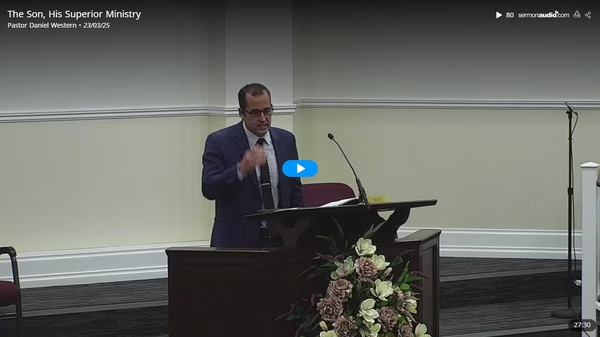
The book of Hebrews is a book of better things. Its central argument is that the Old Testament system – priesthood, tabernacle, sacrifices – was a shadow pointing towards Christ, and that Christ is in every respect superior. In chapter 8, the writer arrives at the sum, the chief point, of all that has been argued: we have such a high priest.
Andrew Murray captures the significance well: in every pursuit, it is most important to keep the eye fixed on the main thing and make everything else subservient to it. A Christian can become perplexed by the variety of truths and duties set before him in Scripture. To see clearly what the central thought is, is like finding the key to a building around which one had wandered seeking an entrance. The central thought here is this: we have a great high priest who is set on the right hand of the throne of the Majesty in the heavens.
This is the answer to every question. In salvation, Christ is the answer. In sanctification, Christ is the answer. In ministry, in marriage, in parenting, in work, in sorrow, in spiritual battles – Christ is the answer. He is the sum of all things, the one for whom are all things and by whom are all things, the author and finisher of faith.
The superiority of the Son’s ministry is first seen in his position. He is set on the right hand of the throne of the Majesty in the heavens – a position of honour that no Old Testament priest could ever occupy. Though high priests entered the holiest of all to sprinkle blood upon the mercy seat, none ever sat at God’s right hand. It is also a position of power, for Christ is both priest and king after the order of Melchizedek – King of Righteousness and King of Peace. In the Old Testament these two offices were always kept separate; no king could serve as priest. But Christ holds both, and this has a searching implication: to desire the blessings of Christ as high priest while resisting his authority as king is a fallacy. He must rule and reign on the throne of the believer’s life if the power of his endless life is to be known.
It is further a position of completed work. The Old Testament priest stood as he ministered – his work was never finished, continuing until old age and death, when the next priest took over. But Christ is seated because his sacrificial work is done. It was a one-time sacrifice, finished and complete. And it is a position of continuous intercession, for he ever lives to make intercession for his people. The contrast is stark: the Old Testament high priest made momentary intercession once a year, but Christ intercedes eternally.
The Son’s ministry is also superior in its place. He is a minister of the sanctuary and of the true tabernacle which the Lord pitched and not man. The Old Testament tabernacle, with its holy of holies, was a very small earthly type of the true dwelling place of God – a shadow with no substance in itself, merely proof that a reality existed behind it. Christ has not entered into the holy places made with hands but into heaven itself, now to appear in the presence of God for us.
This truth confronted Jewish believers with a difficult but necessary reality: the Old Testament system – the temple, the priesthood, the sacrifices – had served its purpose and was now finished. Some people, then and now, prefer formalism to truth. They cling to the shadow rather than the substance. But nothing – no religious heritage, no family tradition, no trappings of ceremony – is worth missing salvation for. The substance is Christ.
The Son’s ministry is superior in his sacrifice. Every high priest was ordained to offer gifts and sacrifices, and it was necessary that Christ also have something to offer. But whereas the Old Testament priests offered animals, Christ offered up himself – both the priest and the sacrifice. No religion offers this. No one could bear sin and die for sinners except Christ. And it was voluntary: “Therefore doth my Father love me, because I lay down my life, that I might take it again. No man taketh it from me, but I lay it down of myself.” (John 10:17-18a)
The Son’s ministry is superior in its covenant. He is the mediator of a better covenant, established upon better promises. Griffith Thomas describes this covenant as absolute rather than conditional, spiritual rather than carnal, universal rather than local, eternal rather than temporal, individual rather than national, internal rather than external. William MacDonald notes that Christ’s ministry is infinitely better: he offered himself rather than an animal, presented his own blood rather than the blood of bulls and goats, put away sins rather than merely covering them temporarily, gave believers a perfect conscience rather than an annual reminder of sins, and opened the way into God’s presence rather than keeping worshippers at a distance.
Finally, the Son’s ministry rests on superior promises – at least three, drawn from verses 10 to 12 of the chapter. First, the law written on the heart: under the old covenant, the law was external, written on stone tablets, but under the new it is internal, written on hearts and minds, which speaks of the true condition of salvation. Second, universal, intuitive, and experiential knowledge of God, when the earth shall be full of the knowledge of the Lord as the waters cover the sea. Third, full forgiveness of sins: “For I will be merciful to their unrighteousness, and their sins and their iniquities will I remember no more.” (Hebrews 8:12) As the Psalmist wrote, as far as the east is from the west, so far has he removed our transgressions.
The question is whether one has partaken of this new covenant. Christ is the great high priest, and through him sins are forgiven. The call is to fix one’s eyes upon him – in the multitude of things to be done, not to forget him – and to walk in the new way opened through the blood of the Lord Jesus.
Sermon Audio Id: 3232572271738