


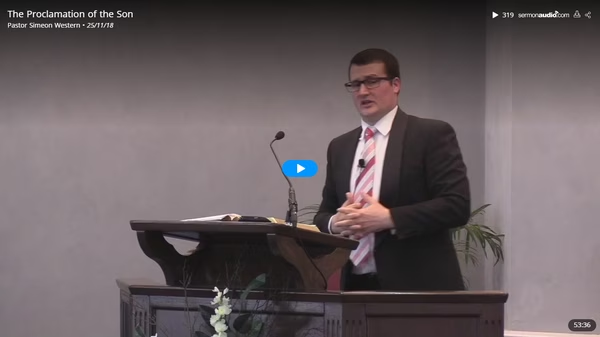
Having described the baptism and temptation of Christ, Mark now gives a summary of the preaching ministry of the Messiah. Often in the Gospels we have reference to Christ ‘teaching’ but we also have references like this one that reveal that Christ was also a preacher. He proclaimed the truth with authority and anointing.
The three synoptic Gospels (Matthew, Mark and Luke) focus on Christ’s ministry in Galilee. John’s Gospel in the early chapters provides details of the first year of Christ’s public ministry that preceded this point. Some have called this the “year of obscurity”
Having described the baptism and temptation of Christ, Mark now gives a summary of the preaching ministry of the Messiah.
In this lesson, we will consider three things in relation to Christ’s ministry of preaching.
The Time of His Preaching (Vs. 14a)
The Imprisonment of John (Vs. 14a)
- Christ commenced His Galilean ministry after John was incarcerated by king Herod. The details of the events that lead to John’s imprisonment are recorded in 6:14-29 and will be the focus of a later sermon but in summary, John was imprisoned for two reasons:
- Due to his bold denunciation of sin – John was not afraid to rebuke the highest ruler in the land for his sin. There is a price to pay for being faithful to the truth!
- Due to his purpose being fulfilled – John’s ministry was to prepare the way for the Messiah. God, in His sovereignty, used John’s imprisonment to bring about the transition from John’s ministry to Messiah’s ministry. The ending of John’s public ministry marked the beginning of Christ’s public ministry in Galilee.
The Appointment of the Father (Vs. 15a)
- ‘time’ = not a reference to time in general but to a season or epoch; a special time with a special event, a particular time. It was “time heavy with eternal significance.” (Hiebert)
- Christ entered the world at the exact time ordained by God.
- Galatians 4:4 “But when the fulness of the time was come, God sent forth his Son, made of a woman, made under the law, To redeem them that were under the law, that we might receive the adoption of sons.”
The Topography of His Preaching (Vs. 14b)
The Location of Galilee
- The northernmost of the three main divisions of Palestine. Palestine was divided into three provinces at the time of Christ – Judea, Samaria and Galilee
- Unger’s description: “Galilee occupied the upper part of the land, being the NW province. In the time of Christ, it included more than one-third of western Palestine, extending from the base of Mt. Hermon on the North to the ridges of Carmel and Gilboa on the South, and from the Jordan to the Mediterranean Sea, about fifty by twenty-five miles in extent. Solomon once offered the tract to Hiram, who declined it, after which Solomon colonized it. It embraced a large norther portion of the tribe of Naphtali and was called Galilee of the Gentiles.”
The Population of Galilee
- Galilee was a populous and fertile region. Christ went to where the people were!
- Galilee was made up of a mix of Jew and Gentile, hence its name “Galilee of the nations”. “Galilee was cosmopolitan. It was a region where Roman, Greek and Jew mixed and intermingled because the population of Galilee was as much Gentile as it was Jewish” (John Phillips). While much of Christ’s earthly ministry was focused on Israel, at the same time, He came to be the Lamb for the “sin of the world” (John 1:29).
- Galilee was a somewhat despised and disregarded area as it was far from the religious center of Jerusalem. Nathanael said, “Can there any good thing come out of Nazareth?” (John 1:46)
The Prediction of Galilee
- Christ’s ministry in Galilee was the fulfilment of prophecy.
- Matthew 4:12-17 – Matthew quotes from Isaiah’s prophecy (Isaiah 9:1-2 & 42:6-7). Christ entered this area covered in spiritual darkness as the light of the world (John 8:12). The “sun of righteousness” had finally arisen! (Mal. 4:2)
The Topics of His Preaching (Vs. 15)
The Revelation of the Kingdom (Vs. 15a)
- “gospel” = good news
- “the kingdom of God” = the long anticipated Messianic kingdom foretold in the O.T. Christ offered the kingdom to Israel but they rejected and crucified their king. The kingdom of God will still be fulfilled literally in the future in the Millennial reign of Christ.
- “time is fulfilled…at hand” = Christ’s message contained a sense of urgency. “at hand” means “is now near.”
The Requirements of the Kingdom (Vs. 15b)
Repentance
- Repentance was a keynote of N.T. Gospel preaching
- The example of John the Baptist (Vs. 4)
- The example of Christ (Matt. 4:17; Mk. 1:15)
- The example of the disciples (Mark 6:12)
- The example of Peter (Acts 2:38)
- The example of Paul (Acts 20:21)
- Repentance is essential for salvation (Luke 13:3 & 5)
- Repentance is a part of the Great Commission (Luke 24:47)
- Repentance defined
- What repentance is not
- It is not reformation. This would be works. A change of life is the result/fruit of genuine repentance
- It is not mere remorse. Sorry for sin is a part of repentance but remorse in and of itself is not repentance. Regret for the consequences of one’s actions is distinct from repentance for the sinfulness of one’s actions. Judas is an example of one who was remorseful but did not truly repent (Matt. 27:3-4)
- What repentance is
- Repentance is a change of mind that results in a change of life. The Greek word is metanoew (metanoeo) which is made up of two words: ‘meta’ (after) and ‘noeo’ (to think) so “to think after”.
- David Cloud:“Biblical repentance as preached by John the Baptist, the Lord Jesus Christ, and the apostles, is A CHANGE OF MIND TOWARD GOD AND SIN THAT RESULTS IN A CHANGE OF LIFE. IT IS A SPIRIT-WROUGHT CHANGE OF MIND THAT LEADS TO A CHANGE OF LIFE. It is not a change of life. That would be a works salvation. It is a radical, Spirit-wrought change of mind toward sin and God, such a dramatic change of mind that it changes one’s actions.”
- C.H. Spurgeon:“Just now some professedly Christian teachers are misleading many by saying that ‘repentance is only a change of mind.’ It is true that the original word does convey the idea of a change of mind; but the whole teaching of Scripture concerning the repentance which is not to be repented of is that it is a much more radical and complete change than is implied by our common phrase about changing one’s mind. The repentance that does not include sincere sorrow for sin is not the saving grace that is wrought by the Holy Spirit. God-given repentance makes men grieve in their inmost souls over the sin they have committed, and works in them a gracious hatred of evil in every shape and form. We cannot find a better definition of repentance than the one many of us learned at our mother’s knee: ‘Repentance is to leave the sin we loved before, and show that we in earnest grieve by doing so no more’” (Charles Haddon Spurgeon, “The Royal Saviour,” Metropolitan Tabernacle, London, England, Feb. 1, 1872).
- What repentance is not
- Repentance illustration: Parable of the two sons (Matt. 21:28-32)
- Baptist Theologian B.H. Carrol on repentanceThe preacher who leaves out repentance commits as grave a sin as the one who leaves out faith. I mean he must preach repentance just as often, and with as much emphasis, and to as many people as he preaches faith. To omit repentance, to ignore it, to depreciate it, is rebellion and treason. Mark its relative importance: You may make a mistake about baptism and be saved, for baptism is not essential for salvation. You may be a Christian and not comprehend fully the high priesthood of Jesus Christ (Heb. 5:11), but “Except ye repent ye shall all likewise perish.” So said the Master Himself. Repentance is a preparatory work. For thus saith the Lord: “Break up your fallow ground and sow not among thorns.” I submit before God, who will judge the quick and the dead, that to preach faith without repentance is to sow among thorns. No harvest can be gathered from an unplowed field. The fallow ground needs to be broken up. The most striking instance on record of repentance as a preparatory work was the ministry of John the Baptist. He was sent “to make ready a people prepared for the Lord.” He did it by preaching repentance, and Mark says his preaching was “the beginning of the gospel of Jesus Christ, the Son of God.” Here is the true starting point…When true repentance was preached and emphasized, there were not so many nominal professors of religion. To leave out or minimize repentance, no matter what sort of faith you preach, is to prepare a generation of professors who are such in name only. I give it as my deliberate conviction, founded on twenty-five years of ministerial observation, that the Christian profession of today owes its lack of vital godliness, its want of practical piety, its absence from the prayer meeting, its miserable semblance of missionary life, very largely to the fact that old-fashioned repentance is so little preached. (B.H. Carroll, 1889)
Faith
- The definition of ‘faith’
- Faith means to think to be true (mind)
- Faith means to trust or rely on (heart) (Rom. 10:9-10) “To believe means more than to give credence to the message; it involves a personal commitment to, and reliance upon, that which is believed.” (Hiebert)
- Faith means to receive (will) “But as many as received him, to them gave he power to become the sons of God, ever to them that believe on his name.” (John 1:12)
- The focus of ‘faith’
- Faith in “the gospel” – Christ’s death on the cross for sin, burial and resurrection (1 Corinthians 15:1-4).
- Faith in Christ himself – “…Believe on the Lord Jesus Christ, and thou shalt be saved, and thy house.” (Acts 16:31)
Conclusion
- Have you truly repented of your sin and your own way and trusted in Christ for salvation?
- As believers, are we boldly proclaiming the timeless, unchanging message of repentance and faith to a lost world?
Sermon 6 of 59 in Mark Series
Sermon Audio Id: 1124181425350