

Exposition of John’s greeting to the seven churches. His greeting contains a heart warming description of the believer’s position in Christ as well as an announcement of the grand theme of the Book.
Review:
- The key to the Book – 1:19
- Revelation deals with prophetic (future) things
- Revelation gives us the details of Daniel’s 70th week (refer chart)
In this lesson we will study the Apostolic greeting (preface) to the Book under 4 headings:
The People in the Preface (Vs. 4a)
The Author – ‘John’
- John is clearly stated as the human author 4 times in the Revelation (1:1, 4, 9; 22:8).
- John also authored the Gospel of John and 3 Epistles (1, 2, & 3 John).
- John is described 4 times in the Gospel of John as “the disciple whom Jesus loved” (John 13:23; 20:2; 21:7, 20).
The Audience – “to the seven churches”
- There were other churches at this time in the region but John writes to these as representative of all the churches and also because it was with these churches that he was intimately acquainted.
- The first use of the number ‘seven’ in Revelation. The word ‘seven’ appears 54 times in the Book and is the number of completion. E.g. God rested on the 7th day, indicating that creation was finished.
The Prayer of the Preface (Vs. 4b-5a)
The Substance of the Blessing (Vs. 4b)
- Grace – God’s unmerited favor. John writes to those who have experienced this grace in salvation but he also desires that they might also continue to know God’s grace for Christian living.
- Peace – peace with God (salvation) and the peace of God (Christian experience).
The Source of the Blessing (Vs. 4c-5a)
Grace and peace are viewed as coming from the Triune God – Father, Son and Spirit (three-fold source). The Divine source is what gives grace and peace its true value and meaning. “It is a blessing backed with all the authority of heaven itself, a blessing bestowed by the Father, the Spirit and the Son.” (Phillips) Grace and peace is from…
- The Father (4c)
- The Title – “from him which is, and which was, and which is to come”
- The Truth – speaks of the eternality of God; His timelessness; His unchangeableness. He is the I AM, the self-existent, eternal one. Our grace and peace (salvation) is absolutely secure because it rests in the hands of the Eternal, unchanging God.
- Isaiah 57:15 “For thus saith the high and lofty One that inhabiteth eternity, whose name is Holy;”
- Psalm 90:2 “Before the mountains were brought forth, or ever thou hadst formed the earth and the world, even from everlasting to everlasting, thou art God.”
- The Spirit (4d) – “from the seven Spirits”
- The description of the Spirit – “the seven Spirits” This is not a reference to the literal number of the Person of the Holy Spirit as other Scripture makes it clear there is only One Holy Spirit (Eph. 4:4) “His word and office are depicted under symbolic language.” (Cloud). The title conveys the following truths:
- The Omniscience of the Spirit – in Rev. 4:5 the “seven Spirits” are likened to lamps of fire which speaks of enlightenment. This title clearly traces its origin to Zechariah 4:1-10 (note particularly Vs. 2, 10 and compare with Rev. 5:6)
- The Omnipresence of the Spirit – Rev. 5:6
- The Offices of the Spirit – the Holy Spirit is manifold in his offices and characteristics. Isaiah 11:2 “And the spirit of the LORD shall rest upon him, the spirit of wisdom and understanding, the spirit of counsel and might, the spirit of knowledge and of the fear of the LORD;”
- Geneva Bible Notes: “This Spirit is one in person according to his subsistence: but in communication of his power, and in demonstration of his divine works in those seven churches, perfectly manifests himself as if there were many spirits, every one perfectly working in his own church.”
- The position of the Spirit – “which are before his throne”
- The description of the Spirit – “the seven Spirits” This is not a reference to the literal number of the Person of the Holy Spirit as other Scripture makes it clear there is only One Holy Spirit (Eph. 4:4) “His word and office are depicted under symbolic language.” (Cloud). The title conveys the following truths:
- The Son (5a) – “from Jesus Christ”
There are three titles of Christ in this verse:- The faithful witness – Christ is faithfulness incarnate
- The first begotten of the dead – Christ’s resurrection. “first begotten” = Greek word ‘prototokos’ referring to a place of prominence (first in rank and position)
- The prince of the kings of the earth – Christ is seated on the throne right now above all but in the future He will rule and reign on earth during the millennium. Christ is King of kings.
The Praise in the Preface (Vs. 5b-6)
There is a doxology of praise in these verses exalting the work of Christ which He accomplished on our behalf:
The Accomplishments of Christ (Vs. 5b-6a)
- Jesus Christ loved us
- Galatians 2:20 “I am crucified with Christ: nevertheless I live; yet not I, but Christ liveth in me: and the life which I now live in the flesh I live by the faith of the Son of God, who loved me, and gave himself for me.”
- Ephesians 3:19 “And to know the love of Christ which passeth knowledge…”
- “Where the nails the solemn power, that held sweet Jesus in that hour? It was love for you for me that held my Saviour to the tree.”
- “Could we with ink the ocean fill and were the sky of parchment made…”
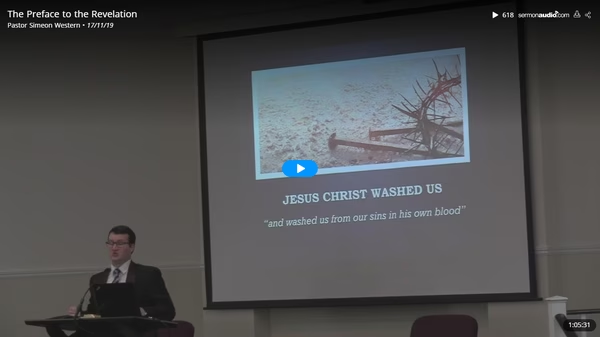
- Jesus Christ washed us
- Salvation is described as a washing. We need washing as we are defiled and unclean with sin (Isaiah 64:6; Rom. 3:10, 23).
- “in his own blood” = the blood of Christ was the price that was paid for sin and is the agent of cleansing
- ‘washed’ = comes from Greek word ◻◻◻◻ (louo) which means “to bathe the whole person.” We need the washing of salvation (a onetime event) and then daily washing for sanctification, fellowship and service.
- Illustration: The washing of the Levites
- First washing was all over (Lev. 8:6).
- Thereafter the hands and feet were to be washed in the laver before entering the tabernacle for service (Ex. 30:18-19).
- 1 John 1:7 “But if we walk in the light, as he is in the light, we have fellowship one with another, and the blood of Jesus Christ his Son cleanseth us from all sin.”
- Jesus Christ elevated us
- Elevated to the status of kings with the Father – one day we will rule and reign with Christ.
- 2 Tim. 2:12 “If we suffer, we shall also reign with him: if we deny him, he also will deny us:”
- 1Cor. 6:3 “Know ye not that we shall judge angels? how much more things that pertain to this life?”
- Rev. 20:6 “Blessed and holy is he that hath part in the first resurrection: on such the second death hath no power, but they shall be priests of God and of Christ, and shall reign with him a thousand years.”
- Elevated to the status of priests with the Father – every believer is a priest with direct access to God, called to offer up spiritual sacrifices in word and deed.
- 1 Peter 2:9 “But ye are a chosen generation, a royal priesthood, an holy nation, a peculiar people; that ye should shew forth the praises of him who hath called you out of darkness into his marvellous light:”
- Andrew Murray: Exerpt from “With Christ in the School of Prayer”
“Think of what constitutes priesthood. There is, first, the work of the priesthood. This has two sides, one Godward, the other manward…A priest is thus a man who does not at all live for himself. He lives with God and for God. His work is as God’s servant to care for His house, His honour, and His worship, to make known to men His love and His will. He lives with men and for men (Heb. 5:2). His work is to find out their sin and need, and to bring it before God, to offer sacrifice and incense in their name, to obtain forgiveness and blessing for them, and then to come out and bless them in His Name. This is the high calling of every believer. “Such honour have all His saints.” They have been redeemed with one purpose to be in the midst of the perishing millions around them, God’s priests, who in conformity to Jesus, the Great High Priest, are to be the ministers and stewards of the grace of God to all around them.”
- Elevated to the status of kings with the Father – one day we will rule and reign with Christ.
The Ascription to Christ (Vs. 6b)
- The details of the ascription
- Christ is worthy of glory
- Christ is worthy of dominion – ‘dominion’ means “Sovereign or supreme authority; the power of governing and controlling.” (Webster)
- The duration of the ascription
- For ever and ever – Christ is worthy of praise for all eternity. Jude 1:25 “To the only wise God our Saviour, be glory and majesty, dominion and power, both now and ever. Amen.”
- ‘Amen’ = John adds his affirmation and agreement
The Purpose in the Preface (Vs. 7-8)
Vs. 7-8 introduce the grand purpose and theme/topic of the Book. The Doxology is followed by a glorious announcement of the Second Coming of Christ.
The Coming of Christ Declared (Vs. 7)
- The speed of His coming (7a)
- ‘cometh’ = present tense. “The use of the present tense depicts a future act that is so certain to be fulfilled it can be spoken of as already happening.” (Walvoord) “He who is already on His way may arrive at any moment.” (Linguistic Key)
- Seven times in the Book of Revelation Christ speaks of His coming (2:5, 16; 3:11; 16:15; 22:7, 12, 20). Note the last 3 times are in the last chapter of the last Book of the Bible. Of all the things God could have recorded in the Bible as His last words, He emphasized the coming of Christ.
- Christ’s coming is a major theme in the N.T. (refer references)
- The sight of His coming (7b)
- “with clouds” = indicates Christ’s heavenly origin. Repeated many times in Scripture in relation to Christ’s return (E.g. Dan. 7:13; Mt. 24:30; 26:64; Mk. 13:26).
- “The clouds are clouds of glory surrounding Christ’s presence (See 2 Chr. 5:14; 7:2).” (Cloud)
- John Phillips:
“The clouds are the clothing of His glory. When God summoned Israel out of Egypt, He marched before them all the way through the desert, wrapped in a cloak of cloud. When Israel pitched the Tabernacle in the wilderness, God enthroned Himself, draped with a cloud, upon the mercy seat. When our Lord stepped from Olivet’s brow to climb the sky to glory, He flung around His rising form a glorious robe of cloud. And when He comes back to do battle with the beast and to claim this robbed and ruined vineyard as His own, He will once again be draped with clouds.”
- “every eye shall see him” = the whole world will see Christ
- “they also which pierced him” = Israel will see Christ
- Explain difference between the Rapture and the Second Coming (Revelation) – Refer charts
- “with clouds” = indicates Christ’s heavenly origin. Repeated many times in Scripture in relation to Christ’s return (E.g. Dan. 7:13; Mt. 24:30; 26:64; Mk. 13:26).
- The sorrow at His coming (7c)
- ‘wail’ = to smite the chest in sorrow as a sing of mourning or remorse
- For the world this will not be the wail of repentance but the wail of terror that their judgment has come
- For the Jews, it will be a wail of repentance – Zec. 12:10 “And I will pour upon the house of David, and upon the inhabitants of Jerusalem, the spirit of grace and of supplications: and they shall look upon me whom they have pierced, and they shall mourn for him, as one mourneth for his only son, and shall be in bitterness for him, as one that is in bitterness for his firstborn.”
- “Even so, Amen” = John’s double affirmation
The Character of Christ Described (Vs. 8)
- The Eternality of Christ (8a)
- The Sovereignty of Christ (Vs. 8b) ‘Almighty’ means “all strength” (Vines) Christ is the absolute and universal sovereign
- The Deity of Christ – This verse clearly teaches that Jesus Christ is God.
Conclusion
Sinner, Are you Ready? Saint, Are you Ready?
Sermon 2 of 38 in Revelation Series