


Exposition of the Olivet Discourse from a Premillennial, Pre-tribulation viewpoint. The Olivet Discourse contains teaching from our Lord’s own lips concerning the coming tribulation period.
To set the framework for a fruitful study of the Olivet Discourse, the following introductory points are of great importance.
This is the longest recorded answer of Christ to a question in the Gospels which says something of its importance. Some have called it “the Little Apocalypse.”
Matthew and Mark emphasis the tribulation period whereas Luke majors more on A.D. 70.
- Constable: “Matthew and Mark both stressed Jesus’ teaching that focused on His second coming. Matthew and Mark also recorded more about Jesus’ answer to the disciples’ second question, “What will be the sign when all these things are going to be fulfilled?” (13:4b). Luke concentrated more on His answer to their first question, “When will these things be?” (13:4a). Matthew wrote to answer the questions of Jewish unbelievers. Mark wrote primarily to respond to those of Gentile Christians living under Roman persecution and in a hostile world. Mark stressed Jesus’ exhortations to watchfulness and His preparation of the disciples for future hardships.”
Israel is in view, not the church.
Internal Evidence (within the chapter)
- We have mention of ‘synagogues’ (Vs. 9), ‘Judea’ (Vs. 14) and the “Sabbath day” (Matt. 24:20).
- The whole passage has a Jewish tone with allusions and quotations to O.T. prophecies concerning Israel (e.g. Vs. 14 and Dan. 9:27).
- Barclay: “Mark 13 is one of the most difficult chapters in the New Testament for a modern reader to understand. That is so because Mark 13 is one of the most Jewish chapters in the Bible. From beginning to end it is thinking in terms of Jewish history and Jewish ideas.”
- At this point the church was still a ‘mystery’ which was not fully unveiled until the New Testament Epistles (Eph. 3:4-6).
External Evidence (within the Bible)
- The tribulation period is distinctly Jewish and not for the church. It is called “the time of Jacob’s trouble” (Jer. 30:7). The seventy weeks are “determined upon thy people and upon thy holy city” (Dan. 9:24).
- The church is promised total deliverance from this future period of God’s wrath in verses such as 1 Thess. 1:10; 5:9 & Rev. 3:10. This is why the church is not mentioned in Revelation 6-18 which detail the judgments of the tribulation.
The Revelation (Second Coming) of Christ is in view, not the Rapture.
- The rapture was another mystery doctrine that was again revealed through the N.T. Epistles (1 Cor. 15:51-52).
- Christ’s return to earth is in view, not His coming in the sky to rapture the church.
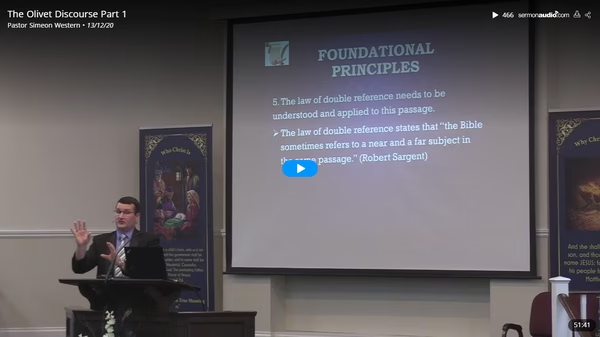
The law of double reference needs to be understood and applied with this passage.
- The law of double reference states that “the Bible sometimes refers to a near and a far subject in the same passage.” (Robert Sargent)
- To illustrate, Ezekiel 29:1-19 is apparently addressed to the king of Tyre who was Ethbaal II. However, it clearly goes beyond the immediate earthly reference to give great detail of the original estate and fall of the evil one behind Ethbaal – Satan. Hosea 11:1 applies primarily to the nation of Israel, but the Holy Spirit also uses it of God’s “greater Son,” the Lord Jesus Christ (Matt. 2:14-15).
- In the Olivet discourse, the near event is the destruction of the temple in A.D. 70, the far event (future) is the seven-year tribulation period. The destruction of the temple in A.D. 70 would foreshadow the future tribulation period. John Phillips writes, “Some overlap occurs between the two prophecies…Like much Bible prophecy, this end-times prophecy had both a near, impending and partial fulfillment (the burden of Luke) and a final, end ties, complete fulfillment (the burden of Matthew and Mark).”
- Cranfield: “The key to…understanding is the recognition that there is here a double reference. The impending judgement [sic] on Jerusalem and the events connected with it are for Jesus as it were a transparent object in the foreground through which he sees the last events before the End, which they indeed foreshadow.”
Chapter divisions. The chapter can be divided as follows:
- Vs. 1-4 – The Disciples Questions
- Vs. 5-7 – The Present Age
- Vs. 8-13 – The Beginning of Sorrows (first half of tribulation)
- Vs. 14-18 – The Abomination of desolation (midpoint of the tribulation)
- Vs. 19-23 – The Great Tribulation (second half of the tribulation)
- Vs. 24-27 – The Second Coming of Christ
- Vs. 28-37 – Parables and exhortations
The Setting of the Discourse (Vs. 1-4)
The Occasion of the Discourse (Vs. 1-2)
- The Disciples Admiration of the Temple (Vs. 1)
- “as he went out of the temple” = it had been an eventful day of teaching in the temple (11:27-12:44)
- “see what manner of stones…!” = notice the exclamation point at the end of the sentence. There was feeling and wonder in the disciple’s voice.
- The temple structure was impressive. According to Josephus, part of it was built of strong; white stones, each measuring 25 cubits long, eight high, and about twelve in breadth. Some of these massive stones weighed more than one hundred tons.
- “Built of polished white stone, with its eastern wall covered in gold, the temple’s main structure gleamed in the evening light as if it were a massive jewel.” (Macarthur) According to John Phillips, “Herod the Great began work on the temple in 20 B.C. and it wasn’t completed until A.D. 64, having taken some 85 years to build.”
- ‘buildings’ = “denotes the temple proper as well as the various courts with their chambers and magnificent colonnades.” (Hiebert)
- The Lord’s Prediction concerning the Temple (Vs. 2)
- Christ prophecies the total destruction of the temple. The temple was the headquarters of the corrupt religious establishment that rejected Christ as Messiah. It would be dealt a smashing blow by the iron fist of Rome under General Titus in A.D. 70.
- “not be left one stone upon another” = this was fulfilled exactly as the Roman soldiers, eager to glean the melting gold from the huge fires, turned each stone over. Josephus remarks that the temple and the city walls, except for a few towers, were so thoroughly “dug up to the foundation, that there was left nothing to make those that came thither believe it had ever been inhabited.”
The Location of the Discourse (Vs. 3a)
- The discourse was given on the Mount of Olives within sight of the temple. “From where they sat, they had a panoramic view of the temple and the city of Jerusalem. The Mount of Olives is almost 150 feet higher than the Temple Mount.” (Hiebert)
- We again note the very Jewish context. The disciples are sitting with Christ on the Mount of Olives starring at the temple. The last thing in the disciples’ minds at that moment was the church as we know it with the advantage of holding in our hands the completed Word of God. They were still anticipating the kingdom and were struggling to come to terms with understanding the impending cross.
- Even after Christ’s resurrection, the disciples were still focused on the kingdom! Acts 1:6 “When they therefore were come together, they asked of him, saying, Lord, wilt thou at this time restore again the kingdom to Israel?” The disciples were thinking about the kingdom, not the church! The truth of the church was still largely hidden from them (Eph. 3:4-6).
The Question of the Discourse (Vs. 3b-4)
- “Peter and James and John and Andrew” = two sets of brothers and Christ’s inner circle of disciples.
- “when shall these things be” = this part of the question relates to the destruction of the temple.
- “what shall be the sign when all these things shall be fulfilled” = looks beyond the destruction of the temple to the end of the age. “The disciples clearly did not foresee the long interval between the two events.” (Hiebert)
- Matthew’s account expresses it as follows: “And as he sat upon the mount of Olives, the disciples came unto him privately, saying, Tell us, when shall these things be? and what shall be the sign of thy coming, and of the end of the world?” (Matt. 24:3) So in essence we have three questions or two questions, the second with two parts:
- “When shall these things be?” – question relating to the destruction of the temple. Luke focuses more on this question than Matthew and Mark.
- “What shall be the sign of thy coming?” – the second coming of Christ. Notice the emphasis on the ‘sign’. Remember, Israel looks for signs, the church listens for sounds.
- “and of the end of the world?” – the end of the age. The disciples therefore wanted to know more than just the details surrounding the prophesied destruction of the temple.
The Present Age (Vs. 5-7)
Deceptions (Vs. 5-6)
- “Take heed” = means to see, behold and therefore refers to a watchful, discerning mindset. This call to watchfulness is repeated four times in the chapter (Vs. 5, 9, 23, 33) They were to be alert for deceptions. While we understand this is not speaking directly to the church, we understand the application that as believers we are to exercise discernment and to be alert to the seducing spirits of the last days (1 Tim. 4:1).
- “many shall come” = many false Christ’s would appear between Christ’s first and second coming. Feinberg documents that up to 1953 there is a record of some 64 false messiahs who have tried to lead Israel astray.
- “shall deceive many” = the terrifying and tragic success of these pretender messiahs.
- The ultimate fulfilment of this will be the Antichrist who is pictured in Revelation 6:2 riding on a white horse as a man of peace. He will make a peace treaty with Israel for a seven-year period (Dan. 9:27) and the world will think that world peace has been achieved at last. But it will be short lived! 1 Thessalonians 5:3 warns, “For when they shall say, Peace and safety; then sudden destruction cometh upon them, as travail upon a woman with child; and they shall not escape.”
Wars (Vs. 7-8a)
- “wars and rumours of wars…such things must needs be” = wars would be an inevitable feature of human history and not a specific sign of the end. Wars and threats of wars will characterize the entire age. The history of mankind has been a blood stained one on account of man’s sinful heart.
- “but the end is not yet” = “these events do not constitute the immediate sing of the consummation of the age.” (Hiebert)
Conclusion
- Are we living for eternity? Prophecy puts this world in proper perspective.
- Are we discerning believers, on the alert for error and false doctrine?
- Will we stand for the truth of the pre-tribulation rapture in these last days?
Sermon 47 of 59 in Mark Series
Sermon Audio Id: 1212202156371812