


Exposition of our Lord’s teaching concerning divorce and remarriage as recorded in the Gospel of Mark. Far too many churches have allowed the world to define their concept of marriage. We need to go back to the Divine perspective on this vital issue.
Marriage and the family as designed by God has been under attack from Satan from the beginning of time, starting with our first parents in the garden of Eden.
The breakdown of the family unit in our society has affected the church greatly. In many cases, churches and pastors have caved in to the pressure from the world and adopted a view of this issue that does not resemble the teaching of Scripture.
In this sermon we will seek to faithfully present our Lord’s teaching on divorce and remarriage. Note: It is not possible to address every question relating to specific, real life examples of marriage breakdown that arise with a sermon on this subject. Our purpose in this sermon is to simply declare the Scriptural position on this subject.
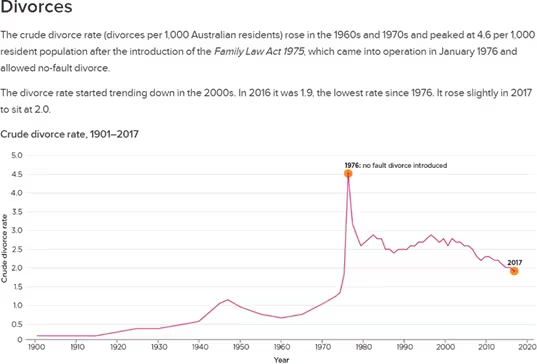
Some marriage and divorce statistics1
- In 2017 there were 112,954 marriages
- In 2017 there were 40,032 divorces in Australia
- The average marriage lasts for 12 years in Australia
- More couples are now living together before committing to marriage and are living together for longer periods of time. Many people see cohabitation as a precursor to marriage, and a means of testing their relationship before committing to marriage. The number of couples living together has increased from 16% of couples in 1976 to 80.8% in 2016.
- Chart from Australian Institute of Family Studies2
The Contention of the Pharisees (Vs. 1-4)
Their Motive (Vs. 2)
- “tempting him” = the Pharisees hoped to trap the Lord on a controversial subject and thereby discredit His ministry.
- Note: The subject was a hotly debated at the time of Christ as well. Nothing has changed!
Their Mindset (Vs. 3-4)
- They were trying to set a trap for the Lord but the Lord turns their question around and exposes their faulty thinking.
- There were two schools of thought in Christ’s day among the Jews in relation to divorce:
- The strict school of Shammai – allowed divorce only if the wife was guilty of unchastity.
- The liberal school of Hillel – permitted divorce for even the most trivial reasons such as spoiling her husband’s dinner, going outside with her head uncovered, for being quarrelsome, childless or even if the husband found some other woman more attractive. (Phillips)
- The Pharisees refer back to Deut. 24:1-4. Matthew records they refer to this as a ‘command’ (Matt. 19:7) but our Lord makes it clear in the next verse (Matt. 19:8) that it was a concession, not a command (‘suffered’). The word ‘suffered’ means to allow. It was permission, not a command.
- Note: The Pharisees had their verses to justify divorce too!
The Refutation of the Lord (Vs. 5-9)
The Background to Moses’ Precept (Vs. 5)
- “for the hardness of your heart” = Christ unmasks the heart issue behind Moses’ law of concession. It was not a precept given that reflected the heart and mind of God but was rather a concession given in response to man’s stubborn persistence in the sin of divorce.
- A careful reading of Deut. 24:1-4 reveals that these measures were put in place, not for the promotion of divorce and remarriage, but to regulate what was already going on in the nation of Israel and to bring a measure of protection for the woman.
- Macarthur: “Far from commanding or even permitting divorce, this injunction merely forbids a man to remarry a woman that he has divorced who has then been married to someone else. The passage recognizes and regulates the reality of divorce without condoning or condemning it.”
- Hendriksen: “The real meaning of the passage is this: ‘Husband, you better think twice before you reject your wife. Remember that once you have put her away and she has become the wife of another you cannot take her back…’”
- “but from the beginning” = introduces a contrast between their view of marriage and the higher intention of God.
The Basis for Marriage Permanence (Vs. 6-9)
Christ takes them back to the beginning and to God’s original intent for marriage, outlining the following facts:
- Marriage is rooted in the distinction between the sexes (Vs. 6). “The distinction of the sexes, established at creation, underlies the institution of marriage and is the foundation of the human family.” (Hiebert) Christ clearly believed in a literal interpretation of the Book of Genesis and its account of creation. Marriage according to God’s design can only be the joining together of one man and one woman. Any other inventions of man (e.g. unions of the same gender) are evil abomination and do NOT constitute marriage in the sight of God, no matter how many parliaments vote and say otherwise!
- Marriage is the joining together of two (a man and a woman) into one unit (Vs. 7-9)
- ‘leave’ = strong word meaning to leave behind, depart, forsake. While a special relationship with one’s parents should remain even after marriage, God’s design is for marriage to involve the establishment of a new family unit. If you are not ready to leave, you are not ready to cleave!
- ‘cleave’ = also a strong word literally meaning to be glued to. Marriage is intended to be an unbreakable bond and if you break it, it leaves much damage. Illustration: Removing battens glued to the back of panels at previous job (Supawood).
- Excerpt from Wedding Liturgy: There is no tie on earth, so deep, so sacred, so binding, as that which joins a man and woman in the bond of marriage. Such a relationship, then, should not be entered into without prayerful thought, or due sincerity, but in the reverential fear of God.
- Marriage is “a union of two lives fused into one. They now form a unit, each forming part of the very existence of the other.” (Hiebert)
- Marriage is a Divinely ordained institution and man is forbidden to interfere or tamper with it.
- “God hath joined together” = yoked together by God. Marriage was created and ordained by God. God created male and female, making the marriage union possible (Gen. 1:27). It was God who said, “it is not good that the man should be alone” (Gen 2:18). God brought Even to Adam and performed the first wedding ceremony (Gen. 2:22-24). From every angle, it was God who established marriage as a Divine Institution!
- “let not man” = no man has the right to separate those whom God has joined. This applies not just to the husband and wife in the marriage yoke but also to those external to a marriage who may try and interfere (e.g. family members, friends, counsellors and pastors that give unscriptural advice, immoral activities).
- “put asunder” = to divide, separate.
- Note: If a pastor takes a weak, unscriptural view of this issue, he will by default, weaken the marriages of the couples in the church he pastors.
The Education of the Disciples (Vs. 10-12)
The Disciple’s Question (Vs. 10)
- Matthew’s account reveals the disciples were startled by Christ’s standard on this subject – “His disciples say unto him, If the case of the man be so with his wife, it is not good to marry.” (Matt. 19:10) This is a sad reflection on the disciples view of marriage.
- Note: If Christ’s position merely affirmed Shammai’s view that the only grounds for divorce was unchastity, it is doubtful the disciples would have been so surprised. Clearly our Lord was presenting a standard that was higher than both schools of thought prevalent at the time.
The Lord’s Instruction (Vs. 11-12)
- Our Lord give a simple equation that applies to both men and women. It is this: Divorce + Remarriage = adultery. There is no way to escape the absoluteness of Christ’s position on this. If you marry a divorced person, you commit adultery!
- Luke 16:18 “Whosoever putteth away his wife, and marrieth another, committeth adultery: and whosoever marrieth her that is put away from her husband committeth adultery.”
- Question: What about the so-called exception clause in Matthew 19:9? “And I say unto you, Whosoever shall put away his wife, except it be for fornication, and shall marry another, committeth adultery: and whoso marrieth her which is put away doth commit adultery.” Some important considerations are as follows:
- The Jewish context of Matthew is important. Both Mark and Luke wrote to Gentile audiences and left out the so called “exception clause”. Mark includes the scenario where a woman divorces her husband (Mk. 10:12) as this was common amongst Greeks and Romans but Matthew makes no mention of it as under Jewish law, only men could divorce their wives.
- The modern versions use the word ‘adultery’ whereas the KJV translators wisely use the word ‘fornication’. Fornication, though a broad word that encompasses many different forms of immorality, primarily applies to pre-marital sex. Within the context of Matthew, and the Jewish betrothal system, it would refer to immorality committed during the betrothal period. Betrothal was as binding as marriage and could not be severed. However, our Lord gives the one exception to this where immorality was involved. Illustration: Joseph (Matt. 1:18-20)
Conclusion
Let me close with a three-fold challenge
- A challenge to married couples – fight for your marriage! Resolve in your heart, if you haven’t already, that there is NO place for divorce and remarriage and stay faithful to your vows no matter the cost. J.C. Ryle’s three rules for marriage are helpful: “Happy are they, who in the matter of marriage observe three rules. The first is to marry only in the Lord, and after prayer for God’s approval and blessing. The second is not to expect too much from their partners, and to remember that marriage is, after all, the union of two sinners, and not two angels. The third rule is to strive first and foremost for one another’s sanctification. The more holy married people are, the happier they are. “Christ loved the church, and gave Himself for it, that He might sanctify it.” (Eph. 5:25-26)
- A challenge to remarried couples – if you find yourself in a position where you have violated the Bible’s teaching you need to: 1. Repent of your sin of adultery 2. Stay committed to your present vows and marriage 3. Discourage others from doing the same thing. Don’t promote divorce and remarriage Christian style!
- A challenge to singles – do not enter into marriage lightly! Pray and seek God’s will fervently. Apart from your salvation, it is probably the most significant decision you will ever make. Resolve in your heart before marriage that should God give you a spouse, it is “till death us do part.” Remove from your heart and mind any thought there is an “out” if things don’t work out.
References
- https://www.budgetdirect.com.au/blog/marriage-and-divorce-statistics-australia.html 2
- https://aifs.gov.au/facts-and-figures/divorce-rates-australia
Sermon 38 of 59 in Mark Series
Sermon Audio Id: 229201927102322