


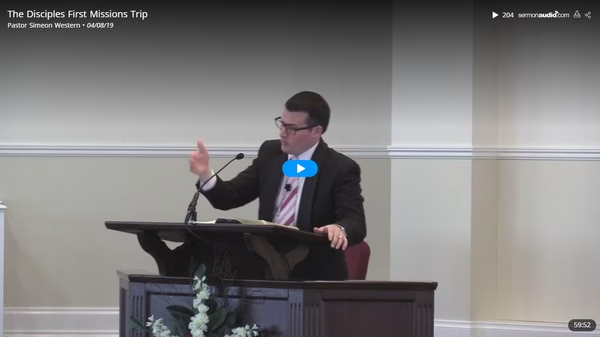
Sermon the first mission outreach of the twelve disciples. There are some unique, dispensational aspects to this first mission of the Apostles but there are also many abiding principles and practical challenges that will help us in our endeavors for the Gospel.
There are two dispensational aspects to this first mission of the disciples we must keep in mind:
- The Jewish aspect – “These twelve Jesus sent forth, and commanded them, saying, Go not into the way of the Gentiles, and into any city of the Samaritans enter ye not: But go rather to the lost sheep of the house of Israel.” (Matt. 10:5-6) The Gospel was to “the Jew first” (Rom. 1:16).
- The Apostolic aspect – “Truly the signs of an apostle were wrought among you…” (2 Cor. 12:12) There were special sign gifts that accompanied the Apostles that were unique to that office and which have since ceased.
- This first mission was local, the second (the Great Commission) was global. The first was to the Jewish nation only, the second to all nations. The first was national, the second international.
However, with the above in mind, we do want to learn from the abiding principles we can discern in this passage. “Some of the things which He said have no application to us; they were only for the men who were then under Him. Nevertheless, there are underlying principles in every part of these charges, which are of perpetual application.” (G. Campbell Morgan)
Let’s study this mission of the Apostles in four sections:
Their Commission for the Mission (Vs. 6-7)
The Period of the Mission (Vs. 6)
- Christ has been active in reaching out with the Gospel (Vs. 6)
- Christ has just exhorted them concerning the need to pray for the harvest (Matt. 9:36-38)
- G. Campbell Morgan: “It is to be carefully noted that the men whom He charged to pray specifically for labourers, were those whom He immediately sent forth to labour. “Pray ye” is the first command, “go ye” is the next. The men who have learnt to look with the eyes of Jesus until they fell with the heart of Jesus; and who, out of such vision and such feeling, begin to pray, are more than half ready for the work of bringing in the harvest.”
The Purpose of the Mission (Vs. 7a)
- “the twelve” = they had already been called to service and had accompanied Christ as He preached and ministered. Now they were to put what they had learned from Christ into practice. This Evangelistic tour was a part of their training.
- Christ had called them with the express purpose of making them fishers of men (Mark 1:17). True discipleship and growth as a believer should lead to us becoming soul-winners.
- Practical service, especially in the area of winning souls, is an absolute MUST for those who believe they are called to full time ministry (2 Tim. 4:5).
The Partnership for the Mission (Vs. 7b)
- “send forth” = Greek word ‘apostle’ meaning “a sent one”
- They were sent out “two by two”. Matthew 10:2-4 appears to indicate the pairs as he lists the names in sets of two.
- This pattern also seen in the Book of Acts. E.g. Paul and Barnabas (Acts 13:2). Perhaps there would be fewer casualties in pioneer missions and church planting if this patter was observed?
The Power for the Mission (Vs. 7c)
- They were given Authority – primary sense of the word ‘power’ in this verse. Same word translated ‘authority’ in Luke’s account (Lk. 9:1)
- They were given Ability – Luke’s word for ‘power’ is dunamis, speaking of supernatural power.
- Principle: Whom God calls, He enables! “But we have this treasure in earthen vessels, that the excellency of the power may be of God, and not of us.” (2. Cor. 4:7)
Their Commands for the Mission (Vs. 8-11)
There was to be…
Faith (Vs. 8-10)
- Faith for daily needs (Vs. 8-9) Beyond a simple walking stick, there were to take:
- No Scrip – a leathern sack in which travellers and shepherds carried their provisions. A small bag, wallet or satchel. David put 5 smooth stones in a scrip (1 Sam. 17:40).
- No bread – they would need to trust God for daily bread
- No money – ‘purse’ refers to the girdle in which coins were often kept
- One pair of sandals
- One coat
- Note: The Lord would provide these needs through the giving of those who responded favourable to the message (Matt. 10:10). That the Lord faithfully supplied can be gathered from their testimony later as recorded in Luke 22:35.
- Faith for dwelling needs (Vs. 10)
- “It was a common cultural practice to offer hospitality to strangers arriving in a village.” (Hiebert) To refuse Christ’s messengers this courtesy would represent a deep-seated rejection of the message they carried.
- By staying in one place, Christ’s disciples would distinguish themselves from false teachers who made profit going from house to house seeking to collect money from people.
Forewarning (Vs. 11)
- A significant gesture (Vs. 11a)
- The Background: “The Jews were accustomed, on their return from heathen countries to the Holy Land, to shake off the dust from their feet at the frontier. This act symbolized a breaking away from all joint-participation in the life of the idolatrous world. The apostles were to act in the same way in reference to any Jewish cities which might reject in their person the kingdom of God.” (Godet)
- “a testimony against them” = gesture was to serve as a visible warning to the rejectors
- The example of Paul with the Christ-rejecting Jews of Corinth: “And when they opposed themselves, and blasphemed, he shook his raiment, and said unto them, Your blood be upon your heads; I am clean: from henceforth I will go unto the Gentiles.” (Acts 18:6)
- A serious judgment (Vs. 11b)
- ‘verily’ = truly. This warning of Christ is trustworthy and true!
- The people of a city that rejected the Gospel message would receive a severer judgment than Sodom and Gomorrah.
- Read Christ’s warnings in Matthew 11:20-24
- Challenge: To reject the offer of salvation has grave consequences for eternity. Hebrews 10:28-31 “He that despised Moses’ law died without mercy under two or three witnesses: Of how much sorer punishment…” See also 2 Thess. 1:6-9
- J.C. Ryle: “One of the greatest sins man can commit in the sight of God is to hear the Gospel of Christ and not believe it – to be invited to repent and believe, and yet remain careless and unbelieving. In short, to reject the Gospel will sink a man to the lowest in hell.”
Their Conduct on the Mission (Vs. 12-13)
The Message they Preached (Vs. 12)
- They preached the kingdom of God (Matt. 10:7; Lk. 9:2)
- “the kingdom” = the rulership of God. The King had arrived and was being offered to the nation but they rejected their King.
- “at hand” (Matt. 10:7) = there was a sense of urgency and responsibility. “Now is the day of salvation” (2 Cor. 6:2)
- They preached the Gospel (Lk. 9:6)
- This was the good news of the kingdom.
- We proclaim the good news of Christ’s death, burial and resurrection.
- They preached Christ (Vs. 14a)
- So effective was their mission, that it impacted Herod’s palace!
- It is significant that Herod did not hear of them (the disciples) but of him (Christ). The result of the disciple’s mission was that Christ’s name was “spread abroad”.
- They preached repentance (Vs. 13)
- They followed in the footsteps of John the Baptist (Matt. 3:1-2) and Christ (Mk. 1:15).
- No repentance equals no salvation! (Luke 13:3 & 5)
The Miracles they Performed (Vs. 13)
- Delivering people from demons (13a)
- Delivering people from diseases (13b)
- This included raising the dead (Matt. 10:8)
- Those claiming to have the same power as the Apostles should be able to raise the dead, not just “heal” the sick.
- These miracles were not an end in themselves. They served a secondary role to confirm and authenticate the message.
Their Completion of the Mission (Vs. 30-31)
They Reported to Christ (Vs. 30)
- They reported their words and works.
- Reporting an important, Biblical principle for mission work. The Apostle Paul another good example of this in relation to his home church of Antioch.
- Challenge: We will all give an account of our Christian life and service to the Lord at the judgment seat of Christ. “…the fire shall try every man’s work of what sort it is.” (1 Cor. 3:13)
They Rested with Christ (Vs. 31)
- Christ invites them to take some time to rest and recuperate; an important practice to follow after intense periods of Christian service.
- “a while” = means a little, a short time.
Conclusion
- Challenge: Are you saved? Will you repent and receive Christ today?
- Challenge: Are you a soul-winner?
Sermon 24 of 59 in Mark Series
Sermon Audio Id: 82196514399