


Genesis is absolutely foundational to Christian morality and marriage is no exception. Failing to accept the historicity of Genesis leaves the Christian church without any real basis for Christian marriage and the home. It is significant that the institution of the home was the first formed by God before human government and the church. The home is the fundamental building block of the nation and the church. Destroy the home and the inevitable consequence will be the demise of both the nation and the church. No wonder Satan has focused so much of his attacks against the Christian home.
In this message, we will explore the creation of marriage and the home in the beginning and seek to re-affirm the Biblical foundations the Word of God presents for Christian marriage.
The home in Australia is in dire straits with the rise of de facto couples, single parent households, rampant divorce and the introduction of same sex marriage at the end of 2017. If ever there was a time when the Christian church needs to reaffirm the teaching of the Word of God on this subject, it is today.
The Context Of Christian Marriage (Vs. 18-20)
Observe the setting of the stage for the first marriage in these verses.
The Declaration of Man’s Need (Vs. 18)
- The Deficiency of Man (Vs. 18a)
- For the first time in the Creation week God announces that something is not good. This doesn’t mean “not good” in a moral sense as God created a perfect universe without sin and error but “not good’ in the sense that there was something incomplete.
- Unless specially gifted and called by God to a life of singlehood, the majority of men don’t fair well on their own! A single female can experience loneliness and can sense a need for a companion but it won’t be to the same degree as a male.
- The Help for Man (Vs. 18b)
- God saw that the man he had made needed help and so made a help meet (helper suited) for him. The word ‘help’ is used elsewhere in the O.T. to describe God as being our help (e.g., Ps. 33:21, 70:5, 115:9-11, 122:2). If the term is applied to God, then we could never arrive at the idea that the term implies inferiority to the woman.
- The creation of the woman to be a helper to the man reveals God’s model for marriage and the home. The woman was to be a completer, not a competitor to her husband. The marriage unit was intended to be complimentary rather than competitive. There is no question as to the woman’s equality of standing as she was also created in God’s image and given the dominion mandate alongside the man (Gen. 1:27-28). God ordained a distinction, not in equality, but in roles for men and women. The distinction is in function, not in standing.
- Illustration: Citizens of our country are said to have equal standing before the law. The fact that authority structures exist, does not imply inferiority. The Prime Minister of Australia is vested with more authority than any other citizen in the country and yet he is of equal standing with the rest of the country.
- Illustration: The authority structure of the Trinity.
- The role of the husband was to take a leading role in carrying out the dominion mandate. He, not Eve, was specifically tasked with the tending and keeping of the garden, the first home of the first couple. From this, and the testimony of other key Scriptures on the subject, we understand that the man is to lead the family unit and be its primary provider and protector. The husband’s role could be summarized as follows:
- Leader (Gen. 2:15, Eph. 5:23; 1 Cor. 11:3). Biblical examples: Abraham (Gen. 18:19) & Joshua (Josh. 24:15).
- Progenitor (Gen. 1:28). Illustration: Obededom (1 Chr. 26:4-5; See also Ps. 127:3-5; 128:3-4).
- Provider (Gen. 2:15; 1 Tim. 5:8). Illustration: Boaz (Ruth 3:15).
- Lover (Eph. 5:25; Col. 3:19). Illustration: Christ (Eph. 5:25).
- Protector (Gen. 2:15; 1 Pet. 3:7). Joseph (Matt. 2:13-15).
- The role of the wife was to be a helper to her husband, to assist and support him in his God-given role. With her help, he could reach his full potential and excel in the role God had given him. The wife’s role could be summarized as follows:
- Follower (1 Tim. 2:12-13; Eph. 5:22; Col. 3:18). Illustration: Sarah (1 Pet. 3:6).
- Helper (Gen. 2:18). Illustration: Prov. 31 woman; Rebekah (Gen. 24:19-20).
- Home-maker (1 Tim. 5:14; Titus 2:5; Prov. 31:10-31). Illustration: Abigail (1 Sam. 25:41).
- Mother/Nurturer (1 Tim. 5:14). Illustration: Hannah (1 Sam. 1-2; note 2:19 in particular).
- Lover (Tit. 2:4). Illustration: The Shulamite bride (Song 2:6-7; 3:5).
- Question: I am still single. Where do I fit in and what can I do? The Apostle Paul answers that question for you in 1 Corinthians 7:33-34. While single, you have a unique opportunity to give more attention to the service of God before the pressures of family become a reality for you.
The Demonstration of Man’s Need (Vs. 19-20)
It appears there were two main purposes for Adam’s naming of the animals:
- To begin exercising his God-given dominion. While the woman also received this mandate, Adam’s naming of the animals highlights that he was to take a leading role in the carrying out of the dominion mandate. The intelligence of the first man is highlighted in this account. Note: Some raise an objection here saying that it would be impossible for Adam to name all the animals in one day. This argument falls apart when you consider:
- The number of “kinds” was much smaller than the number of today’s “species”. Adam would have been naming the original pairs of animals, not all the variations that would come later over time.
- The text does not claim that Adam names all living creatures but rather to “every beast of the field” (compare with “beast of the earth” in 1:25) and “every fowl of the air”. Sea creatures are excluded as well as the “creeping things” (1:25). Jonathan Sarfati outlines a possible scenario; “Combining both facts – that ‘kinds’ are broader than species, and that there was only a small subset of all kinds – there were probably only a few thousand animals involved at most. Even if we assume that Adam had to name as many as 2,500 kinds of animals, if he took five seconds per kind, and took a five-minute break every hour, he could have completed the task in well under four hours.”1
- Further, God brought them to Adam, he did not have to go looking for them.
- Finally, Adam’s mental capacities were not yet affected by the fall meaning he would have had an extremely high IQ, unmatched by anything any one possesses today. The naming of the animals evidently did not take him long.
- To further highlight to Adam his aloneness and to heighten his desire for a companion of his own – “but for Adam there was not found an help meet for him”. Presumably, the animals came to Adam in pairs, giving him a sense that something was missing in relation to himself. Leupold writes, “The bringing of the creatures before man was to arouse man to the awareness of his not having a mate as the other creatures had. Such an awareness makes him appreciated God’s gift the more.”2 Jonathan Sarfati cites J. McKeown; “The parade of the animals before the human would highlight their dual sexuality – male and female – and thereby accentuate the loneliness of the human being.”3
The Creation Of Christian Marriage (Vs. 21-23)
The Method of Eve’s Creation (Vs. 21-22)
- The Specialness of it (Vs. 21)
- Whereas Adam was made out of the dust, the woman was made out of the man. She was destined to be a part of him, bone of his bones, and flesh of his flesh. She was not made to be separate from him but to be one with him, welded to him by the deepest bonds of love and intimacy.
- The unique manner in which God created the woman highlights her elevated and special status. The Word of God exalts women to their rightful place alongside men. The word ‘made’ is the Hebrew word ‘banah’ which means “to build, construct and even fashion.” “Build”, says Leupold, “applies to the fashioning of a structure of some important; it involves constructive effort. Both of these factors are in evidence in the case of the creation of woman.”
- The account of the creation of the woman also totally dismantles the theory of theistic evolution. 1 Tim. 2:13 says, “For Adam was first formed, then Eve” and 1 Cor. 11:8 states, “For the man Is not of the woman; but the woman of the man.”
- The Substance for it (Vs. 21b-22a)
- The anesthesia – God causes Adam to sleep deeply.
- The Surgeon – God performs the first surgery, taking a rib from Adam’s side.
- The significance – the ribs are close to the heart and are located on the upper part of the man’s body. She was to be his equal, his counterpart and to be loved with every beat of his heart. Matthew Henry writes, “The woman was made of a rib out of the side of Adam; not made out of his head to rule over him, nor out of his feet to be trampled upon by him, but out of his side to be equal to him, under his arm to be protected, and near his heart to be loved.”
- Snapshot from Science: The Genesis account inspired the Scottish Obstetrician, Sir James Young Simpson (1811-1870) to pioneer the use of anesthesia. He was the first to use chloroform in obstetrics to ease the suffering of women in childbirth. He fought strongly for doctors to wash their hands thoroughly between helping women to prevent the deadly disease of puerperal fever that killed many women after childbirth.4
- The Sequel to it (Vs. 22b)
- Having taken the rib from the man, presumably with some of his flesh (See verse 23), God forms the body of the woman.
- God then brings her to Adam. God is the Supreme Matchmaker who brings couples together if we remain surrendered to him and sensitive to His guidance in this matter. Proverbs 19:14 says, “…a prudent wife is from the LORD.” Mark 10:9 says, “What therefore God hath joined together, let not man put asunder.” (See also Matt. 19:6)
- The Significance of it (the type)
- Adam is a type of Christ, the second Adam. Adam slept, and from his wounded side, his bride was formed. In like manner, Christ’s side was wounded after he slept in death, and from his wounded side, the church, his bride, was formed.
- M.R. DeHaan explains, “Adam is a picture of the Lord Jesus, who left His Father’s house to gain His bride at the price of his own life. Jesus, the last Adam, like the first, must be put to sleep to purchase His Bride the Church, and Jesus died on the cross and slept in the tomb for three days and three nights. His side too was opened after He had fallen asleep, and from that wounded side redemption flowed. I believe that in the creation of Eve, Adam gave his literal blood. God opened his side and this implies a wound and blood-shedding. Here then at the very dawn of creation even before man had fallen, we have an implied reference to a new creature taken form the side of a man and becoming a part of him, even of his flesh, and of his bones.”5
- Henry Morris adds, “These thoughts, of course, immediately remind us again of the One whose side was pierced on Calvary as He entered the “deep sleep” of death, of whose body not a bone was broken, but from whose side “forthwith came there out blood and water” (John 19:34-36). From the “life” of Adam (the blood sustaining his bones and his flesh) God made Eve, his bride. In like manner, we who constitute the bride of Christ (2 Cor. 11:2; Rev. 19:7) have received life by His blood (John 6:54- 56). Thereby we become “members of his body, of his flesh, and of his bones” (Eph. 5:30).”
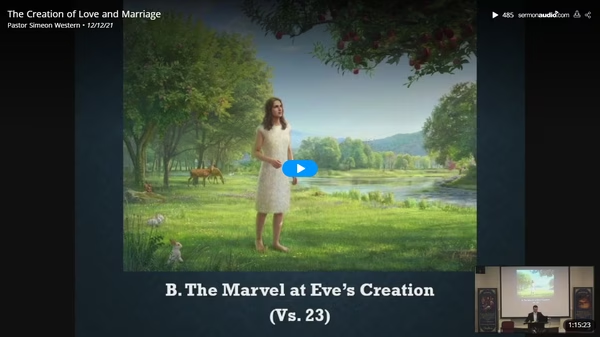
The Marvel at Eve’s Creation (Vs. 23)
- Adam’s reaction to Eve (Vs. 23a). According to Hebrew experts, there is a tone of excitement in the grammatical structure of Adam’s words. Christian marriage is a glorious and marvelous thing!
- Adam’s designation of Eve (Vs. 23b). Again, we see the leadership function of Adam in his naming of Eve. Naming is a function of authority.
- The great poet, Milton, gives a moving description of God’s creation of Eve:
Under His forming hands a creature grew,
Manlike, but different sex, so lovely fair,
That what seem’d fair in all the world, seem’d now
Mean, or in her summ’d up, in her contain’d
And in her looks, which from that time infused
Sweetness into my heart, unfelt before,
And into all things from her air inspired
The spirit of love and amorous delight.
The Character Of Christian Marriage (Vs. 24-25)
A Divine pronouncement over the first couple is made by God Almighty. We know that it was God who spoke these words from the Lord Jesus’ reference to them when responding to the divorce question. “And he answered and said unto them, Have ye not read, that he which made them
at the beginning made them male and female, And said, For this cause shall a man leave father and mother, and shall cleave to his wife: and they twain shall be one flesh? Wherefore they are no more twain, but one flesh. What therefore God hath joined together, let not man put asunder.” (Matt. 19:4-6) This Divine Utterance forms the bedrock of Christian marriage and is quoted by both Christ and the Apostles in the New Testament. There are some key pillars to marriage in the Divine declaration. There is:
A Separation – ‘leave’ (Vs. 24a)
- God’s design is that marriage establish a new family unit under the leadership of the husband. There is no set rule in the Scriptures as to the ideal age for marriage but what is clearly implied is that a couple needs to be of sufficient maturity to be able to stand independently on their own.
- There is an adjustment that takes place in the child-parent relationship when one is married. While honouring one’s parents is a lifelong duty, a child is no longer under their parents’ authority once they are married. They have the liberty to make their own decisions before the Lord as a separate family unit. Parents may offer council to their married children but it should always be remembered that it is council and not commands. A couple is not under any obligation to submit to their parents’ wishes once they are married. Beware of the “interferer in law” model that sometimes damages good marriages.
A Consummation – ‘cleave’ (Vs. 24b-25)
- The principle of a ceremony and a covenant (vows) preceding the consummation of the marriage bed is also established in the Scriptures. A physical relationship alone does not constitute marriage otherwise there would be no such thing as fornication and adultery.
- The principle of a formal ceremony is found right here in Genesis. We have God bringing the man and woman together and the making a formal pronouncement over the couple.
- The principle of a covenant is also found in the Scriptures. According to Malachi 2:14, a wife is a man’s ‘companion’ and “the wife of his covenant”. According to Proverbs 2:17, the strange woman has forgotten “the covenant of her God”.
- God’s intent is that the marriage be consummated in the one flesh union of the newly married husband and wife. This is the ONLY appropriate context for intimacy between a man and a woman. The word ‘cleave’ means “to stick like glue”. In fact, this is the word from which the modern Hebrew word for glue is derived.6 Sexual intercourse was created and ordained by God for the marriage union before the fall and fell under the banner of the all- encompassing endorsement of the Almighty – “behold, it was very good” (1:31).
- The Mathematics of Marriage is 1 + 1 = 1. This refutes the unscriptural marriage models often seen such as:
- The suppression model which looks something like this: 1 (Husband) + 1 (Wife) = 1. This often the case in pagan and non- Christian cultures. Marriage under early Roman law conformed to this model. C.L. Brace, in his book Gesta Christi, writes; “As a wife, the husband had, under old Roman law, power of life and death over her, and absolute control of her property. When she passed in manum – into the power – of her husband, she became not his equal, but his adopted daughter or ward. The law considered her as a sister of her own children; all her property became that of her husband; all her earnings were his. Like children and slaves, she was not, while in manu, a person in her own right.”
- The Partition model which looks something like this: 1 [] 1 = 1. In this model of marriage there is a great degree of separation between the parties. She has her friends, he has his friends, she has her bank account and he has his bank account. There is only a very shallow interface between them, and multiple divorces and break-ups are the result. This was the model of later Roman times as C.L. Brace again notes, “But side by side with the ancient marriage, sprang up another form, of ‘Free marriage,’ – a re-action from the former and in the interest of the woman, as that had been entirely in favour of the man Under it the children were submitted to the ‘paternal power,’ and the woman lived with her husband, but she possessed her own property, worshipped her own gods, and was still connected with her own family. There was, under this form, entire separation of property between husband and wife, and they could even bring a civil action against one another in the courts. The ‘Free marriage’ naturally gave rise to the utmost freedom of divorce. Separation could be legally caused by either party, by a desire to divorce expressed in writing Women made use of this even more than men Seneca speaks of ‘ quotidiana repudia,’ daily divorces, and in another well-known passage, of the illustrious and noble-born women who reckon their years not by the number of the consuls, but by that of their husbands. Even the calm philosophers, like Seneca, felt the deep depravity of the time. Woman he stigmatizes as a foolish, wild creature, unable to control her lusts.”7
A Summation
Let’s consider a summary of what we learn about marriage from the Genesis account.
- Marriage was instituted and designed by God. It is not man’s institution to tamper with and adjust according to his sinful whims.
- Marriage involves a distinction in roles for husband and wife.
- Marriage is the coming together of two distinct genders – a male and a female.
- Marriage is monogamous, the coming together of one man and one woman. This rules out polygamy and polyandry.
- Marriage involves the establishment of a new, separate family unit.
- Marriage includes the making of a covenant together before God.
- Marriage is the consummation of two (the husband and wife) into one unit.
- Marriage was designed by God to be permanent, severable only by death.
A Refutation
the truth of marriage in the Word of God exposes the perversions of man in this area. Luther wrote, “It is God’s order and institution that a man and woman should unite (in marriage) in a proper way, which Moses here indicates by saying that the Lord God, that is, God the Father, Son and Holy Ghost, brought the woman to the man. Let us therefore learn from these words to defend marriage against the wicked blasphemies of those who revile it.”
- The Perversion of Immorality (1 Cor. 6:9, 13-20; Eph. 5:3; Col. 3:5; 1 Thess. 4:3)
- Fornication. This is still a sin in God’s eyes, despite the searing of the conscience of millions through sexualized media. Even the Pope in a recent interview went softly on this sin.8
- Incest.
- Prostitution. Intimacy is a sacred thing that is to be given freely within the context of a loving marriage bond. It is not something to be bought and sold.
- The Perversion of Pornography (Matt. 5:27-28). This sin falls under the category of fornication as the word pornography is derived from the Greek word ‘porneia’.
- The Perversion of Polygamy. While there are cases of polygamy recorded in the Scriptures, they were never blessed of God. The accounts themselves bear testament to the fact this was not God’s design for marriage. Heartache and strife characterized the polygamous unions in the Bible.
- The Perversion of Adultery (Ex. 20:14).
- The Perversion of Sodomy (Lev. 18:22; 1 Cor. 6:9).
- The Perversion of Transgenderism.
- The Perversion of Bestiality (Lev. 18:23).
Conclusion
To the married: Make sure you fight for your marriage and stay true to God’s model for it. Have you embraced the Biblical roles for husband and wife in your marriage or is your mind still full of unbiblical ideas and philosophies?
To the single: Resolve to wait on God and do things His way in relation to a spouse. Seek God’s choice for you. If marriage evades you, use your single state to serve God passionately. Focus on your relationship to your heavenly husband, Christ.
References
- J Sarfati, The Genesis Account, Creation Book Publishers 2015, p. 327.
- H.C. Leupold, Exposition of Genesis, p. 130.
- Ibid, p. 322.
- Ibid, p. 328.
- M.R. DeHaan, Portraits of Christ in Genesis, Zondervan Michigan, 1966, p. 33.
- Sarfati, p.
- C.L. Brace, Gesta Christi, Hodder & Stoughton London, p. 20-24
- The Australian Newspaper, https://www.theaustralian.com.au/world/the-times/vatican-city-dont-sweat- about-sins-of-the-flesh-says-pope/news-story/1ffb49e80e871794dd095bbe0132c23d – Viewed 10.12.21.