
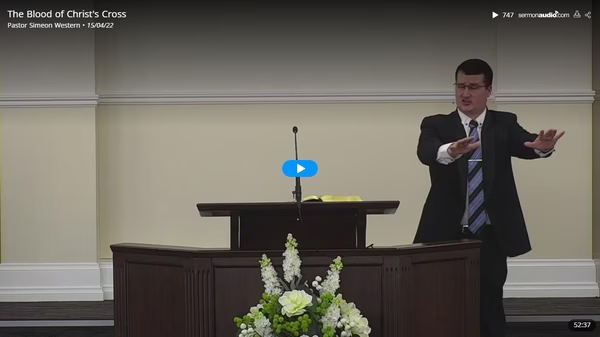
In this Easter message we will consider the preciousness of Christ’s blood and what it accomplished for guilty sinners.
The blood of Christ secured at least 7 salvation blessings for those who will repent and receive Christ as Saviour:
The blood of His Cross secured our…
Reconcilation (Col. 1:20-21)
The Person of our Reconciliation (Vs. 15)
The reason what Christ did on the cross has infinite value is because of who Christ is.
- Jesus Christ is the Revealer (Vs. 15a) 1 Timothy 3:16 “And without controversy great is the mystery of godliness: God was manifest in the flesh…” Jesus Christ is God! God in the flesh hung on the cross and died for our sins.
- Jesus Christ it the Creator (Vs. 15b-19)
- Creator of the Cosmos (Vs. 15b-16)
- Creator of the Church (Vs. 18-19)
- Jesus Christ is the Sustainer (Vs. 17) Hebrews 1:3 “Who being the brightness of his glory, and the express image of his person, and upholding all things by the word of his power, when he had by himself purged our sins, sat down on the right hand of the Majesty on high;”
The Price of our Reconciliation (Vs. 20a)
- The sufferings of the cross – “the blood of his cross”.
- The shedding of blood – “the blood of his cross”. Christ’s blood was shed when he was scourged, crucified and speared.
The Peace of our Reconciliation (Vs. 20)
- The word ‘peace’ means “to bind together”. Wuest comments, “Our Lord by His death on the Cross bound together again a Holy God and sinful man who placed his faith in the Saviour.”
- Why do we need peace with God? Because in our sin we are in a state of hostility towards God as described in verse 21.
The Past before our Reconciliation (Vs. 21)
This verse describes each and every one of us before we come to know Christ. Before salvation we are all:
- Estranged from God (Vs. 21a)
- The word ‘alienated’ means “cut off, separated, a foreigner or stranger”.
- “…without Christ…without God in the world.” (Eph 2:12)
- Enemies towards God (Vs. 21b)
- ‘enemies’ = hostile, hateful.
- ‘mind’ = the rational faculty, the heart, seat of moral judgment.
- Psalm 10:4 “The wicked, through the pride of his countenance, will not seek after God: God is not in all his thoughts.”
- For a sinner to be saved, he must repent. Repentance involves a radical change of mind! Isaiah 55:6-8 “Seek ye the LORD while he may be found, call ye upon him while he is near: Let the wicked forsake his way, and the unrighteous man his thoughts: and let him return unto the LORD, and he will have mercy upon him; and to our God, for he will abundantly pardon. For my thoughts are not your thoughts, neither are your ways my ways, saith the LORD.”
- Evil before God (Vs. 21c)
- “wicked works” = sinful practice.
- We are all sinners by nature and practice (Rom. 3:10, 23).
The Performance of our Reconciliation (Vs. 21c)
- The word ‘yet’ is a precious word and speaks of God’s intervention on the sinner’s behalf.
- Ephesians 2:1-9 – “And you hath he quickened…” Listen for the “But God”!
The blood of His Cross secured our…
Remission (Eph. 1:7; Col. 1:14)
The Condition requiring Forgiveness – “the forgiveness of sins”
- The same word translated ‘forgiveness’ in these verses is also frequently translated ‘remission’. Here’s a few examples.
- Luke 24:47 Jesus said, “And that repentance and remission of sins should be preached in his name among all nations, beginning at Jerusalem.”
- Acts 10:43 “To him give all the prophets witness, that through his name whosoever believeth in him shall receive remission of sins.”
- Rom. 3:25 “Whom God hath set forth to be a propitiation through faith in his blood, to declare his righteousness for the remission of sins that are past, through the forbearance of God;”
- We need forgiveness because we have sinned against God.
The Provision of Forgiveness – “the forgiveness of sins”
- The word ‘forgiveness’ comes from the Greek word ‘aphesis’ and means to send or carry away. “In classical literature the word was used to describe the cancellation or release from a legal charge, financial obligation, or punishment. The basis meaning is ‘release’. In the New Testament it refers to the permanent cancellation of or release from the punishment for sin because it has been paid for by Christ’s sacrifice.” (Hoehner)
- Illustration: The scape goat (goat of departure) in the O.T. Leviticus 16:21-22 “And Aaron shall lay both his hands upon the head of the live goat, and confess over him all the iniquities of the children of Israel, and all their transgressions in all their sins, putting them upon the head of the goat, and shall send him away by the hand of a fit man into the wilderness: And the goat shall bear upon him all their iniquities unto a land not inhabited: and he shall let go the goat in the wilderness.”
- “As far as the east is from the west, so far hath he removed our transgressions from us.” Psalm 103:12
- John 1:29 “The next day John seeth Jesus coming unto him, and saith, Behold the Lamb of God, which taketh away the sin of the world.”
The blood of His Cross secured our…
Redemption (1 Pet. 1:18-19)
See also Eph. 1:7; Col. 1:14; Heb. 9:12; Rev. 5:9.
Our Past before Redemption (what we are redeemed from) (Vs. 18)
Without Christ, all we have are:
Empty Lives – “vain conversation”
- ‘vain’ = empty, fruitless. “Trying to do something, trying to attain to something but always failing.” (J. Thackway) Like someone chasing a rainbow. They feel they get close but can never reach it.
- ‘conversation’ = our manner of life.
- “The whole course of a man’s life out of Christ is nothing but a continual trading in vanity, reaping no benefit of all.” (Robert Layton)
Erroneous Traditions – “received by tradition from your fathers”
- ‘tradition’ = something inherited, handed down. E.g., oral traditions, religious traditions.
- Context: It seems Peter has a Jewish audience in mind but this would apply to both Jewish religion (e.g., the Pharisees’ sect) or Gentile religion (pagan worship).
- What you need is not the traditions of religion but the truth of Christ’s Person (John 14:6; Acts 4:12).
Enslaved Existences – ‘redeemed’
(bought back from slavery) Redemption is the picture of a slave being set free. Without Christ, we are in bondage to:
- Sin’s slavery: John 8:34 “Jesus answered them, Verily, verily, I say unto you, Whosoever committeth sin is the servant of sin.” The world promotes the idea that to be truly free you just need to follow your sinful desires. The opposite is true. Sin brings bondage.
- Satan’s tyranny: Without Christ we are all:
- Dominated by Satan’s spirit: “Wherein in time past ye walked according to the course of this world, according to the prince of the power of the air, the spirit that now worketh in the children of disobedience.” Eph. 2:1
- Blinded by Satan’s deceit: “In whom the god of this world hath blinded the minds of them which believe not, lest the glorious gospel of Christ, who is the image of God, should sine unto them.” 2 Cor. 4:4
- Imprisoned in Satan’s darkness: “Who hath delivered us from the power of darkness…” (Col. 1:13) The word ‘power’ contains the idea of authority and mastery. Acts 26:18 “To open their eyes, and to turn them from darkness to light, and from the power of Satan unto God, that they may receive forgiveness of sins, and inheritance among them which are sanctified by faith that is in me.”
The Price of our Redemption (what we are redeemed by) (Vs. 19)
- Precious blood – “precious blood”. The word ‘precious’ has a two- fold meaning. It means ‘costly’ in the sense of value, and “highly esteemed or held in honour.” The blood of Christ is costly, essentially and intrinsically precious because it is God’s blood (Acts 20:28), for Deity became incarnate in humanity. (Wuest)
- Powerful blood – ‘redeemed’. The word means to set someone free by the payment of a ransom. In the ancient world, the word was used to describe the ransoming of prisoners of war and the manumission (liberation/emancipation) of slaves.” (Hiebert) Christ paid the price sufficient for our freedom, delivered us from the slave market of sin and set us free!
- John 8:36 “If the Son therefore shall make you free, ye shall be free indeed.”
- Acts 20:28 “Take heed therefore unto yourselves, and to all the flock, over the which the Holy Ghost hath made you overseers, to feed the church of God, which he hath purchased with his own blood.”
- Perfect blood – “as of a Lamb without blemish and without spot”. The Sinless Nature of Christ guarantees the sinlessness of His blood. “…in him is no sin.” (1 Jn. 3:5)
The blood of His Cross secured our…
Restoration (Eph. 2:12-13)
Key phrases – “were far off”, “made nigh”. Christ’s blood made it possible for us to be rescued from our lost estate and brought back to God.
The Distance of the Sinner before Salvation – “far off” (Vs. 12)
We could summarize the existence of the lost without Christ in one word – ‘without’. The lost are destitute of 5 blessings/privileges…
- Without Christ – “without Christ” (Vs. 12a). To have Christ is to have true life (John 10:10).
- Without the Commonwealth – “aliens from the commonwealth of Israel” (Vs. 12b) The word ‘alien’ means “foreign; not belonging to the same country, land or government.” (Webster) We were outside of the privileges of Israel.
- Without Covenants – “strangers from the covenants of promise” (Vs. 12c) The word ‘strangers’ means “one who is not a member of a state or city, foreign to a thing, having no share in it.” (Expositors) The ‘covenants’ are likely a reference to the unconditional covenants such as the Abrahamic, Davidic and New covenants. God’s covenant to Abraham in Gen. 12:1-3 did have the blessing of the Gentiles in view (“in thee shall all the families of the earth be blessed”) but God had not made a covenant with the Gentiles directly.
- Without Confidence – “having no hope” (Vs. 12d) The word has the sense of “utterly without hope”. Before salvation they had no hope – no hope in this life and no hope of eternal life.
- Without the Creator – “without God in the world” (Vs. 12e). They had many false gods and goddesses (e.g., the goddess Diana) but they did not know the One True God and Creator of all.
The Drawing of the Sinner in Salvation – “made nigh” (Vs. 13)
- Our sins separated us from God and kept us “far off” from Him. The cleansing of His blood made it possible for us to be drawn near.
- Jesus said, “For the Son of man is come to seek and to save that which was lost.” (Luke 19:10)
- 1 Peter 3:18 “For Christ also hath once suffered for sins, the just for the unjust, that he might bring us to God…”
The blood of His Cross secured our…
Justification (Romans 5:8-9)
The Death for our Justification (Vs. 8)
- The word ‘commendeth’ contains two concepts. It means to prove or demonstrate and also to recommend.
- McLaren: “A significant word employed in 2 ways in the N.T. It sometimes means to establish, or to prove, or to make certain. But ‘prove’ is a cold word, and the expression also means to recommend, to set forth in such a way as to appeal to the heart, and God does both in that great act. He established the fact, and He, as it were, sweeps it into a man’s heart, on the bosom of that full tide of self-sacrifice.”
The Definition of Justification (Vs. 9a)
- The word ‘justification’ means one is declared righteous, clean, acceptable. The words righteous, righteousness and justified are all closely related. They all relate to the simple concept of ‘right’. The word ‘justified’ here continues the theme of God’s righteousness. In being justified, we are being provided the very righteousness of God Himself. (Sorenson)
- It is interesting to trace the theme of justification in the Book of Romans. We are justified by grace (Rom. 3:24); justified by faith (Rom. 5:1) and justified by Christ’s blood (Rom. 5:9). Grace is the source of my justification. Faith points to the medium through which justification is received. Christ’s blood points to the price that was paid at the cross for my justification. God can declare me righteous on the basis of the fact the debt of my sin has been paid by the shedding of Christ’s blood.
The Deliverance of our Justification (Vs. 9b)
- ‘saved’ = means to deliver, rescue. Being justified by the blood means I am delivered from God’s righteous wrath.
- If you refuse Christ’s blood as the payment for your sin, the wrath of hell fire awaits. No amount of good works or religion can ever pay the penalty of your sin. Only the blood of Christ (See Eph. 2:8-9).
- Illustration: Passover – “when I see the blood, I will pass over you” (Ex. 12:13)
The blood of His Cross secured our…
Propitiation (Rom. 3:25)
Propitiation Defined
- Propitiation contains the idea of appeasement. Webster defines the word as meaning, “the act of appeasing wrath and conciliating the favor of an offended person. In theology, the atonement or atoning sacrifice offered to God to assuage His wrath and render him propitious to sinners.” The root word is translated ‘merciful’ in Luke 18:13 where the guilty publican in the temple pleads with God to “be merciful” towards him as “a sinner”. Because of Christ’s death on the cross, the just demands of the Father have been ‘satisfied’ and on that basis, God can show the guilty sinner mercy. Isaiah 53:11 “He shall see of the travail of his soul, and shall be satisfied:” Vine writes, “Through the propitiatory sacrifice of Christ, he who believes upon Him is by God’s own act delivered from justly deserved wrath, and comes under the covenant of grace.”
- Propitiation contains the idea of atonement. An atonement is a covering and the blood of Christ provides a perfect covering for our sin.
- Touchingly, in Romans 3:25 Christ Himself is said to be our ‘propitiation’. “The phrase ‘by His blood’ is to be taken in immediate connection with ‘propitiation’. Christ, through His expiatory death, is the Personal means by whom God shows the mercy of His justifying grace to the sinner who believes.” (Vine)
- Christ has provided propitiation for the sins of the whole world. 1 John 2:2 “And he is the propitiation for our sins: and not for ours only, but also for the sins of the whole world.”
- 1 John 4:10 “Herein is love, not that we loved God, but that he loved us, and sent his Son to be the propitiation for our sins.”
Propitiation Illustrated
- The same word ‘propitiation’ is translated ‘mercyseat’ in Hebrews 9:5. This provides a wonderful picture to help us understand the word. The mercyseat was the lid/covering on the top of the Ark of the Covenant in the Jewish temple.
- It was upon the mercyseat that the high priest sprinkled the blood once a year to atone for the sins of the people on the Day of Atonement (See Lev. 16). The tables of the law were stored inside the Ark of the Covenant, under the mercy seat. The mercy seat perfectly covered the law which was contained in the Ark (Ex. 25:17, 21). This symbolizes propitiation – Christ covering the demands of God’s law with His precious, sinless blood.
- The two goats on the Day of Atonement picture the two aspects of propitiation. The blood of the first goat atones for sin at the mercy seat. The second goat typifies the result of the blood payment; sins are removed forever. Psalm 103:12 “As far as the east is from the west, so far hath he removed our transgressions from us.”
The blood of His Cross secured our…
Purification (Rev. 1:5)
The blood of Christ is the cleansing agent for the sinner and the saint. There is:
The Washing of Salvation (Rev. 1:5; 7:14)
- Salvation is described as a washing. We need washing as we are defiled and unclean with sin (Isaiah 64:6; Rom. 3:10, 23).
- The word ‘washed’ comes from Greek word ◻◻◻◻ (louo) which means “to bathe the whole person.” The washing of salvation is a onetime event when I am made totally clean from all my sin. From that point on I am a child of God. I then need the daily washing for sanctification, fellowship and service.
The Washing of Sanctification (1 John 1:7)
- We need the washing of salvation (a onetime event) and then daily washing for sanctification, fellowship and service.
- Illustration: The washing of the Levites
- First washing was all over (Lev. 8:6).
- Thereafter the hands and feet were to be washed in the laver before entering the tabernacle for service (Ex. 30:18-19).
Conclusion
All of these salvation blessings and many more are offered freely to all who will repent (turn) from their sin and in faith receive God’s offer of salvation. Will you receive Christ as your Saviour right now?
Sermon Audio Id: 41422546316637