

Study of the Altar of Incense and how it typifies the ministry of intercession – Christ’s intercession on our behalf and our ministry of intercession through Christ as our Mediator.
This chapter: The altar of incense, atonement money, laver, anointing oil and incense.
The timing of the Revelation of the Altar of Incense is instructive when considering the flow of the Biblical text. It comes after the great consecration chapters (28-29). For there to be communion with God (pictured in the golden altar of incense), there must be a High Priest and a sacrifice.
Note that there were two altars in the tabernacle – the brazen altar of sacrifice and the golden altar of incense. Both have an important relationship to each other, as the coals of fire for the altar of incense were taken from the altar of sacrifice. Blood would be applied to the Golden Altar once a year on the Day of Atonement.
“Sweet incense was offered upon the Golden altar daily by the high priest (vss. 7,8). In the brazen altar, we have a type of Christ meeting the need of the sinner (Exod. 27:1-8). In the golden altar, we have a type of Christ meeting the need of the believer, in prayer, worship and service. It typifies Christ as High Priest and Advocate.” (Typical Truth in the Tabernacle)
“At the Brazen Altar Christ died for us, shed His blood, and reconciled us to God. At the Golden Altar, He lives in heaven to intercede for those for whom He has already died and who are saved. The Brazen Altar tells us of His death on the cross. The Golden Altar tells us of His resurrection, His ascension, and His Priestly intercession.”
“The golden altar sets forth the work of Christ as priest after his death. The brazen altar outside the sanctuary speaks of the cross, and the golden altar inside the sanctuary speaks of a work continued after death.” (Weaver)
The Altar of Incense symbolises the ministry of intercession.
- Christ’s ministry of intercession for us.
- Our ministry of intercession through Christ. In ourselves, our prayers are not acceptable, but in Christ, they are perfectly acceptable.
In this message and the next, we will consider 9 points about the Altar of Incense:
The Purpose of the Altar (Vs. 1)
The purpose of the altar was “to burn incense”.
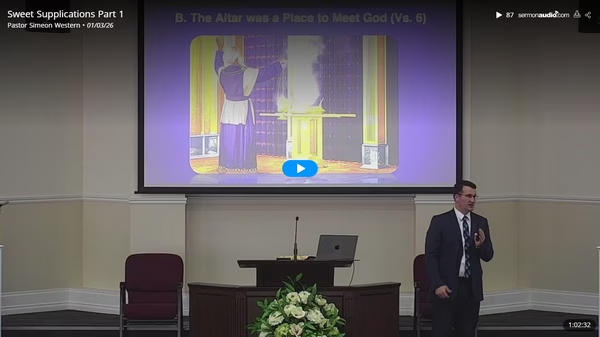
The Altar was a Place to Seek God (speak to God) (Vs. 1)
- The Incense is symbolic of intercessory prayer
- Christ’s intercession for us
- Heb. 7:25 “Wherefore he is able also to save them to the uttermost that come unto God by him, seeing he ever liveth to make intercession for them.”
- What a marvellous thought! Jesus is praying for you!
- Our intercession through Christ
- Psalm 141:2 “Let my prayer be set forth before thee as incense; and the lifting up of my hands as the evening sacrifice.”
- Rev 5:8 “And when he had taken the book, the four beasts and four and twenty elders fell down before the Lamb, having every one of them harps, and golden vials full of odours, which are the prayers of saints.”
- Rev 8:4 “And the smoke of the incense, which came with the prayers of the saints, ascended up before God out of the angel’s hand.”
- Christ’s intercession for us
- The Incense had to be made up of the right ingredients (Vs. 34-38) If our prayers are to be a sweet smell to our God, they need to contain the right ingredients, such as:
- Faith (Matt. 21:22; Heb. 11:6)
- Submission to God’s Will – “thy will be done in earth as in heaven” (Matt. 6:10, Lk. 11:2); “if we ask anything according to his will he heareth us” (1 Jn. 5:14)
- Persistence (Col. 4:2; Lk. 11:8, 18:1)
- Reverence
- Praying to the Father in Jesus Name with the help of the Holy Spirit.
- The incense ascended by the flames of the altar – note the phrase “burn incense” (Vs. 1, 7, 8)
- The incense ascended by flame towards heaven. There needs to be some fire and fervency in our praying! Cold, heartless prayers drop to the floor. Passionate praying ascends to the throne of God in heaven.
- “…The effectual fervent prayer of a righteous man availeth much” (James 5:16). The word ‘fervent’ has the sense of energised. The Holy Spirit is the One who energises our praying (Rom. 8:26, Jude 1:20)
- E.M. Bounds: “No erudition (knowledge, education), no purity of diction, no width of mental outlook, no flowers of eloquence, no grace of person can atone for lack of fire. Prayer ascends by fire. Flame gives prayer access as well as wings, acceptance as well as energy. There is no incense without fire; no prayer without flame.”
The Altar was a Place to Meet God (hear from God) (Vs. 6)
- In prayer, there is a real meeting in the spiritual realm between the believer and God.
- “The Lord is nigh unto all them that call upon him, to all that call upon him in truth” (Psalm 145:18).
- Heb. 4:16 “Let us therefore come boldly unto the throne of grace, that we may obtain mercy, and find grace to help in time of need.”
- Jas 4:8 “Draw nigh to God, and he will draw nigh to you. Cleanse your hands, ye sinners; and purify your hearts, ye double minded.”
The Proportions of the Altar (Vs. 2)
The Horizontal Measurements (Vs. 2a)
- The altar was 1 cubit by 1 cubit, making it a square shape (“foursquare”).
- The symmetry of the Altar speaks of the perfect balance and proportionality of our Lord’s intercession.
The Vertical Measurement (Vs. 2b)
- It was 2 cubits in height, making it the highest piece of furniture within the Tabernacle proper, surpassed only by the Brazen altar on the outside by a cubit (3 cubits).
- Prayer is the highest act of spiritual service we can offer as priests. Prayer lifts us up into fellowship with God in heaven.
- “The height of the golden altar speaks of the exalted character of prayer. The Christian’s highest act is that of prayer. No one can rise to greater heights than when he is on his knees. Prayer brings the believer up to the very throne of God.” (Weaver)
The Projections of the Altar (Vs. 2b-3)
The Altar of Incense had four horns and a gold moulding/border in a crown pattern around the edge.
The Horns of the Altar (Vs. 2b)
- The horns symbolise the strength/power of Christ’s intercession.
- They “represent Christ as having all authority in heaven and in earth (Mt. 28:18). Horns represent power (Ps. 75:4-5; 89:24; 91:10; 112:9). When Christ prays for His people, His prayers have divine authority!” (D. Cloud)
- His prayers are so powerful that they guarantee our eternal security. Heb 7:25 “Wherefore he is able also to save them to the uttermost that come unto God by him, seeing he ever liveth to make intercession for them.” We studied previously how the high priest’s breastplate and shoulder pieces beautifully portray the believer’s security in Christ. He carries us upon His shoulders and upon His heart before the presence of the Father.
- Baptist preacher I.M. Haldeman writes, “Again and again when the believer is on the edge where it seems the next step would make him slip, plunge and fall into the black abyss of unbelief, there comes as directly out of Heaven itself a touch of power that repudiates even the thought of doubt or question and gives him a vigor of faith such as he never dreamed ever could be his. Yonder at the throne, He has seen our special need and prayed for us.”
- The horns symbolise the scope of Christ’s intercession. Some have pointed out that the four horns pointed out in the direction of the four Israelite encampments around the tabernacle (see diagram) and thus speak of the scope of our Lord’s intercession. Each one of God’s children are the object of His High Priestly prayers. None are excluded! Think of how much of a challenge it is for you to consistently pray for your family and those you know personally. The Son of God prays for millions!
- The horns covered in gold remind us of the sacredness of Christ’s intercession. His prayers are the prayers of Deity, the prayers of the Son of God.
- The horns remind us practically of the power of prayer in our own lives as New Testament priests. Prayer moves the heart and hand of God on our behalf. Abraham prayed, and the day of doom for Sodom and Gomorrah was postponed. Joshua prayed, and the sun stood still. Elijah prayed and fire fell from heaven. Hezekiah prayed, and fifteen years were added to his life. Daniel prayed, and the lions lost their appetite. The early Church prayed, and Peter got out of jail.
The Crown of the Altar (Vs. 3)
- As discussed before, the crown speaks of Christ’s Deity. He is the King of kings and the Lord of lords. The crown on the altar of incense points to the royalty, dignity and divinity of our Lord’s intercession.
- The crown border served the practical function of keeping the coals of the altar from falling off. Our prayers need to be kept within the borders the Bible sets for them. Prayer needs to be in accordance with Christ’s will as revealed in Scripture (1 Jn. 5:14-15).
The Poles of the Altar (Vs. 4-5)
The Rings (Vs. 4)
- Four rings were to be made for the rods. They were to be located beneath the crown border/moulding.
- A ring is a circle that has no start or end point. Christ’s intercession is eternal and enduring.
The Rods (Vs. 5)
- Two staves (poles) were to be made out of shittim wood and overlaid with gold.
- The purpose of the rings and poles was so that the altar of incense could be carried by the priests when they moved from place to place.
The Representation
- The rings and rods speak of the provision of prayer – God’s people can always pray wherever they are. 1 Thess. 5:17 “Pray without ceasing.” “
- The Hebrews prayed in Egypt. Moses prayed on a mountain top. David prayed late at night on his bed. Jonah prayed from the depths of the grave. The Syro-Phoenician woman prayed on the street. Zacharias prayed in the temple. The publican prayed outside the temple. The prodigal son prayed in a pigsty. Jesus prayed on a cross. Lydia prayed by the riverside. Peter prayed while trying to walk on water. Paul and Silas prayed in a Philippian jail. John prayed on the Isle of Patmos. Paul said, “I will therefore that men pray everywhere, lifting up holy hands, without wrath and doubting” (1 Timothy 2:8). God’s people ought to be people of prayer.” (Weaver)
- God’s attribute of Omnipresence makes prayer possible literally anywhere and anytime!
- The rings and rods speak of the parameters of prayer. Notice that the rings were fastened below the crown. Our prayers are to always be in submission to our crowned Christ.
The Position of the Altar (Vs. 6)
The Specialness of the Position (Vs. 6a)
- It was “before the vail” and hence in front of the Ark albeit separated by the curtain.
- The altar of incense was the closest you could get to the presence of God in the Old Testament system, apart from the High Priest who entered the Holiest of all once a year on the Day of Atonement.
- Glorious N.T. Truth! There is no longer a veil between us and the presence of God. The veil was rent when Christ died on the cross and cried, “It is finished”. Now we can have boldness to enter the holiest by the blood of Jesus (Heb. 10:19-22).
- It was “before the mercy seat”. We are reminded that our approach to God is always on the basis of His mercy and grace.
- You need to come to the mercy seat once for salvation.
- You need to come to the mercy seat often in supplication.
The Sacredness of the Position (Vs. 6b)
- This was the meeting place between God and man, the place of communion and fellowship. So it is with prayer. In prayer, we meet with God, and He meets with us. In prayer, we speak to God, and in the Bible, God speaks to us.
- Challenge: Do you meet with God regularly in prayer? Do you have a prayer altar in your daily walk?
The Procedure of the Altar (Vs. 7-8)
The Repetition of the Incense (Vs. Vs. 7-8a)
Incense was to be offered in the morning (Vs. 7) and in the evening (Vs. 8) when the priest would tend to the candlestick, teaching us that:
- The need for regularity (persistence) in prayer. We are exhorted in the Bible to:
- Col 4:2 “Continue in prayer, and watch in the same with thanksgiving;
- 1 Thess. 5:17 “Pray without ceasing.”
- The need for daily prayer. Note the “morning” and “evening” principle. Daily devotions are so vital to the Christian life.
- The need for duty and prayer. Prayer needs to be offered in connection with other forms of service. Notice that the incense was to be offered at the time of the dressing and lighting of the lamps. Prayer keeps our lives shining for Christ.
The Description of the Incense (Vs. 7a)
The incense is described as “sweet incense” 8 times in Exodus (See Ex. 25:6, 30:7, 31:11, 35:8, 15, 28; 39:38, 40:27). The ingredients for the incense are called “sweet spices” (Ex. 30:34).
- Prayer is Sweet to God (Psalm 141:2, Rev. 5:8, 8:3-4).
- Christ’s prayers are sweet to God, especially as we offer them in the name of the Lord Jesus. Offered in the name of Jesus Christ, mere human words become sweet beyond description.
- Our prayers are like sweet incense before the throne of God and are used as a part of the worship in heaven. God even uses them in the outworking of His purposes on earth. (Rev. 8:3-5). Illustration: Prayers all over the auditorium on Wednesday nights.
- Prayer is sweet to the Believer. What a privilege it is to pray! What a comfort to the soul it is to pray! Prayer also has a marvellous sweetening effect on the believer’s life. Prayer can have a sweetening effect in a marriage and a home. Prayer has a sweetening effect in the local church. “The offering of prayer to God is the sweetest thing that the believer can give him. The perfumed smoke which rose from the altar was not only sweet to God, it was also sweet to the one who offered it.” (Weaver)
- Illustration: William W. Walford was a blind English preacher of lowly birth. Although he did not have a formal education, people called him ‘the walking Bible’ for his ability to quote Scripture with great precision. Although he was unable to see the beauty of this world, the glories of heaven were opened to him through the privilege of prayer. Spending many sweet hours in the throne room of intercessory prayer, he was moved to pen these words in 1842:
“Sweet hour of prayer, sweet hour of prayer|
That calls me from a world of care,
And bids me at my Father’s throne
Make all my wants and wishes known.
In seasons of distress and grief,
My soul has often found relief,
And oft escaped the tempter’s snare,
By thy return, sweet hour of prayer”
The Representation of the Incense (Vs. 8b)
- Practically, the incense speaks to the believer’s prayer life, as we have discussed.
- Typically, the incense points to Christ’s intercession for us, particularly to its ongoing aspect. It is sweet before the Father and prevails. It is continuous and everlasting. Note that the incense is described as “perpetual incense before the LORD throughout your generations.” Christ ever lives to make intercession for us (Heb. 7:25).
To be continued in Part 2
Conclusion
Do you have a prayer altar in your life? How important is prayer to you in:
- Your personal life.
- Your family life.
- Your church life.
Sermon 52 in Exodus Series
Sermon Audio Id: 22726637401705