

The Christian life rests on three realities drawn from the book of Ephesians: being seated with Christ in heavenly places, walking in a transformed manner of life, and standing firm in spiritual warfare. Each flows from the one before it – the believer’s exalted position in Christ empowers a changed way of living, and that disciplined walk prepares the heart for combat against spiritual enemies. There is real hope here: the same power that raised Christ from the dead is at work in every believer, providing the strength to put off the old nature, put on the new, and stand unshaken with the full armour of God.
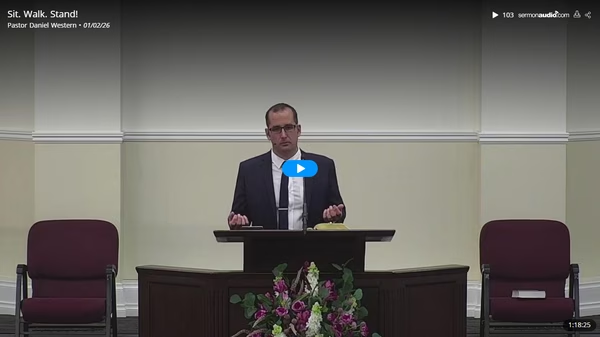
The book of Ephesians reveals three dimensions of the believer’s life, captured in three words: sit, walk, stand. These are not mere metaphors but realities that reshape everything about how a Christian lives, thinks, and engages with the spiritual realm.
The first reality is positional. When God saved the believer, He did not merely forgive sins – He raised the believer up and seated them with Christ in heavenly places. Ephesians 2:4-7 declares that God, who is rich in mercy, has quickened believers together with Christ, raised them up, and made them sit together in heavenly places in Christ Jesus. This is the same power described in Ephesians 1:19-21 – the exceeding greatness of God’s power toward believers, the same power that raised Christ from the dead and set Him at the Father’s right hand, far above all principality and power. The believer has been placed in Christ, and therefore shares in His death, burial, resurrection, and ascension. Romans 6 establishes that the believer died with Christ, was buried with Him, and was raised to new life – not only dealing with sin’s penalty but breaking sin’s power as a ruling force. This position is grasped by faith. It may be difficult to comprehend, but the Word of God declares it, and from this exalted position everything else flows. The believer now has access to the Father through the Holy Spirit, a new relationship, and a new sphere of life.
The second reality is practical. Because the believer is seated with Christ, there must be a new walk – a new manner of living. Ephesians 4:17-32 lays this out with striking directness. The prohibition comes first: believers are no longer to walk as the Gentiles walk, in the vanity of their mind, with darkened understanding, alienated from the life of God, past feeling, given over to uncleanness. This is a description of life without God – vain philosophies, empty thinking, moral blindness. The world’s position that man is inherently good and merely shaped by his environment is the exact opposite of the biblical one: man is inherently sinful because of the fall, and circumstances simply bring out what is already within.
But the believer has not so learned Christ. Christianity is not linked to a creed or code but to a person – Christ Himself. The Holy Spirit, who is the Spirit of Christ, becomes the believer’s teacher, convicting and instructing. And the instruction is twofold: put off the old man, which is corrupt according to deceitful lusts, and put on the new man, which after God is created in righteousness and true holiness. The old nature is still present after salvation, and there is genuine internal conflict between the two natures. But the believer is called to make a choice, empowered by the Spirit, to say no to what is wrong and yes to what is right.
What makes this passage so compelling is how it moves from the theological to the intensely practical. God does not leave the instruction abstract. He gives specific examples of what putting off and putting on looks like in everyday life. Lying must be put away – and this encompasses not just outright falsehood but half-truths, exaggeration, selective reporting, presenting assumptions as facts, and telling truth with the intent to deceive. Believers are members one of another, and dishonesty is destructive to the whole body. Anger must be handled carefully – there may be righteous anger, as the Lord Jesus demonstrated, but it must not be cherished or harboured. The question God asked Jonah is a searching one: “Doest thou well to be angry?” When the sun sets on anger, it has crossed the line, and unresolved anger gives the devil a beachhead – a topos, a place of operations – to wreak havoc in a believer’s life. In families especially, conflict must be addressed promptly rather than allowed to fester.
Stealing must cease – and this extends beyond obvious theft to time sheets, business dealings, tax returns, and taking things that are not rightfully yours, even when offered by someone who has no authority to give them. God provides a legitimate alternative: honest labour, so that the former taker can become a giver. Corrupt communication – rotten, putrefied speech – must be replaced with words that edify and minister grace. This covers swearing, filthy jokes, gossip, backbiting, and the destruction of others’ reputations. The tongue can be used under the Holy Spirit’s power as a building tool rather than a wrecking ball. And the Holy Spirit Himself must not be grieved by the believer living under the old nature.
Bitterness, wrath, anger, clamour, evil speaking, and malice are all to be put away. Bitterness defiles; wrath boils over and scalds everyone nearby; clamour turns homes into shouting matches; evil speaking and slander can tarnish reputations for years through no fault of the one slandered; and malice – anger iced over – waits patiently for revenge. In place of all this: kindness, tenderheartedness, and forgiveness. Forgiveness is not optional for the Christian – it is obligatory. God forgave the believer everything, on account of Christ, and demands the same toward others. This does not mean trust is automatically restored or that consequences disappear, but when someone says they were wrong and asks forgiveness, the believer must give it.
The third reality is warfare. Ephesians 6:10-19 calls the believer to be strong in the Lord and in the power of His might, to put on the whole armour of God, and to stand against the wiles of the devil. The battle is not against flesh and blood but against principalities, powers, and spiritual wickedness in high places. Therefore the weapons must be spiritual: truth, righteousness, the gospel of peace, the shield of faith, the helmet of salvation, the sword of the Spirit which is the Word of God, and prayer. Each piece of armour answers a specific attack – when the devil accuses, the breastplate of righteousness answers that the believer’s righteousness is from Christ. When doubt assails, the shield of faith quenches the fiery darts. When despair whispers, the helmet of salvation declares that nothing can take away what Christ has secured.
The key to this warfare is position. A striking illustration from the Second World War captures it: Chinese forces, lacking tanks to counter the Japanese armour, would use snipers to fire repeatedly at a tank turret until the frustrated driver opened the hatch to look for the source of fire – and was shot. While the driver remained inside the armour, the rounds were harmless. The moment he came out, he was finished. So it is with the believer: while standing with Christ in heavenly places, clothed in God’s armour, the fiery darts of the enemy are quenched. But when frustration or the flesh drives the believer to drop the armour and fight in their own strength, that is when defeat comes.
The Christian life, then, is not merely about trying harder. It begins with understanding a position already secured by God’s power, walks out from that position in practical obedience empowered by the Holy Spirit, and stands firm from that same ground of victory against every spiritual assault. The weapons of the Word of God and prayer are available for both defence and offence – not from a position of weakness, but from a position of victory already won in Christ.
Sermon Audio Id: 2126721267656