

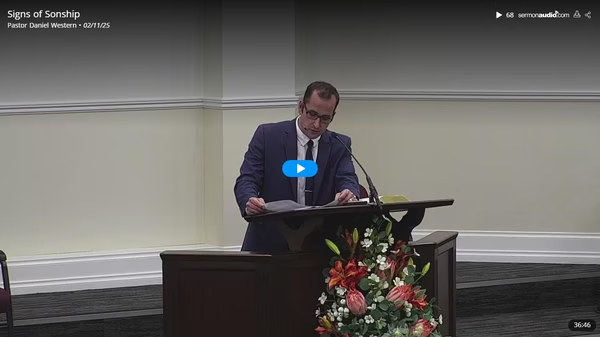
What does it really mean to belong to God’s family? Romans 8:14-17 presents four remarkable evidences that a person truly belongs to Christ – the leading of the Holy Spirit, the spirit of adoption that replaces fear with intimacy, the inner witness of the Spirit, and the promise of a glorious inheritance. These truths are not merely doctrinal points but deeply personal realities that shape how believers relate to God, surrender control, and find assurance of their salvation. Whether you have walked with God for years or are still wrestling with doubt, these signs of sonship offer both searching challenge and rich encouragement.
Romans 8:14-17 sets out four indicators that someone truly belongs to Christ, and each one carries both assurance and challenge for those who profess faith.
The first sign is the leading of the Holy Spirit. “For as many as are led by the Spirit of God, they are the sons of God” (Romans 8:14). Just as children in a family are identifiable by the father they follow, true children of God are marked by the fact that the Spirit of God directs their lives. This is not merely guidance for the big decisions – marriage, career, ministry – but extends into the arena of sanctification. The verses immediately preceding, Romans 8:12-13, speak of mortifying the deeds of the body through the Spirit, and therein lies a major tension for many believers. They desire the blessings and direction of the Spirit for life’s major crossroads, but resist His work in the area of personal holiness. They approach the Word of God like a smorgasbord, selecting the doctrines and commands they find palatable while passing over others – giving, missions, biblical roles, or whatever confronts their autonomy.
The root issue is control. Many want the Holy Spirit’s empowerment but on their own terms – calling on Him to bless their plans rather than surrendering to His reorientation of their desires. As Andrew Murray expressed it, being led by the Spirit begins with surrendering to His work as He convinces of sin and cleanses the soul for His temple. It is as the indwelling Spirit fills, sanctifies, and rules the heart and life that He enlightens and leads. The illustration of a tap that has been shut off is apt: the Spirit is present, but His working is restricted because the believer insists on maintaining control. The resolution is not more effort but less resistance – a willingness to say, “Whatever you want, Lord. If it’s Bible, I’m going to eat it.”
Surrendering to the Spirit’s leading is also, paradoxically, the path to peace. Rather than straining to manufacture outcomes or force one’s own way, the believer can rest in God’s sufficiency and power. The evidence of God opening and closing doors, restraining in some circumstances and prompting in others, all testify to the reality of His leading. William Newell’s words underscore the point: a holy life without a controlled body is an absolute contradiction not to be dreamed of for a moment.
The second sign is the spirit of adoption. “For ye have not received the spirit of bondage again to fear; but ye have received the Spirit of adoption, whereby we cry, Abba, Father” (Romans 8:15). The contrast is striking – not the dread of a slave who fears punishment or execution from a harsh master, but the intimate cry of a child to a father. The Greek word for bondage, douleia, carries the force of slavery, and the word for fear, phobos, means dread or terror. Religion produces fear; the gospel produces freedom and intimacy. The relationship has radically changed from judge to criminal to father to child. “If the Son therefore shall make you free, ye shall be free indeed” (John 8:36).
Believers may still feel condemned or fearful at times, but the Apostle John addresses this directly: “If our heart condemn us, God is greater than our heart, and knoweth all things” (1 John 3:20). The heart of man can condemn, but that condemnation does not define the believer’s standing before God.
The word “Abba” is best understood as something like “daddy” – the cry of a small child for his father. This is the very way the Lord Jesus prayed – “Abba, Father, all things are possible unto thee” (Mark 14:36b) – and at the point of salvation, God places the Spirit of His Son into the believer’s heart. Galatians 4:6 confirms this: “And because ye are sons, God hath sent forth the Spirit of his Son into your hearts, crying, Abba, Father.” The impulse in every true believer to cry out to God as Father is itself evidence of spiritual life. When God brings someone into His family, He infuses the family likeness into them – and Romans 8:29 declares the end goal: to be conformed to the image of His Son, that He might be the firstborn among many brethren. This family likeness expresses itself practically in an affinity with other believers – feeling more at home with the people of God than even with unsaved family members.
The third sign is the witness of the Spirit. “The Spirit itself beareth witness with our spirit, that we are the children of God” (Romans 8:16). The Spirit of God witnesses with – not merely to – the spirits of His children. The Greek word summartureo means to testify in support of someone, and this is the deep, inward work of God in the heart of the believer that brings assurance of salvation. The inner witness of the Holy Spirit has been regarded as one of the greatest evidences of genuine faith. It is the Spirit who gives assurance deep down in someone’s heart. However, this witness can be muted when a believer resists the Spirit’s working by insisting on personal control. When God’s voice seems silent, the Christian may begin to doubt – but the remedy is not to seek louder experiences but to remove the hindrances to the Spirit’s free working. The fruit of the Spirit – love, joy, peace, longsuffering, gentleness, goodness, faith, meekness, temperance – can only be manifest in a life controlled by the Spirit of God.
The fourth sign is the promise of inheritance. “And if children, then heirs; heirs of God, and joint-heirs with Christ; if so be that we suffer with him, that we may be also glorified together” (Romans 8:17). God’s love extends beyond salvation and sonship to the giving of an inheritance. The Lord Jesus promised, “In my Father’s house are many mansions” (John 14:2), and Peter wrote of “an inheritance incorruptible, and undefiled, and that fadeth not away, reserved in heaven for you” (1 Peter 1:4).
The Roman practice of adoption illuminates the weight of this truth. Under Roman law, the adopted person lost all rights in his old family and gained all the rights of a legitimate son in his new family. His old life was completely wiped out – all debts cancelled. He was regarded as a new person entering a new life with which the past had nothing to do. He became heir to his new father’s estate, inalienably co-heir with any existing or future sons. The case of Nero’s adoption by Emperor Claudius illustrates the thoroughness of this legal reality: Nero and Claudius’s daughter Octavia were not blood relatives, yet the Roman Senate had to pass special legislation before they could marry because in law they were brother and sister.
The application is humbling. A believer saved out of a terrible background of sin stands on exactly the same footing as one who grew up in a Christian home and was spared much. There are no tiers in the family of God – no platinum level and bronze level. All are co-heirs together with Christ, sharing the same Father, the same family, the same Holy Spirit, the same Scriptures. God humbles everyone to the same point of need and then brings all into the same salvation – and at the end, God is glorified.
Ephesians 1:13-14 adds the further assurance that the Holy Spirit is the earnest – the deposit or down payment – of the believer’s inheritance, guaranteeing that the full amount will come. Having the Holy Spirit is the pledge that there is much more yet in store.
Life and ministry are busy, and it is easy to become the one in charge rather than asking, “Lord, are you in control?” The call is to begin each day with the prayer, “I want to be led of you today. I want the Holy Spirit to be in control.”
Sermon Audio Id: 1122575129429