

Sardis was a church that had a good reputation but lacked spiritual life and vitality. It presents a powerful challenge to churches that are living off past glory but in reality are devoid of spiritual power.
Consider some facts about Sardis:
- Geographically: Located approx. 45 miles (72 kms) south of Thyatira in the Hermus River Valley. It was considered to be an impenetrable fortress on account of its location. The acropolis was 1,500 feet above the valley floor. The city was twice defeated due to a lack of caution and a failure to watch.
- Economically: Sardis was an important trade center as it lay at the junction of five roads. Like Thyatira, it was famous for its woolen manufacturers and dyeing industry (Swete). Wool was sent for Sardis for processing. The Sardis carpets were so famous they were used by the king of Persia (Cloud). Its wealth also came from its jewelry trade and was the first place were gold and silver coins were first struck. (Walvoord) Much of Sardis’s wealth came from gold taken from the nearby Pactolus River, archaeologists have found hundreds of crucibles, used for refining gold, in the ruins of Sardis. (Lyle)
- Religiously: The city featured magnificent pagan temples, such as the temple of Zeus (Jupiter, Jove), built by Alexander the Great, and the temple of the goddess Artemis. Portions of the 78 great pillars that adorned the latter temple remain today; they were 58 ft (19m) high. The city also had a large Jewish population. The largest ancient synagogue ever discovered was excavated in 1962. (Cloud) We will study Christ’s letter to Sardis under 4 headings
The Person speaking to the Church (Vs. 1a)
Christ reveals Himself as the Possessor of…
The Seven Spirits
- The number ‘seven’ speaks of the perfection of the Spirit.
- The number seven speaks of the manifold ministries of the Spirit (Isaiah 11:2)
- The figure also speaks of the Omniscience of the Spirit (Rev. 5:6)
- Christ is revealed as the one who possesses the totality of the Spirit’s fulness. John 3:34 “For he whom God hath sent speaketh the words of God: for God giveth not the Spirit by measure unto him.”
The Seven Stars
- Christ is the one who “holdeth the seven stars in his right hand” (Rev. 2:1). The ‘stars’ are the angels (messengers/pastors) of the seven churches.
- Picture is of Christ’s authority and sovereignty over the messengers and therefore the churches also.
The Problem in the Church (Vs. 1b)
How alarming that there is no word of commendation! How shocking that a church can be so backslidden that Christ has nothing good to say about it! From the text we can discern at least a three-fold problem with this church:
Deadness (Vs. 1b)
The façade – “a name that thou livest”
- “a name” = Sardis had a reputation before men but it didn’t line up with the reputation it had “before God” (Vs. 2).
- “thou livest” = the church was living in the glory of yesteryear
- “Like the city, the church was existing in the past, so to speak. Its fame and the ministry of its members for Christ in the past were the basis for its present reputation.” (Thomas)
The facts – “art dead”
- The Omniscient eye of the Spirit indwelt Son of God revealed an entirely different picture to that which met the human eye. There is no mention of false doctrine or of persecution. This church was doctrinally sound, materially well off BUT spiritually dead. “The church at Sardis presented to the eye of Christ the paradox of death under the name of life.” (Swete) “Sardis serves as a warning to all ‘great churches’ that are living on past glory…Like the city itself, the church at Sardis gloried in past splendor, but ignored present decay.” (Wiersbe)
- This church had reputation but had lost its reality, it had a profession but no power, doctrine but no dynamic, materials but little movement, form but no fire and programs but little purity. A tide of apathy had swept over this congregation.
- Illustration: The story is told of a little boy who walked out of a church building one Sunday. Out in the porch was an engraved plaque listing all the members of the church who had died in the war. The little boy asked his father, “Daddy what’s that?” His daddy replied, “That’s for the members who died in the service.” To which the little boy asked, “Which service did they die in Daddy? The morning or the evening service?”
- Dr. V. Havner reminds us that spiritual ministries often go through four stages – A Man, A Movement, A Machine and a Monument.
Deterioration (Vs. 2b)
- “that are ready to die” = there were some embers of life left in the church but they were also on the verge of becoming extinct. This church was regressing instead of growing, dying instead of reviving.
- “for I have not found thy works perfect” = ‘perfect’ means fulfilled, brought to completion/maturity.
Defilement (Vs. 4b)
- “a few names…which have not defiled” = only a small remnant in the church was maintaining a pure testimony in an evil city.
- ‘defiled’ means to smear, soil, befoul or pollute and connotes a mingling of pagan practices with a Christian profession, thereby defiling the purity of one’s alleged relationship with Christ (Thomas). Swete: “The reference is doubtless to heathen impurities into which the Sardians had plunged, spiritual deadness having issued in indifference to moral evil.”
- Implies the majority of the church had settled for a peaceful coexistence with an idolatrous culture, hence why there was no persecution.
The Prescription for the Church (Vs. 2-3)
Christ prescribes a 6-fold remedy for this church to experience revival:
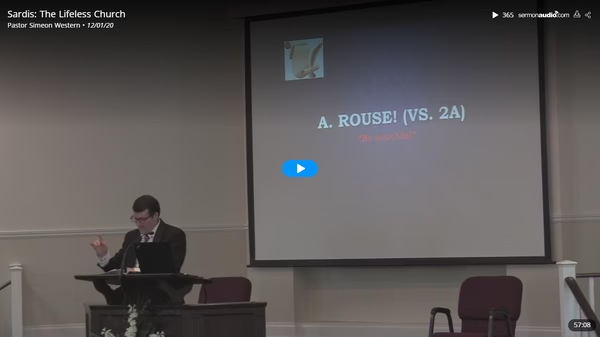
Rouse! (Vs. 2a)
- “Be watchful” = interesting command in light of the history of Sardis. Sardis was considered almost impregnable on account of its natural fortifications. As a result, they left certain areas unwatched. It was in that unguarded area, considered to be a place of strength, that the enemy used to his advantage. The city first fell to the army of the Persian king Cyrus in 549 BC by scaling the cliffs under cover of darkness and then the second time to Antiochus in 218 BC by the same method. “The spiritual history of the Sardis church corresponded to the political history of the city.” (Walvoord)
- “Leave no unguarded place, no weakness of the soul, take every virtue, every grace and fortify the whole.”
- Spiritual vigilance required of each believer
- Romans 13:11-14 “And that, knowing the time…”
- Eph. 5:15 “See then that ye walk circumspectly, not as fools, but as wise,” The word ‘circumspectly’ means “with watchfulness every way; with attention to guard against surprise or danger.” (Webster)
- 1 Peter 5:8 “Be sober, be vigilant; because your adversary the devil, as a roaring lion, walketh about, seeking whom he may devour:” The word ‘vigilant’ literally means “to keep awake, that is watch.” (Strongs)
- God’s Word repeatedly calls on the believer to “be sober” (1 Thess. 5:6, 8; Titus 2:2, 4, 6; 1 Peter 1:13)
- Spiritual vigilance required of church leaders (Acts 20:31; Heb. 13:17; 1 Tim. 3:2)
Reinforce! (Vs. 2b)
- “strengthen the things which remain” = ‘strengthen’ means to establish, make firm, make stable. It carries the sense of “that which survives” (Thomas) “It refers to the basics of the spiritual life such as Bible study, prayer, worship and fellowship. Christ is saying, Get back to the basics!” (Lyle)
- While the church in general was in a state of spiritual deadness, Christ detected some glowing embers that could be fanned into a fresh flame.
Remember! (Vs. 3a)
- They were to remember and thereby return to the basics of the Christian faith they had received. Similar instruction to Ephesus.
- Cloud: “They needed to return to the New Testament faith and practice, the things they had heard from the Apostles…A church that wants to please Christ must go back to the original faith and practice.”
- Phillips: “The dynamic of former years has to become again the norm for today. The demand is for self-examination and self- judgment.”
- Challenge: Very often we need to go back before we can go forward. Back to the Bible, back to prayer, back to the walk of faith, back to the Gospel etc… Christian, think back for a moment. When did things change in your Christian walk?
- Illustration: John Newton, the converted slave trader, had Deut. 15:15 displayed in his study over the mantelpiece – “Thou shalt remember that thou wast a bondman in the land of Egypt, and the Lord thy God redeemed thee.”
Retain! (Vs. 3b)
- “hold fast” = to keep, guard (pres. tense). The command to “hold fast” is given to three churches – Thyatira (Rev. 2:25); Sardis (3:3) and Philadelphia (3:11).
- The command implies that we can let things slip (Heb. 2:1). We are to hold fast to the truth. In its backslidden condition, Sardis was letting the truth slip out of its grasp.
Repent! (Vs. 3c)
- Christ called for “a quick change of thought and behavior. They were to repent of their spiritual lethargy. They were to do an immediate about face.” (Thomas)
- It is not enough to simply acknowledge where I have erred. I must change my thinking and turn around, cooperating with the workings of the Holy Spirit to bring about fruits of repentance. Revival starts with repentance but repentance requires self-abnegation and humility.
Regard! (Vs. 3d)
- “If therefore thou shalt not watch” = Christ now issues a warning to the church to further motivate them to heed His instructions.
- “I will come on thee as a thief” = the Lord would come suddenly and unexpectantly and bring judgment to this disobedient church. Christ’s coming likened to a thief a number of times in Scripture (Matt. 24:43; Lk. 12:39; 1 Thess. 5:2; 2 Pt. 3:10; Rev. 16:15).
- Note: Prophetically, Sardis seems to picture the Reformation period. Reformed theology tends to produce an unwatchful attitude towards Christ’s return due to its Amillennialism and denial of the rapture. In fact, most of Christendom today is largely unwatchful!
The Promise to the Church (Vs. 4-5)
There is a promise to…
The Present Overcomers (Vs. 4)
- “Thou hast a few names” = Christ addresses the faithful, living remnant in this church
- “not defiled their garments” = this remnant of believers was maintaining godly separation from the evil world around them. They had not compromised with the pagan society around them. They were living in a manner consistent with their profession of faith.
- “they shall walk with me in white” = a symbol of purity (Rev. 7:13- 14; 19:8). White garments were worn in the ancient world at weddings and other feasts. (Walvoord) These overcomers in Sardis could look forward to a glorious future in fellowship with Christ in heaven, clothed in heavenly garments.
The Prospective Overcomers (Vs. 5)
There are two blessings promised the overcomers in this verse:
Raiment (Vs. 5a)
- “shall be clothed in white raiment” = symbolic of the imputed righteousness of Christ imputed to the believer by faith (Rom. 3:21-22; Phil. 3:9). “There will be a real garment in the resurrection and its glory cannot now be fathomed.” (Cloud)
- Rev. 19:8 “And to her was granted that she should be arrayed in fine linen, clean and white: for the fine linen is the righteousness of saints.”
- Isaiah 61:10 “I will greatly rejoice in the LORD, my soul shall be joyful in my God; for he hath clothed me with the garments of salvation, he hath covered me with the robe of righteousness, as a bridegroom decketh himself with ornaments, and as a bride adorneth herself with her jewels.”
- Hymn: “Jesus thy blood and righteousness, my beauty are, my glorious dress”
Registration (Vs. 5b)
- “will not blot out his name out of the book of life” = (ou me) double negative in the Greek, meaning “in no way!” These believers will not in any way have their names blotted out. The believer’s salvation is eternally secure, being written there before the foundation of the world according to the foreknowledge of God (Rev. 13:8; 17:8; 1 Peter 1:2).
- Luke 10:20 “Notwithstanding in this rejoice not, that the spirits are subject unto you; but rather rejoice, because your names are written in heaven.”
- This verse pictures the book of life as being under the control of Christ. It is called “the Lamb’s book of life” (Rev. 21:27).
- “but I will confess his name” = Christ will confess our name in heaven before
- The Father
- The Angels
- Matt. 10:32 “Whosoever therefore shall confess me before men, him will I confess also before my Father which is in heaven.” (See also Lk. 12:8)
Conclusion
- Are you born again? Or do you simply have an empty profession of life but in reality, are still dead in trespasses and sins? (Eph. 2:1)
- Are you living in a state of spiritual stagnation, deadness and apathy as a Christian? Will you repent and return today to a vibrant Christian walk? Will you allow God’s Holy Spirit to revive you?
Sermon 9 of 38 in Revelation Series