
The Atonement Money & Brazen Laver

Study of the atonement money (silver half shekels of the sanctuary) and the brass laver. The atonement money teaches a lesson in salvation, the brass laver a lesson in service.
This chapter: The altar of incense, atonement money, laver, anointing oil and incense.
In our last two messages, we studied the altar of incense and how it typified the ministry of intercession – Christ’s ministry of intercession for us and our ministry of intercession through Christ.
In this sermon, we will study the atonement money and the brass laver.
- The silver atonement money pictures Christ’s atonement.
- The laver pictures cleansing for service.
Key words in this passage are: ‘atonement’ (5x), ‘offering’ (3x) and ‘ransom’ (1x). The word “ransom” means to satisfy a debt with a full payment. It means to appease an offended party.
The Atonement Money: Salvation (Vs. 11-16)
The timing of the Revelation is significant. “The work of the priests at the Golden Altar was only available to those who had come to know atonement, and every time that they were to pass before the Lord to be numbered they were reminded of this and the obligation it placed upon them.” The silver half shekel was for the atonement of the “soul” and typifies the atoning blood of Christ (1 Pet. 1:18-19) The silver typifies the redemption/atonement of Christ in at least 10 ways:
- The Necessity of the Atonement – every person needed the ransom – “every man” (Vs. 12). All have sinned (Rom. 3:23) and all need the atoning blood. Without Christ’s atonement, you will be lost forever.
- The Provision of the Atonement – This was all God’s plan. The ransom price was set by God (“after the shekel of the sanctuary,” Ex. 30:13). God provided a way for a sinful people to be brought back into fellowship with Himself. Ultimately, He was the one who provided the means for the half-shekel offering when He gave the Israelites favour in the sight of the Egyptians as they left Egypt (Ex. 11:2). God will accept only the sacrifice of His own holy Son. He will not accept anything that man offers, such as good works and religious deeds and the “sincerity of heart.”
- The Availability of Christ’s Atonement – the half shekel was within reach of all, rich or poor. The amount was only one-half shekel, which was available to every person. Likewise, Jesus “gave himself a ransom for all” (1 Tim. 2:6). None were excluded! Salvation is offered freely to all. It has nothing to do with your background, social or financial status. There is only one way of salvation. He does not save some by one method and others by another. All must come by faith along a blood- sprinkled pathway.
- The Abundance of Christ’s Atonement – the tabernacle was resting on about 4.5 tons worth of silver, speaking of the vastness of Christ’s salvation. “The talent in each socket represented 3,000 shekels of the silver ransom money, which was the amount given by 6,000 men (each giving one-half shekel). (603,550 men gave one-half shekel each for a total of 301,775 shekels, Ex. 28:26. 300,000 shekels represented 100 talents (Ex. 38:27). Since there were two silver sockets under each board, this represented the ransom money for 12,000 men. This points to the multitudes without number who will be redeemed from every nation (Rev. 7:9).” (Cloud) Salvation is abundant, rich and free!
- The Focus of Christ’s Atonement – the atonement was “unto the LORD” Vs. 12, 14, 15). We have offended God by our sin, and it is God who must be propitiated. Christ offered Himself without spot to God (Heb. 9:14).
- The Preciousness of Christ’s Atonement – silver is a precious metal, and Christ’s atonement is infinitely precious. 1 Pet. 1:18-19 “Forasmuch as ye know that ye were not redeemed with corruptible things, as silver and gold, from your vain conversation received by tradition from your fathers; But with the precious blood of Christ, as of a lamb without blemish and without spot:” Christ’s blood is pure and precious!
- The Perfection of Christ’s Atonement – the word ‘atonement’ is mentioned 5 times, offering 3 times and ‘ransom’ 1 time in this section. Christ’s atonement was perfect and sufficient for every sinner.
- The Price of Christ’s Atonement – the ransom money pictures the cost of redemption. What a price our Lord Jesus paid for our atonement. The price He paid was His own precious blood. “For ye are bought with a price…” (1 Cor. 6:20, 7:23)
- The Sureness of Christ’s Atonement –what a solid foundation there was in all that silver!
- Two silver sockets were at the base of each board, for a total of 96 sockets across 48 boards.
- These sockets were made from the half shekels of the sanctuary, the atonement offering required of every Israelite (See Ex. 30:11- 16)
- Each socket weighed one talent (42.6 kg or 94 pounds; see Ex. 38:27). Thus, the entire tabernacle rested on a strong silver foundation.
- Christ is an unshakable foundation for those who put their faith in His atoning work. His atonement is foundational to our whole faith. Everything to do with our relationship to God—service, worship, and fellowship — depends on redemption. “Believe on the Lord Jesus Christ, and thou shalt be saved…” (Acts 16:31)
- The Power of Christ’s atonement – God’s provision of atonement for His people was effectual, powerful and sufficient. Nothing had to be added. Truly, there is power in Christ’s atoning blood. The Blood of Christ:
- Reconciles (Col. 1:20-21)
- Forgives (Eph. 1:7; Col. 1:14)
- Redeems (1 Pet. 1:18-19)
- Saves (Eph. 2:12-13)
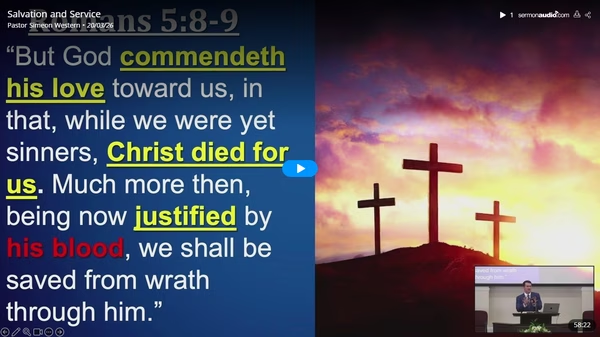
- Justifies (Rom. 5:8-9)
- Atones (Rom. 3:25)
- Cleanses (Rev. 1:5)
The Brass Laver: Service (Vs. 17-21)
The Particulars of the Laver (Vs. 17-18a)
- It was made of brass, specifically the brass looking glasses of the women of the congregation (Ex. 38:8).
- It had a foot/base also constructed of brass.
- No dimensions are given, so we are unclear on the size of this vessel.
The Position of the Laver (Vs. 18b)
- The Laver was positioned between the brazen altar and the tabernacle proper.
- This was because the priests were to wash their hands and feet in the laver before entering the tabernacle proper for service.
The Purpose of the Laver (Vs. 19-21)
- The purpose was “to wash withal”.
- Moses washed Aaron and his sons as a part of their consecration to the priesthood. The laver was used to maintain cleanliness as part of their service.
- The priest was washed entirely in water when he started his ministry, which depicts regeneration (Lev. 8:6). After that, the priest was required to wash his hands and feet before he could enter the tabernacle to serve God (Vs. 19-20).
The Picture of the Laver
Pictures the Purification for Service – There was one bath and many washings. This signifies that sinners must be washed once by the blood of Christ and then cleansed daily by confession and obedience.
- The Members for Cleansing – “their hands and their feet” (Vs. 19, 21)
- Notice that it was particularly the hands and feet that were to be washed (Vs. 19, 21). The hands and feet are easily defiled in daily life, often unintentionally. We need cleansing from both the intentional and unintentional defilements of sin and the world.
- Illustration: You are confronted with an ungodly image. You haven’t sinned, but you sense the defilement and ask for cleansing.
- The Agent of Cleansing – “thou shalt put water therein” (Vs. 18) The water of the laver speaks of daily cleansing for service. As New Testament priests, we need:
- The cleansing of the blood for service (1 Jn. 1:8-9)
- The purification of the Word for service. In the laver we see a symbol of:
- The Reflection the Word provides (2 Cor. 3:18, James 1:22-25). The laver revealed uncleanness. The laver was made of mirrors, and God’s Word is a powerful mirror that shows us our faults, failings and sins so that we might then avail ourselves of the cleansing available in Christ.
- The Rinsing the Word provides (Ps. 119:9, Jn. 15:3, Eph. 5:26). The laver provided cleansing. We need to read the Word, meditate on the Word, memorise the Word and hear the Word. We need to wash in the laver of daily devotions. We need to wash in the laver of faithful preaching (Heb. 10:25).
- The Necessity of Cleansing – “that they die not” (Vs. 20, 21).
- To serve a Holy God with dirty hands and feet as a priest was a very serious matter. In fact, it could cost you your life!
- The lesson is crystal clear. A Holy God required purity in His priests. God’s mind has not changed! “…be ye clean, that bear the vessels of the LORD.” (Is. 52:11)
- God desires service from a clean life! Our personal purity as priests is a priority! We need to wash in the laver of the Word regularly. We need to apply the blood of Christ to our sinful failings and also to the accidental defilements we inevitably encounter as we serve in a sinful world.
Conclusion
- Have you sheltered under Christ’s atonement?
- How often are you washing at the laver of the Word as a N.T. priest?
Sermon 54 in Exodus Series
Sermon Audio Id: 3202674214657