


Exposition of Christ’s letter to the church at Philadelphia. This letter contains one of the clearest verses in the N.T. that teaches a Pre-Tribulation rapture (Rev. 3:10).
Historically Philadelphia was founded by Attalus II in 140 BC. Attalus was called Philadelphos which means brother love and it was after him that Philadelphia was named. Interestingly, the primary purpose for the founding of this city was that it might be a missionary city, spreading the Greek culture and language in the eastern parts of Lydia and Phrygia (Lyle; Thomas). The city was situated in a strategic place on the main route of the Imperial Post from Rome to the East, and thus was called “the gateway to the East” (Wiersbe). To its disadvantage, Philadelphia sat on a geological fault and was destroyed in 17 B.C. by a severe earthquake. After this earthquake, some of the citizens chose to remain in the surrounding countryside rather than move back into the city that was beset for some years with aftershocks.
Geographically Philadelphia is located about 40 miles (64km) southeast of Sardis and about 150 miles (240km) due east of Ephesus. The modern Turkish city of Alasehir is built over the top of ancient Philadelphia so there are fewer archeological discoveries that have been made.
Spiritually Philadelphia was famous for its wine and associated drunkenness and debauchery. The city’s coins featured an image of Bacchus, the god of wine and immorality. Rev. 3:9 indicates a Jewish presence in the city as well.
We will study Christ’s letter to Philadelphia under 4 headings
The Person speaking to the Church (Vs. 7)
The Attributes of Christ Revealed (Vs. 7a)
- Christ is the Holy One
- The concept of holiness comes from a Semitic root meaning “to cut”. Christ is the separate, set apart one.
- Heb. 7:26 “For such an high priest became us, who is holy, harmless, undefiled, separate from sinners, and made higher than the heavens;”
- Christ is the Truth
- Christ is authentic and genuine in contrast to everything that is false (e.g. false gods).
- Christ is the truth Personified (John 14:6).
The Authority of Christ Revealed (Vs. 7b)
- He is the Possessor of the Key – “he that hath the key”
- A key speaks of authority, control, access and ownership. (Cloud)
- Christ also holds the keys of hell and death (Rev. 1:18). He reigns as sovereign over those realms.
- “the key of David” = based on Isaiah 22:22 “And the key of the house of David will I lay upon his shoulder; so he shall open, and none shall shut; and he shall shut, and none shall open.” “King Hezekiah was king over the Davidic Kingdom and was served by a man called Eliakim as the royal treasurer. Eliakim was the guardian of the king’s treasures. He alone possessed the keys to open the royal treasure vault. He controlled all access to the king’s vast treasures. In just the same way the Lord Jesus has been handed the keys of heavens treasury by God the Father.” (Lyle)
- “the key of David” = also a reference to the future Messianic kingdom. The key of David is the eternal kingdom that God promised to David (2. Sam. 7:12-13, 16; Ps. 89:3-4, 19-29, 34- 37, Is. 9:6-7). Jesus Christ it he greater Son of David who has inherited His Father’s kingdom and will rule over it forever. (Cloud) Christ is also referred to in Revelation as “the root and offspring of David” (5:5; 22:16). “Christ controls the entrance to David’s house, which ultimately refers to the Messianic kingdom.” (Thomas)
- He is the Administrator of the Key – “he that openeth…and shutteth” Speaks of Christ’s Sovereignty and Omnipotence. He is in control over all things.
The Praise of the Church (Vs. 8)
The Favor to the Church (Vs. 8a)
- “I have set before thee an open door” = this is the first of 4 doors in the Revelation. There’s the door of service (3:8), the door of the human heart (3:20), the door of the rapture (4:1) and the door of the second coming (19:11). The figure of an open door often speaks of opportunity for Gospel witness in the N.T. For example:
- Acts 14:27 “And when they were come, and had gathered the church together, they rehearsed all that God had done with them, and how he had opened the door of faith unto the Gentiles.”
- 1 Cor. 16:9 “For a great door and effectual is opened unto me, and there are many adversaries.” Note that the opportunities and obstacles come together! The promise land has both grapes and giants!
- 2 Cor. 2:12 “Furthermore, when I came to Troas to preach Christ’s gospel, and a door was opened unto me of the Lord,”
- Col. 4:3 “Withal praying also for us, that God would open unto us a door of utterance, to speak the mystery of Christ, for which I am also in bonds:”
- “no man can shut it” = when God opens a door for ministry, it is sovereignly held open by God and there is nothing man can do to stop it.
The Faithfulness of the Church (Vs. 8b)
Despite this church’s lack (“little strength”) it was faithful in two areas:
- Faithful to the Precepts of Christ – the Written Word
- Christ is pleased when we stay true to His Word in both profession and practice. We are to observe “all things” that Christ has commanded (Matt. 28:19-20).
- ‘kept’ = means to guard and protect as well as to fulfill and obey.
- Faithful to the Person of Christ – the Living Word
- “not denied” = this church had remained loyal to Christ despite the pressures and persecutions of a pagan society.
- “my name” = Christ’s Person embodied in His Name. They held to Christ as the Only Saviour (Acts 4:12).
- Challenge: When the believer is weak, he becomes more usable for the Lord (2. Cor. 12:9-10).
The Promises to the Church (Vs. 9-12)
Christ blesses this faithful church with some wonderful promises. There is a promise of…
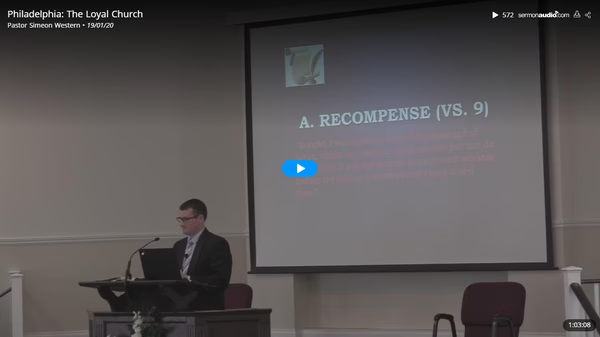
Recompense (Vs. 9)
- “synagogue of Satan” = reference to the unbelieving Judaizers that persecuted the early church. They were Jews naturally but not Jews spiritually and inwardly (Rom. 2:28-29). Christ labeled them as liars and the synagogue of Satan. The true source of their persecution is revealed (Eph. 6:12). Unlike the soft preachers of the 21st century, Christ spoke the truth plainly!
- “I will make them…” = Christ would bring their enemies to the place where they would be forced to recognize that the Philadelphian Christians were His true, beloved servants.
- Barnes: “It does not mean necessarily that they would themselves be converted to Christ, but that, as they had been accustomed to revile and oppose those who were true Christians, they would be constrained to come and render them the respect due to those who were sincerely endeavoring the serve their Maker.”
- Challenge: Our job is to love and pray for our enemies (Matt. 5:44) and leave recompense in the Lord’s hands (Rom. 12:19).
Rapture (Vs. 10-11)
- The Exemption (Vs. 10)
- The Temptation we are delivered from
- ‘temptation’ = means testing and comes from the same root word as ‘try’ in the same verse.
- “keep thee from” = the word ‘from’ is from the Greek word ‘ek’ meaning, out of. Therefore, the promise is that we will be kept out of this time of testing. Vs. 13 makes it clear that this promise was not only for the church of Philadelphia but for all true, Philadelphian churches throughout the church age.
- The Time we are delivered from
- “the hour of temptation” = this is clearly another description of the Great Tribulation, the time of Jacob’s trouble, the 70th week of Daniel, the Day of the Lord. It is the time described in detail in Rev. 6-18.
- “shall come upon all the world” = this is not a local persecution but a universal tribulation.
- “to try them that dwell upon the earth” = reveals the purpose of the tribulation period. It is the time of God’s judgment on an unbelieving world. Its purpose is to try the unbelievers, not the saints.
- Walvoord: “It should be noted that this deliverance is not only from trial but from a period of time in which the trial exists, “the hour of temptation.” If the expression had been simply “deliverance from trial,” conceivably it could have meant only partial deliverance. The expression seems as strong as possible that the Philadelphian church would be delivered from this period, which is the great tribulation, Daniels seventieth week (cf. Dan. 9:25- 27).
- The Temptation we are delivered from
- The Exhortation (Vs. 11)
- “Behold, I come quickly” = “strengthens the view that Vs. 10 promises a rapture before the tribulation.” (Wiersbe) “It is an assurance to the church at large that it will be kept from that hour by the Lord’s coming in the sky.” (Phillips) The word ‘come’ is in the present tense to describe a future event with great certainty (Linguistic Key). As far as the church of Philadelphia was concerned, they were to be ready for Christ to come at any moment (immanency) prior to the outpouring of God’s wrath in the Great Tribulation. Our expectancy is to be the same! The truth is clear! Christ will keep His church from the tribulation by coming for them at the rapture!
- Thomas: “The placement of this fifth promise at this point is clear implication that deliverance of the faithful will occur in conjunction with His coming. To Philadelphia, this was a word of encouragement and comfort. It is an imminent event that will come suddenly and unexpectedly.”
- Poem –
“I will also keep thee from the hour of temptation”
We’re not looking for the hour of temptation but the moment of translation!
We’re not looking for preservation through but deliverance from!
We’re not going through, we’re going up!
We’re not going to be caught in, we’re going to be caught up!
We’re not going to be overtaken, we’re going to overcome!
We’re not looking for signs, we’re listening for sounds!
We’re not anticipating the seals, we’re awaiting the Saviour!
We’re not looking for the sounding of the trumpets, we’re listening for the trumpet sound!
We’re not looking for the vials, we’re listening for the voice of the Archangel!
We’re not watching for judgment; we’re watching for Jesus!
We’re not looking for the Great Tribulation but for the Great God & Saviour!
We’re not staying on earth for the Seventieth Week, we’re flying to heaven for the Supper of the Lamb!
We’re not looking for Jacob’s trouble, we’re looking for Jesus’ triumph!
We’re not looking for the man of sin, we’re looking for the Son of Man!
We’re not looking for the deceiver, but for the Deliverer!
We’re not looking for the Antichrist, but for the Appearing!
We’re not looking for the little horn, but for the Lord of glory!
We’re not looking for the beast, but for the blessed hope and the Bridegroom!
We’re not looking for the son of perdition but for the Son of God!
We’re not looking for that Wicked, but for the living Word!
We’re not looking for wrath, we’re looking for the rapture!
We’re not looking for the tribulation, but for the Translation!
We’re not looking for the Antichrist, we’re looking for Jesus Christ!
1 Cor. 15:52 “Behold, I shew you a mystery; We shall not all sleep, but we shall all be changed, In a moment, in the twinkling of an eye, at the last trump: for the trumpet shall sound, and the dead shall be raised incorruptible, and we shall be changed.”
1 Thess. 4:16-18 “For the Lord himself shall descend from heaven with a shout…” - “hold fast that which thou hast” = means to grasp. This church already had a testimony for being faithful but Christ’s exhortation to them in light of His imminent return was for them to continue being faithful to the end. Dear Christian, don’t bomb out of the Christian life! Don’t take a sudden turn of the old paths just before the finish line!
- “that no man take thy crown” = the prospect of loss of rewards should also motivate us to remain faithful to God and His Word. We cannot lose our salvation, but we can “suffer loss” of rewards at the Judgment Seat of Christ (1 Cor. 3:15; 2 John 7- 11). 2 Tim. 2:5 “And if a man also strive for masteries, yet is he not crowned, except he strive lawfully.”
- Note: There are 2 motivations for faithfulness in this verse. 1. The imminent return of Christ. 2. The prospect of rewards for faithful service
Reward (Vs. 12)
- Christ will make the Overcomer (Permanence) (Vs. 12a)
- “a pillar” = ancient cities often honored great leaders by erecting pillars with their names inscribed on them. God’s pillars are not made of stone but a living pillar. We will be living monuments to God’s amazing grace! The picture is of permanence and stability. Our place in the New Jerusalem will be guaranteed.
- Peter, James and John are referred to as ‘pillars’ in Gal. 2:9.
- “he shall go no more out” = further emphasizes the permanence and security of the believer in glory. This promise would have had special meaning to these believers as many did not have a stable dwelling in the city on account of the devastating earthquakes it had experienced.
- Christ will mark the Overcomer (Ownership) (Vs. 12b) The believer will be marked with three names:
- “the name of my God” = reference to God the Father; signifies ownership. We belong to God.
- “the name of the city of my God” = we will have all the rights and privileges of citizenship in the new Jerusalem described in Rev. 21-22. Illustration: As a citizen of Australia, you are afforded certain privileges. Imagine the glories that await the children of God in the celestial city!
- “my new name” = a reference to Christ. Christ’s Names reveal His Character. There is a name of Christ we don’t know yet which will be revealed to us in glory. What glorious truth about our Saviour will be unveiled in that day to us?
The Plea to the Church (Vs. 13)
A Call to the Individual (Vs. 13a)
- A church is made up of individuals and can only experience true revival if each individual takes the message of Christ seriously.
- To hear means more than to listen, it means to heed and obey.
A Call to the Church (Vs. 13b)
- Christ speaks to the church as a whole. We are to respond as individuals but keeping in mind the wider picture of the church as a whole.
- What’s the main message from Christ for us in the letter to Philadelphia? It is “Behold I come quickly, hold fast…”
Conclusion
Christ’s message to us today is “Behold I come quickly, hold fast…”
Sermon 10 of 38 in Revelation Series