


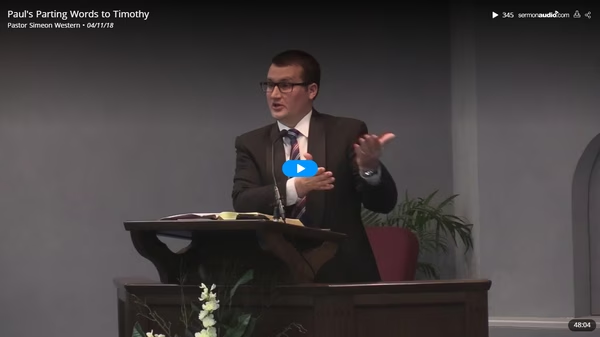
Exposition of Paul’s final recorded words before his martyrdom. Though Paul is facing the trials of imprisonment and his impending martyrdom, yet his spirit remains victorious.
The Epistle now closes with Paul’s final recorded words before his martyrdom in Rome. They contain matters of a more personal nature but contain some precious gems to inspire and encourage all believers.
Though Paul is suffering greatly, yet these words contain the spirit of victory.
The text naturally divides into four sections as follows:
Paul’s Petitions (Vs. 9-13)
In these verses Paul makes two personal requests to Timothy:
Please Come (Vs. 9-10)
- The request (Vs. 9)
- “do diligence” = make haste, exert every energy to come shortly or quickly
- “do thy diligence to come before winter” (Vs. 21) = winter would make travel impossible and Paul doesn’t have much time left
- At Paul’s time of deep trial, he longed to see Timothy his son in the faith one more time.
- The reason (Vs. 10)
- Paul had been forsaken (10a)
- Departing Demas had abandoned Paul in his hour of greatest need.
- Demas had ministered to Paul in his first imprisonment – “Luke, the beloved physician, and Demas, greet you.” (Col. 4:14) “Marcus, Aristarchus, Demas, Lucas, my fellowlabourers.” (Phil. 1:24)
- What was it that caused Demas to forsake Paul? Answer: “having loved this present world”. As a believer, Demas was drawn away from the place of faithfulness to the Lord and the Lord’s servant, due to the pull of the world.
- This is the reason many believers leave a good, solid church that preaches the truth and turn their backs on a faithful preacher who comes under fire for the truth (Note Vs. 4). They simply love their worldliness too much to endure separated preaching or take a stand that will cost them something.
- Illustration: Christ experienced the same thing during his earthly ministry – “From that time many of his disciples went back, and walked no more with him.” (John 6:66)
- Paul was isolated (Vs. 10b)
- There were those who had left Paul in the will of God. This was not as grievous as Demas’ departure but still involved pain and loneliness.
- Crescens to Galatia (Vs. 10)
- Titus to Dalmatia (Vs. 10)
- Tychicus to Ephesus (Vs. 12)
- Paul had been forsaken (10a)
Please Bring (Vs. 11-13)
- Bring yourself (Vs. 9)
- Bring Mark (Vs. 11) – what a change this represents concerning Mark who previously came to blows with the Apostle Paul (Acts 15:36-41). Mark has gone from being a deserter to being a useful servant of the Lord.
- Bring my things (Vs. 12)
- His cloke – winter is about to arrive (Vs. 21) and the cell is cold.
- His books and parchments – his study materials
- ‘books’ = contained writings on the cheaper and more perishable papyrus paper
- ‘parchments’ = writings written on costlier and more permanent skins of vellum. Likely the O.T. Scriptures
- Essentially Paul says, “Please bring me my Bible and my books.”
- C.H. Spurgeon comments on “books and parchments”
“Even an apostle must read…He is inspired, and yet he wants books! He has been preaching at least for thirty years, and yet he wants books! He had seen the Lord, and yet he wants books! He had had a wider experience than most men, and yet he wants books! He had been caught up into the third heaven, and had heard things which it was unlawful for a man to utter, yet he wants books! He had written the major part of the New Testament, and yet he wants books! The man who never reads will never be read; he who never quotes will never be quoted. He who will not use the thoughts of other men’s brains, proves that he has no brains of his own. Brethren, what is true of ministers is true of all our people. You need to read…we are quite persuaded that the very best way for you to be spending your leisure is to be either reading or praying…Paul cries, “Bring the books” – join in the cry.”
Paul’s Tribulations (Vs. 14-18)
Paul recounts his experiences at his first trial before the Roman court:
He Faced Opposition (Vs. 14-15)
- “Alexander the Coppersmith” = Could be the same Alexander mentioned in 1 Tim. 1:20. Whoever he was, he was one of Paul’s chief opponents at his trial. He fiercely opposed Paul and his ministry
- “the Lord reward him” = Paul pleads for the justice of God in relation to this man’s evil activities, placing Him in the hands of the Judge of all the earth who will always do right. Paul’s concern here was not himself but the bigger picture of God’s work and God’s honour. There is a place to pray that God will deal justly with those who oppose His work.
- “of whom be thou ware also” = ‘ware’ means to guard, keep watch, observe, beware. Paul didn’t hold back from warning against the wolves that would tear the sheep. He identified them by name! Paul names people specifically in his two Epistles to Timothy at least 7 times (1 Tim. 1:20; 2 Tim. 1:15; 2:1; 4:14)
He Faced Desertion (Vs. 16)
- “at my first answer” = his first defence (apologia) before the imperial court.
- “no man stood with me” = Paul had to stand alone without the support of others. Bearing one’s cross can be a lonely road so far as human support is concerned.
- A.W. Tozer “It is doubtful that the Lord used anybody greatly, without first hurting them deeply.”
- “I pray God that it may not be laid to their charge” = Paul prayed for those who hurt him by abandoning him with a forgiving spirit. Paul exhibited the same spirit as Stephen who prayed when the stones were being hurled at him, “Lord, lay not this sin to their charge” and Christ who prayed as he endured the agonies of the cross, “Father, forgive them, for they know not what they do.”
He Found Consolation (Vs. 17-18)
- Past Victory (Vs. 17)
- “the Lord stood with me” = While Paul was alone so far as human support was concerned, when he stood before the highest tribunal in the world at that time, He knew the strengthening presence of God with him. He was not alone! John Wesley’s dying words were, “The best of all is, God is with us.”
- “that by me the preaching might be fully known” = the purpose for which Paul was strengthened by God. God was able to use Paul’s court case as an opportunity for the Gospel to be made known as he testified
- “and I was delivered” = Paul’s first defence meant that his case was adjourned until a second hearing. During this time, Paul was able to pen 2 Timothy! God kept Paul alive until all His purposes which he had to accomplish through him were complete.
- Future Hope (Vs. 18)
- “shall deliver me” = Paul looks to the future, viewing his martyrdom as ordained of God to deliver him from “every evil work”
- Past victories form a foundation for assurance, a foot hold for faith as we look to the future.
Paul’s Salutations (Vs. 19-21)
Greetings from Paul (Vs. 19)
At the end of Paul’s life when he could have greeted any number of people, two families were on his mind. Both were sold out for the Lord’s work and had a special ministry of support to Paul.
- Priscilla and Aquila = Note Paul’s words concerning this couple in Romans 16:3-4 “Greet Priscilla and Aquila my helpers in Christ Jesus: Who have for my life laid down their own necks: unto whom not only I give thanks, but also all the churches of the Gentiles.”
- The household of Onesiphorus = this man, with the support of his family, had a special ministry of support to Paul. Described in first chapter of this Epistle (1:16-18)
Remarks from Paul (Vs. 20-21a)
- Erastus stayed at Corinth
- Paul left Trophimus at Miletum due to sickness. This passing reference “clearly shows that miracles of healing were not wrought at the mere will, even of an apostle, they were doubtless exceptional manifestations of divine power, made only as the Holy Spirit directed and empowered him who performed them.” (Harvey)
Greetings from the Brethren (Vs. 21b)
Paul’s Benedictions (Vs. 22)
Paul concludes with his last words of comfort to Timothy, desiring he would know:
- The Lord’s presence – “the Lord Jesus Christ be with thy spirit”
- The Lord’s grace – “grace be with you”
Conclusion:
- Are you a “departing Demas”? Are you being drawn away from a fruitful Christian life by the love of the world?
- How if your passion for studying the Word of God? If Paul still desired to grow in his knowledge of God’s Word as a man about to die in prison, how much more should we.
- Are we praying in our trials, drawing on the strength of God to stand for Him?
- There we leave our studies of the Pastoral Epistles for now! Remember the central theme of each Epistle – “Behave thyself” (1 Timothy); “Maintain good works” (Titus) and “Continue thou” (2 Timothy)
Grace be with you. Amen
Sermon 13 of 13 in 2 Timothy Series
Sermon Audio Id: 113181459322