


In this section we continue with the chapter on the fall of man. We see God’s justice at work in dealing with sinful man but at the same time, His grace shines through the darkness of the hour as God makes the way possible for mankind’s reconciliation with Himself.
We will note the curse that came upon the cosmos which will help us to make better sense of the suffering we see in Creation.
For this study, we will divide the text under four headings.
The Examination (Vs. 9-13)
The first trial in human history is conducted by God Almighty. Note how God deals with sinners to bring them to a realization of their sinfulness. God only asks questions, four in total. God knows all things so the purpose in the questioning was not for information but to seek to bring his estranged children to a place of confession.
God Questions Adam (Vs. 9-12)
- Where are you?
- This question highlights the spiritual death that had occurred. Adam and Eve where now separated from God because of their sin. In this respect, they died the very day they ate the fruit. The process of physical death also commenced this day that would lead to their eventual death.
- Man has been a fugitive ever since:
I fled Him, down the nights and down the days;
I fled Him, down the arches of the years;
I fled Him, down the labyrinthine ways
Of my own mind; and in the midst of tears
I hid from Him, and under running laughter.
Up vistaed hopes, I sped; And shot, precipitated,
Adown Titanic glooms of chasmed fears,
From those strong Feet that followed, followed after.
(Francis Thompson) - Illustration: If a branch is chopped off a tree and it falls onto hard concrete, one can say that it’s already dead, cut off from the source of life. But the process of physical death takes some time – the cells in the leaves will continue to photosynthesize for several hours at least. Similarly, when Adam sinned, he immediately cut himself off from the Source of life, but the dying process took 930 years.1
- Leupold puts it this way, “For a fact, after the commission of sin man at once stepped upon the road of death.”
- Who told you? God does not wait for man to answer this question but immediately follows it up with the next question.
- What have you done?
- God asks Adam plainly if he has broken His law. It is instructive to note that God does not ask any “why” questions. A “why” question can tend towards providing the guilty an opportunity to excuse his transgression.
- Adam’s response is to try and shift the blame for his transgression. This is a feature of the fallen nature of man. He usually will not admit to his wrong to begin with but will rather seek to pass the buck to someone else. We see this aspect of man’s depraved nature on full display in our “victim culture” today where everyone is a victim and not responsible for his/her actions.
- Adam blames God – “the woman whom thou gavest to be with me”. This amounts to an accusation of God Himself. How many people today still point the finger at God and try to blame Him for what they have done.
- Adam blames Eve – “the woman…she gave me of the tree”. Some men are always trying to hide behind their wives rather than take responsibility!
- Illustration: Saul is another example of someone who tried to blame others rather than confess his own guilt. 1 Samuel 15:15 “And Saul said, They have brought them from the Amalekites: for the people spared the best of the sheep and of the oxen, to sacrifice unto the LORD thy God; and the rest we have utterly destroyed.”
God Questions Eve (Vs. 13)
- The question (Vs. 13a). Again, the Lord asks a “what” rather than a “why” question.
- The response (Vs. 13b). Like Adam, Eve seeks to shift the blame rather than offer an unqualified confession of her sin. Unlike Adam, she does not seek to implicate the Creator. There was also an element of truth that she was deceived. Nonetheless, the confession was insufficient and did not go far enough.
The Condemnation (Vs. 14-19)
God Almighty now passes sentence on each person involved in the fall, following the same chronological order in which the participants were involved in the fall (Serpent – Woman – Man).
The Curse upon the Serpent (Vs. 14-15)
- The penalty upon the literal serpent (Vs. 14)
- The degree of the curse (Vs. 14a)
- It is important to recognize that the curse did not just fall upon the serpent but upon all the creation. Romans 8:22 “For we know that the whole creation groaneth and travaileth in pain together until now.”
- The serpent was cursed “above” the other creatures because of its role in the fall.
- The details of the curse (Vs. 14b)
- The snake’s locomotion – “upon thy belly shalt thou go”. This possibly indicates that the snake originally moved in a more erect posture.
- The snake’s humiliation – “dust shalt thou eat”. This does not mean that the snake’s food would be dust but it does mean it would be in that position of humiliation in the dust. It is also true that the snake uses its tongue to help it smell. Jonathan Sarfati explains, “In the roof of a snake’s mouth there is an organ called the vomeronasal organ (VNO) or Jacobson’s Organ. Like the sense of smell, it is a system designed to detect many different kinds of chemicals. But the VNO specializes in non- volatile chemicals, so requires direct physical contact. The snake achieves this with its forked and constantly flicking tongue. This picks up dust on the points of the fork, then carries the samples to the matching pair of sensory organs inside the mouth.”2
- The penalty upon the Satanic Serpent (Vs. 15) The focus now clearly shifts to Satan, the personage behind the serpent. This verse has been called the protoevangelium, that first Gospel proclamation in the Bible. The verse also predicts the conflict of the ages between the seed of the serpent and the seed of the woman. There would be a conflict in two senses:
- A conflict in a general sense (Vs. 15a)
- ‘enmity’ = hostility. This hostility is God’s doing – “I will put enmity”. This verse speaks of the unrelenting war of this age – the war between Christ and Satan.
- “thee and the woman” = significant that the serpent overcame the woman, but it would be the woman’s seed that would overcome the serpent.
- “between thy seed and her seed” = the conflict would polarize the souls of men – the seed of the woman against the seed of the serpent.
- Note: It is most significant that the reference is not to the seed of the man but to the seed of the woman. Usually, the seed is attributed to the male in the Scriptures. In fact, it is the biblical norm to trace genealogies through the fathers (e.g., Gen. 5, 11; 1 Chr. 1-9; Matt. 1:1-17; Lk. 3:23-38). The prophecy clearly points to the miraculous conception and virgin birth of Christ. Isaiah 7:14 “Therefore the Lord himself shall give you a sign; Behold, a virgin shall conceive, and bear a son, and shall call his name Immanuel.”
- “The Son, which is the Word of the Father, begotten from everlasting of the Father, the very and eternal God, and of one substance with the Father, took man’s nature in the womb of the blessed Virgin of her substance: so that two whole and perfect natures, that is to say, the Godhead and the manhood, were joined together in one Person, never to be divided, whereof is one Christ, very God and very man.”3
- A conflict in a specific sense Vs. 15b)
- The conflict would culminate in a show down between the woman’s seed (Messiah) and Satan. The Messiah would be wounded in the conflict but the serpent would be dealt a mortal blow to the head from which he would never recover. This took place at the cross. Christ was pierced through His feet, wounding his heels as this verse predicted but as He died, He triumphed over Satan and crushed his head. The final defeat of Satan is yet future (Rev. 20:10) but it is guaranteed because of Christ’s finished work on the cross.
- Col. 2:15 “And having spoiled principalities and powers, he made a shew of them openly, triumphing over them in it.”
- A conflict in a general sense (Vs. 15a)
- The degree of the curse (Vs. 14a)
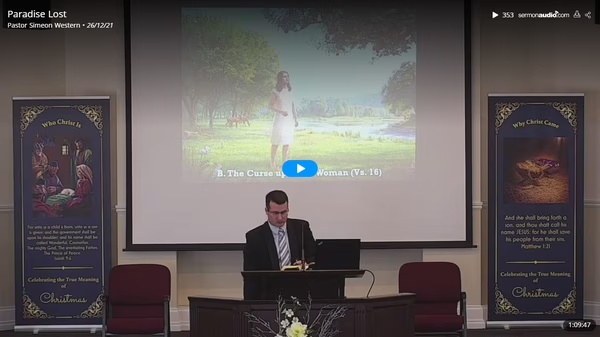
The Curse upon the Woman (Vs. 16)
She would experience:
- Sorrow in Motherhood (Vs. 16a)
- The curse is not multiple conceptions as some of the family banning people would like to argue as the testimony of the rest of Scripture is clear that children are a blessing from God. The curse is that the process would be beset with pain, especially in the birthing process.
- Mary Kassian, in her book “Women, Creation and the Fall” discusses the pain experienced by women in childbirth. “Childbirth is painful. I had read about it and believed it before the birth of my first child, yet nothing could have prepared me for the intense agony of labour. Labour pain is simply inexplicable to one who has not experienced it. Dr. Ronald Melzack, a leading expert in the field of pain, has recently completed research on the intensity of labour pain. He found, that on average, labour pain ranks amongst the severest. According to his study, it may be exceeded only by the suffering of some terminal cancer patients and often is worse than having the finger amputated without anaesthetic.”4
- Struggle in Marriage (Vs. 16b)
- Again, this verse is not teaching that male headship was a result of the fall. We have already seen from the creation order that God ordained for the husband to take a leadership role.
- However, after the fall, there would be a tendency for the man, without God, to become harsh and suppressive towards the woman. The woman would be more vulnerable to suffering, because she has the greater natural affection for the man, than the man does for the woman.
- It is only the Gospel, salvation and submission to God’s model for marriage as outlined in passages such as Ephesians 5 that provides a solution to this problem. The proper treatment of women is something that is only found where a culture has been deeply influenced by the Word of God.
The Curse upon the Man (Vs. 17-19)
- He would battle with the ground (Vs. 17-19a)
- Growing food from the ground would involve hard labor. Sweat speaks of the intense struggle against a hostile environment. He would no longer be able to just eat from plants growing naturally but would need to farm, growing crops for his sustenance.
- Growing food from the ground would involve obstacles (thorns and thistles).
- Significantly, the text says that the ground was cursed “for thy sake”. In a sinful world, hard work would be good for the man. This is true. A decent work routine has a way of keeping even an unsaved individual out of trouble. It is no coincidence that the suburbs with the highest crime rates are usually the suburbs with the highest concentration of unemployed. In this fallen world, it is God’s will for a man to work and work hard!
- He would be buried in the ground (Vs. 19b). Eventually he would succumb to death and be buried in the very ground with which he had struggled his entire life. This verse again reinforces the truth that death came after man sinned and not before. There would be no point to the punishment if death was already in existence.
- Note: Consider Christ as the Son of Man and second Adam and what He suffered for our Redemption:5
- Christ suffered the curse for us (Gal. 3:13).
- He was a man of sorrows and acquainted with grief (Is. 53:3).
- He offered up prayers and supplications with strong crying and tears (Heb. 5:7).
- His sweat was as great drops of blood (Lk. 22:44).
- He was wounded, bruised and chastised for us (Is. 53:5).
- He bore a crown of thorns, the very symbol of the curse upon His brow (Matt. 27:29; Mk. 15:17; Jn. 19:2, 5).
- He died an actual death (Ps. 22:15; Rom. 5:8).
The Provision (Vs. 20-21)
A New Beginning (Vs. 20)
- Adam originally called his wife “Woman” (Gen. 2:23). He now calls her ‘Eve’ which means life giver. This shows a wonderful reconciliation between them that only true repentance and faith in God could accomplish. It appears that Adam believed in the promise of God concerning the coming seed who would bring salvation.
- Eve is called the “mother of all living”. In other words, this means that all human beings trace back to this first human couple. Interestingly, modern DNA discovery confirms that all people originate from a common ancestor. Sarfati explains, “Most of the DNA we inherit from our parents comes from the nucleus. But the ‘powerhouse’ organelles of our cells, the mitochondria, have their own limited set of DNA. This DNA is generally inherited only through the mother’s line, because it seems that the sperm cells can’t pass it on, although there is some debate about this. In the 1980s, geneticists analyzed mitochondrial DNA from all around the world. They came to a startling discovery (for evolutionists): the similarities indicate that all people on earth are descended from a single human female. Even evolutionists have called her ‘Mitochondrial Eve’…Evolutionists claimed that they had clear proof against the biblical account, because ‘Mitochondrial Eve’ supposedly lived about 200,000 years ago. However, recent evidence shows that mitochondrial DNA mutates far faster than previously thought. If this new evidence is applied to ‘Mitochondrial Eve’, it indicates that she would have lived only 6,000-6,500 years ago. Of course, this is perfectly consistent with the biblically indicated age of the “mother of all living”, but an enigma for evolution/long age beliefs.”6
- Interestingly, there is a parallel account with males: evidence from the Y-chromosome is consistent with all people being descended from a single man. He is referred to as ‘Y-chromosome Adam’.7
A New Covering (Vs. 21)
- In response to their faith, God graciously provided a covering for their nakedness.
- This is the first time there is the death of the innocent for the guilty and is the first picture of the substitutionary death of Christ which was to come. Perhaps Adam and Eve witnessed the shedding of blood to provide the coats of skin for them.
- The garment of fig leaves was insufficient to cover man’s sin. They needed a covering provided by God. This is a picture of imputed righteousness. The filthy, tattered garment of our own righteousness will never make us fit to stand in God’s presence. We need the seamless, perfect robe of God’s righteousness. It cannot be earned; it must be received as a gift by faith.
- Isaiah 61:10 “I will greatly rejoice in the LORD, my soul shall be joyful in my God; for he hath clothed me with the garments of salvation, he hath covered me with the robe of righteousness, as a bridegroom decketh himself with ornaments, and as a bride adorneth herself with her jewels.”
- Fruchtenbaum writes, “Physically, He clothed their nakedness, but spiritually, He also covered their sin by making for them their first atonement. The lessons to be drawn from this verse are as follows. First, to approach God, one must have a proper covering. Second, the man-made covering was not acceptable. Third, God Himself must provide the covering. Fourth, the proper covering required the shedding of blood. Fifth, God’s grace provided for them, for the covering was given before the actual expulsion from Eden.”8
- Note: This verse also teaches the practical truth that in a fallen world, it is God’s will for us to be modestly covered. Clothing for sinful mankind was God’s idea! A culture of nakedness and immodesty is not a sign of a progressive but a degenerate culture. Let’s keep the necklines up and the hemlines down!
The Expulsion (Vs. 22-24)
Banished from the Garden (Vs. 22-24a)
- There is another council within the Godhead recorded for our instruction and benefit. God would not allow sinful man to have access to the tree of life lest he live forever. A casual reading of this might leave us with the wrong impression that this was a cruel thing to do on God’s part. But in reality, it was God’s mercy not to allow sinners to live forever in their sinful condition! Also, the penalty of sin which is death had to be executed.
- Evidently, the garden of Eden continued to exist for an unknown length of time after the departure of Adam and Eve, hence why they needed to be denied access to it.
- Note: Since that day, mankind lost access to the tree of life. But for those who are saved, our access to it will be restored in the new Jerusalem (Rev. 22:2).
Barred from the Garden (Vs. 24b)
Two obstacles were put in place to bar Adam and Eve from the garden:
- The Divine Personages. The Cherubim are a special class of angels associated with the throne and presence of God in the Bible (See Ps. 80:1; 99:1). Significantly, the mercy seat of the ark of the covenant was overshadowed by two golden representations of the cherubim. It was here that once a year the high priest sprinkled the blood on the Day of Atonement. Morris comments that “by analogy, it may well be that it was here, between the cherubim guarding the way to the tree of life, that God continued at intervals to meet with Adam and those of his descendants who desired to know Him.”9
- The Divine Presence. A flaming sword – this was not a sword in the hands of the Cherubim but a manifestation of the Shekinah glory of God in the shape of a sword. Leupold explains, “This is best taken as meaning a flame, swordlike in appearance and continually rotating or even, perhaps, moving zigzag like flashes of lightning; at any event, a sight effectually deterring man from attempting to enter, so effectually, no doubt, that he did not even venture to approach the garden from any other side.”10
- Note: It appears that God’s manifest presence was maintained at the at the garden’s entrance and was the likely place where offerings were brought.
References
- Illustration from Peter Sparrow (Creation Bus Ministry Australia), cited by Sarfati, p. 320.
- J Sarfati, The Genesis Account, p. 362.
- The Thirty-Nine Articles, excerpt from Article 2.
- Cited by Jonathan Sarfati, The Genesis Account, p. 368.
- Adapted from Henry Morris’ commentary “The Genesis Record”.
- Sarfati, p. 385.
- Ibid, p. 386.
- Cited by Sarfati, p. 387.
- H Morris, The Genesis Record, p. 132.
- H C Leupold, Exposition of Genesis, p. 184.