


The second half of Genesis 6 provides a brief statement concerning Noah’s godliness, a repeated description of the wickedness of Noah’s day and then the instructions for and preparations of the ark that would save Noah and his family from God’s judgement. In this sermon we will focus on Noah’s godly walk in the midst of a wicked world.
Chapters 6-9 are the great flood chapters in Genesis. They describe the lead up to the flood (chap. 6), the construction of the ark (chap. 6), the flood itself (chap. 7-8), and the events immediately after the flood (chap. 9).
Godly Noah is the prominent character of these chapters. Noah is a significant character in the Bible, being mentioned at least 58 times by name in the Scriptures.
The details about the ark revealed in the Word of God itself is the best answer to the shallow- minded attacks of the sceptics.
We will divide the account into three sections for our study:
- Noah’s Walk with God (Vs. 8-10)
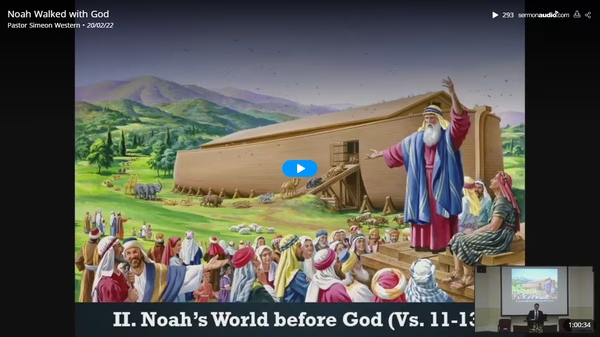
- Noah’s World before God (Vs. 11-13)
- Noah’s Work for God (Vs. 14-22)
Noah’s Walk with God (Vs. 8-10)
Consider three facets of Noah’s godly walk:
The Start of His Walk (Vs. 8)
- Noah’s walk started with the first step of salvation. His salvation was all of grace, not of works.
- Romans 4:4-5 “Now to him that worketh is the reward not reckoned of grace, but of debt. But to him that worketh not, but believeth on him that justifieth the ungodly, his faith is counted for righteousness.”
- Eph. 2:8-9 – “For by grace are ye saved through faith…”
- Titus 3:5 “Not by works of righteousness which we have done…”
- Illustration: The Apostle Paul. Phil. 3:4-9 “Though I might also have confidence in the flesh..”
- You must be reconciled to God before you can walk with God and work for God. You must belong to God before you can live for God. A new life comes from a new heart.
- Have you taken the salvation step?
The Sanctification of His Walk (Vs. 8)
- It was the grace of God that saved Noah and made him a child of God. But it was also the grace of God that preserved Noah in his walk from the influences of a wicked world around him. The only way to be saved is by the grace of God and the only way to live a truly sanctified life is by the grace of God!
- One definition of grace is this, “the Divine influence upon the heart, and its reflection in the life.”
- Barnhouse writes, “Noah was no different from any other son of Adam. If the grace of God had not restrained him, the evil in his heart, which was just as great as the evil in the other hearts that were destroyed, would have manifested itself in a wickedness as great as theirs.”1
The Specifics of His Walk (Vs. 9a)
- The Terms – “just man and perfect”. Two words are used to describe godly Noah in this verse. This refers to Noah’s conduct in relation to man.
- A just man – the word ‘just’ means righteous. Noah was:
- Positionally righteous before God because of salvation. He was made just, justified on the basis of the free grace of God (Vs. 8).
- Practically righteous before men because of salvation. “Goodness comes after grace, not before grace. Grace comes before we read of Noah being a just man and walking with God. Noah’s goodness was a result of grace. Grace was not a result of his goodness.”2 “Noah’s righteousness didn’t come from his good works; his good works came because of his righteousness. His righteousness was God’s gift in response to his personal faith.” (Wiersbe)
- A perfect man – the word has the idea of whole, complete, mature. It does not describe a man who is sinless but a man who is blameless. It speaks of “an all-sided life, well rounded out in all its part, with no essential quality missing” (Leupold). Maclaren writes, “His whole nature is developed, and all in due symmetry and proportion; no beauty wanting, no grace cultivated at the expense of others. He is a full man, not one- sided and therefore a distorted one.”3
- A just man – the word ‘just’ means righteous. Noah was:
- The Time – “in his generations”. This is a different word to the word ‘generations’ at the start of the verse. It is a reference to a generation in the sense of an age, a time period. A significant statement considering the moral climate of his day. Barnhouse writes, “It is possible to grow a lily in a manure pile. No circumstances of this world are too low for God to produce therein faith and holiness.”4 Titus 2:11-12 “For the grace of God that bringeth salvation…”
The Secret of His Walk (Vs. 9b)
You might ask, “how did Noah live a righteous and godly life in such an evil generation?” The answer is found in the words “and Noah walked with God”. This was Noah’s conduct in relation to God. Noah’s walk with God was the secret behind the godly life he lived outwardly before his generation. We cannot overemphasis the importance of walking with God in the Christian life. It is the key to everything! The Word of God has much to say about what this walk looks like. The believer is to:
- Walk after the LORD (Deut. 13:4; 2 Kings 23:3; 2 Chr. 34:31). That’s followership.
- Walk before the Lord (Gen. 17:1; 1 Kings 8:23, 25; 2 Chr. 6:14; 7:17). That’s faithfulness.
- Walk with God (Gen. 5:22, 24; 6:9). That’s fellowship.
- Walk in God’s ways (Deut. 10:12; 11:22; 19:9; 28:9; 30:16; Josh. 22:5; 1 Kings 2:3; 8:58; 11:38; 2 Chr. 6:31; Ps. 119:3; Jer. 7:23).
- Walk uprightly (Ps. 84:11; Prov. 2:7).
- Walk with a perfect heart (Ps. 101:2).
- Walk in the way of good men (Prov. 2:20).
- Walk in the old paths (Jer. 6:16).
- Walk humbly with God (Mic. 6:8).
- Walk worthy (Eph. 4:1; Col. 1:10; 1 Thess. 2:12).
- Walk in love (Eph. 5:2).
- Walk as children of light (Eph. 5:8).
- Walk circumspectly (Eph. 5:5).
- Walk in the Spirit (Gal. 5:16, 25).
- Walk in newness of life (Rom. 6:4).
- Walk honestly (Rom. 13:13; 1 Thess. 4:12).
- Walk by faith (2 Cor. 5:7).
- Walk in good works (Eph. 2:10).
- Walk in Christ (Col. 2:6).
- Walk in the light (1 Jn. 1:7).
- Walk as Christ walked (1 Jn. 2:6).
- Walk after Christ’s commandments (2 Jn. 2:6).
- Walk in truth (3 Jn. 1:4; Ps. 86:11).
- Note: The Bible also has much to say about how we are not to walk as well.
Noah’s World Before God (Vs. 11-13)
The wickedness of pre-flood world is documented in these verses and God’s pronouncement against it. It provides a sharp contrast to the description of the godly life of Noah and also forms a natural basis for God’s instructions to Noah concerning the ark.
The Depravity of Noah’s World (Vs. 11-12)
These verses contain God’s Divine assessment of the world’s condition – “corrupt before God”. God is the one who sets the moral standards for His creatures. He is the one who defines what is good and what is evil. The world of Noah’s day was:
- A Corrupt World – ‘corrupt’. The word ‘corrupt’ is used 3 times in these verses to describe the antediluvian world. It is a strong word often translated ‘destroy’. It means “gone to ruin”. Mankind had destroyed itself through depravity. As man ruined the earth, God will ruin man. “Sin is death in the making; death is sin finished.”5
- A Cruel World – ‘violence’. The word is used twice to describe the antediluvian world.
- The source of the violence. The violence was a byproduct and fruit of the world’s corruption. Note the order of the wording in verse 11. When men walk according to the depravity of their hearts, it inevitably leads to injuring others.
- The scope of the violence. The whole earth was “filled with violence”. Violence was widespread and abundant.
- Psalm 11:5 “The LORD trieth the righteous: but the wicked and him that loveth violence his soul hateth.”
The Decree for Noah’s World (Vs. 13, 17)
God now communicates His mind with Noah directly. This is the first of 7 times that God would speak with Noah (Gen. 6:13, 7:1, 8:15, 9:1, 8, 12, 17), each time in fellowship and blessing to Noah and his family. The judgment that was to be unleashed on the earth was truly awesome. Observe:
- The Magnitude of God’s Judgment (Vs. 13).
- The termination of longsuffering – “the end of all flesh is come before me”. The day of grace eventually runs out. “There come times in the events of this world when God’s gracious dealings with men are definitely terminated. Such times come only when grace has been offered in richest measure.”6
- The termination of life – “destroy them with the earth”
- Mankind would be destroyed.
- Mankind’s habitat and environment would be destroyed.
- The Means of God’s Judgment (Vs. 17). God would send a world- wide flood that would destroy all living creatures with the breath of life on the earth. We know the flood was universal because of:
- The unique words the Bible uses for Noah’s flood. The Word of God uses unique words for Noah’s flood in both Hebrew and Greek that are not used of other floods in the Bible.
- The Hebrew word is ‘mabbul’ and is preceded by the definite article – “the flood”. This Hebrew word is only used in relation to the world-wide flood in the Old Testament.
- The Greek word is ‘kataklusmos’ (◻◻◻◻◻◻◻◻◻◻◻). Our English word ‘cataclysm’ comes from this word. A ‘cataclysm’ is “A large-scale and violent event in the natural world.”7
- The plain statements of Scripture.
- Isaiah believed in a literal Noah and a literal flood: Isaiah 54:9 “For this is as the waters of Noah unto me: for as I have sworn that the waters of Noah should no more go over the earth; so have I sworn that I would not be wroth with thee, nor rebuke thee.”
- The Apostle Peter believed in a universal flood: 2. Peter 3:5-6 “For this they willingly are ignorant of, that by the word of God the heavens were of old, and the earth standing out of the water and in the water: Whereby the world that then was, being overflowed with water, perished:” The word ‘overflowed’ means “to wash down, to deluge.” The root word is translated “raging of the water” (Lk. 8:24) and “wave of the sea” (James 1:6).
- The writer to the Hebrews believed in a universal flood: Heb 11:7 “By faith Noah, being warned of God of things not seen as yet, moved with fear, prepared an ark to the saving of his house; by the which he condemned the world, and became heir of the righteousness which is by faith.”
- The Lord Jesus Christ believed in a universal flood: Luke 17:26-27 “And as it was in the days of Noe, so shall it be also in the days of the Son of man. They did eat, they drank, they married wives, they were given in marriage, until the day that Noe entered into the ark, and the flood came, and destroyed them all.”
- Shame on Christian institutions of higher education which go to great lengths to undermine the truths of the Word of God on Genesis and other fundamental Bible doctrines!
- The colossal size of the ark (Gen. 6:15). If the flood was only local, why build a ship this size?! Clearly it was built to be able to withstand something much larger than a local flood. If it was a local flood, all Noah, his family and the animals would need to do is migrate to safety. The ark would have been around 138m (L) x 23m (W) x 14m (H). In terms of Feet, that would be 450ft x 75ft x 45ft. This would result in a volume of about 44,400 m3.8 To put that in perspective, that would be equivalent to the capacity of over 340 semi-trailers. The Ark would be wider than a six-lane U.S. interstate highway.
- The flood account itself (Gen. 7:17-24). This clearly describes a universal flood.
- The unique words the Bible uses for Noah’s flood. The Word of God uses unique words for Noah’s flood in both Hebrew and Greek that are not used of other floods in the Bible.
To be continued…
Conclusion
Have you accepted God’s gift of grace? Have you entered the ark of salvation? Are you sheltering under his atoning blood? Will you come to Christ today and escape the coming wrath and judgment of God?
How important is it to you to walk with God as a Christian? Are you surrendered to obeying God fully in your life? Is consecration to Christ and all His ways important to you?
References
- J Butler, Noah the Ark Builder: Bible biography series number twenty-three, p. 32.
- Ibid, p. 33.
- A Maclaren, Expositions of Holy Scripture volume 11, p. 49.
- Cited by Butler, pp. 36-37.
- Maclaren, p. 53.
- H C Leupold, pp. 268-269.
- Oxford Dictionary, https://www.lexico.com/definition/cataclysm, Viewed 18/2/22.
- J Safarti, The Genesis Account, pp. 499-500.