


The conflict between the seed of the serpent and the seed of the woman continues in this section with the development of two family lines – one godly and one ungodly. “Cain’s family tree ends with the family of Lamech, an arrogant murderer whose 3 sons manufactured things for this world. Seth’s line ends with Noah (“rest”) whose sons gave the world a new beginning after the flood.” (Wiersbe) Tragically, by the time Noah, his sons and their wives stepped on the ark, the two lines were indistinguishable. The only godly remnant that would remain would be Noah and his family.
The period from the Fall to the Flood, has been commonly called the age of conscience. Sauer prefers to call it the period of general Divine revelation, because this describes God’s method of communication to man before the Law was given at Sinai. This period commenced with one family (Adam’s) and ended some 1600 or so years later with one family (Noah’s).
The conflict between the seed of the serpent and the seed of the woman was predicted in Gen. 3:15 and we saw that tragically play out within the very first family. We saw two competing approaches to God, faith vs. works.
We will trace the development of these two lines and learn some significant spiritual lessons along the way.
The Godless Line Of Cain (Gen. 4:16-24)
Less space is given to the ungodly line and the Messianic line is given greater emphasis in the text. What were the distinguishing characteristics of Cain’s line? We can answer that question by studying the main characters in the genealogy. The Cainites were:
Builders (Cain) (Vs. 16-18)
- Cain removed himself from God (Vs. 16)
- Sadly, Cain chose to go his own way rather than repent of his sin and be reconciled to God.
- He “went out from the presence of the LORD”, meaning he departed from the place where God’s presence was manifested, a likely reference to the presence of God at Eden’s entrance.
- Cain rebelled against God (vs. 17)
- Cain’s attempt to build a city were an attempt to thwart God’s justice in his life. God had sentenced him to a life as a fugitive and a wanderer. Cain attempts to establish himself in one place.
- Significantly the place Cain relocated to (Nod) means ‘wanderings’. Also, Cain ends up naming the city after his son Enoch, indicating that very likely it was his son who completed the city, not Cain. Henry Morris notes, “The Hebrew is indefinite – “was building”, suggesting that he did not complete the city, probably leaving it to his son Enoch to finish and begin the true Cainite civilization.”
- Note: When men reject God, all they are left to is an aimless wandering of heart in this life. There is no real purpose.
- Cain reproduced apart from God (Vs. 18)
Inventors (Lamech’s sons) (Vs. 19-22)
- Jabal (wanderer) – Pioneer of Agriculture (Vs. 20). The word ‘father’ is used in the sense of “founder, originator”. He invented the tent which meant he and his followers had portable homes which would help with their shepherding lifestyle. He also was the pioneer of the domestic animal trade. Abel was a keeper of sheep but Jabal pioneered the cattle trade. The word ‘cattle’ includes camels, assess, goats, kine and perhaps others. (Morris)
- Jubal (sound) – Pioneer of Musical Instruments (Vs. 21). He was a skilled inventor, pioneering both stringed and wind musical instruments. The harp was likely a ‘lyre’ while the ‘organ’ an instrument of reed pipes (Sarfati). No doubt these appealed to the sensual Cainites and were used in connection with their ungodly lifestyles. Jubal likely also profited financially from their sale.
- Tubal-cain (half-brother to the other two) – Pioneer of Metallurgy (Vs. 22). He pioneered metallurgy with both brass and iron and also trained other craftsmen (“artificers”). This would include things like farming tools and weapons. He also had a significant sister named Naamah. The inclusion of a woman in the genealogy is unusual. Why she is included, we are not told.
- Warren Wiersbe writes, “In the city of Enoch, they had everything but God.”
- Note: Such advancements are not sinful in and off themselves. In fact, inventiveness and creativity are God-given endowments in mankind. The issue is when man pursues his own advancement without reference to God. When God is removed from the picture, mankind uses his inventive skills in rebellion against God. History bears abundant testament to this fact and it is the same today. Technological advancements can be used for good and God’s glory or for evil.
- Concerning the Creation Vs. Evolution debate, Henry Morris points out, “Once again, it is significant to note that the element which modern evolutionary archaeologists and anthropologists identify as the attributes of the emergence of evolving men from the stone age into true civilization – namely, urbanization, agriculture, animal domestication, and metallurgy – all were accomplished quickly by the early descendants of Adam and did not take hundreds of thousands of years.”1
Transgressors (Lamech) (Vs. 19, 23-24)
Moral degeneration can be seen in the Cainite line, culminating in deep depravity in Noah’s day (See Gen. 6:5). Two words summarize this moral slide:
- Vice – Lamech’s Polygamy (Vs. 19)
- This is the first reference to polygamy in the Bible and marks a sad deviation from God’s original design for marriage. Lust and selfishness are the underlying motives of polygamy. When men live apart from God, the breakdown of marriage and morals is the sad and inevitable result.
- The Bible does not endorse polygamy as some suggest but rather exposes it for what it is with candid depictions of those who engaged in the practice. It was never intended by God nor was it blessed of Him. Christ reinstated and re-emphasized God’s original design for marriage during His earthly ministry.
- Violence – Lamech’s Poem (Vs. 23-24) This is the first recorded poem in the Bible. It has the features of Hebrew poetry which is called parallelism. Sadly, we see the arts being misused by the Cainites (music and poetry) in a corrupt and God-dishonoring way.
- Lamech is bragging about the fact he has murdered someone (Vs. 23). He follows in the footsteps of Cain, the head of this ungodly line. Violence increased up until the flood to the point where “the earth was filled with violence” (Gen. 6:11).
- Lamech is blasphemous towards God (Vs. 24). He arrogantly claims that Cain would be avenged sevenfold, he would be seventy and sevenfold if someone tried to hurt him. This was a presumptuous claim on Lamech’s part and may also include a tone of mocking at what God had pronounced concerning Cain.
- Note: Lamech’s reference to Cain’s judgment from God reveals that the account was well preserved and had been handed down.
The Godly Line of Seth (Gen. 4:25-5:32)
Some Important Points about the Genealogy
- The Genesis 5 genealogy is vital for tracing the Messianic line from Adam to Christ. This is demonstrated in Luke’s genealogy of Christ (Luke 3:23-28). Take note of the names from Genesis 5 in Luke’s genealogy.
- The Genesis 5 genealogy records the first 1600 years of history from Creation to the Flood. That is a significant junk considering the fact there is only approx. 4,000 years from creation to the times of the New Testament. Bible genealogies provide a lot of the data necessary for understanding the Bible’s timeline and chronology.
- The Genesis 5 genealogy reveals the antediluvian patriarchs would have had ample opportunity for corroboration of the events recorded in the early chapters in Genesis due to the generational overlap. Adam dies in Lamech’s 56th year. That means that only Noah and his sons from the pre-flood civilization would not have known Adam.
- The Genesis 5 genealogy reveals that early record keeping was a part of early, pre-flood civilization. “This is the book of the generations of Adam” (5:1) This was probably an ancient scroll or clay tablet.
- The Genesis 5 genealogy demonstrates early on the truth of death as the fruit of sin entering the world. C.H. Mackintosh writes, “In full confirmation of the foregoing section, we may run the eye over the contents of Chapter 5 and find therein the humiliating record of man’s weakness, and subjection to the rule of death. He might live for hundreds of years, and “beget sons and daughters;” but, at last, it must be recorded that ‘he died’.” Since the fall, mankind has been under the power of death. In our natural state we therefore have no basis for fellowship with God. It is only possible through new spiritual life given to us by God.
- The Genesis 5 genealogy reveals that the antediluvians lived far longer (about 10 times more than the average person today) on account of the pre-flood environment being more favorable for life. Life spans dramatically reduce after the flood.
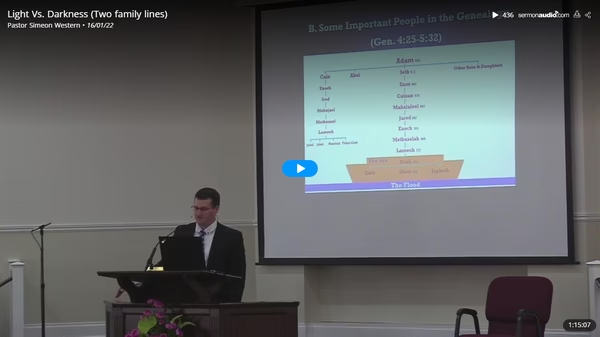
Some Important People in the Genealogy (Gen. 4:25-5:32)
There are 10 generations recorded in this Genealogy from Adam to Noah. The Sethites stand in sharp contrast to the Cainites. “There is a marked change of emphasis in the record of the descendants of Adam through Seth. No more do we read of human accomplishments and boasting, but, rather of men “calling upon the name of the LORD”. (Morris) Their emphasis was on the simple walk of faith. Theirs was an eternal value system as opposed to the temporal mindset of the Cainites. The majority we know very little about apart from their names, lifespan and the fact they “begat sons and daughters”. Let’s survey this godly line. Four names will stand out in particular:
Seth – the provision of faith (Gen. 4:25-5:8). Seth was 105 when his Seed son was born and lived another 807 years, dying at 912.
- Eve’s Faith (4:25). Eve believed that God gave her Seth to replace godly Abel who had been murdered by Cain. The name ‘Seth’ means “substituted, appointed” and is closely related to word ‘appointed’ in the verse. She was right! The future of the godly seed hinged on this one boy Seth.
- Adam’s Faith (5:3). Adam agreed with Eve’s choice of the name ‘Seth’ so evidently, he shared her view that this boy was God’s provision for the continuation of the godly line.
Enos – the organization of faith (4:26). Enos was 90 when he fathered Cainan, lived another 815 years, then died at age 905.
- The name ‘Enos’ means “mortal frailty” and bears testament to Seth’s humble attitude of dependence upon God, a clear contrast to Lamech’s pride and self-sufficiency.
- In Enos’ time men began to “call upon the name of the LORD”, the beginnings of public worship. While not the church, this does represent the first formal assemblies in the Old Testament for the worship of the One true God. Before this point, the worship of God was on the family and individual level only, as illustrated in Cain and Abel’s offerings. Perhaps Enos was instrumental in encouraging spiritual revival in his generation? While the worldly Cainites were pursuing temporal things, Seth’s family was seeking God.
- This was not the church as some Reformed theologians would have us believe. The church was still a mystery at this point (Eph. 3:3). However, the principle of believers assembling together is not new. It is God’s established way and will for His people.
Cainan-Jared – the continuation of faith (Gen. 5:12-20). Beyond their names, lifespans and the fact they reproduced, we know nothing more of these saints of old. But they are still important as they were “living links in the great generational chain that reached from Seth to the birth of Jesus Christ” (Wiersbe). We may get a clue here or there from the meanings of their names:
- Cainan – means ‘smith’. Fathered Mahalalel at 70 then lived for 840 more years, dying at age 910.
- Mahalalel – means “praise of Elohim”. Fathered Jared at 65, lived 830 more years, dying at 895.
- Jared – means ‘descent’. Fathered Enoch at 162, then lived for 800 more years, reaching the second longest lifespan at 895 years.
Enoch – the illustration of faith (Gen. 5:21-24). His name means ‘dedication’. He had the same name as Cain’s son. Cain’s son was dedicated to the new city he was building in rebellion against God whereas Jared was dedicating his son to God.
Enoch’s Testimony (Vs. 21-24a; Jude 14-15)
- The Testimony of his Walk (Vs. 21-24a)
- The Commencement of his Walk (Vs 21-22a). Enoch’s earnest walk with God commenced at the time of the birth of Methuselah. The fatherly sense of responsibility at the sight of his first child coupled with his God given insight into the fact that God’s judgment would be sent at the death of Methuselah, stirred Enoch’s heart to fervently walk with God. And walk with God he did! It is stated twice that he walked with God (Vs. 22 & 24). Enoch was the seventh from Adam in the godly line of Seth. What a contrast his life was to Lamech, the seventh from Adam in the line of Cain (Gen. 5:23-24). C.H. Mackintosh writes, “And oh! How much is involved in these three words, “walked with God!” What separation and self-denial! What holiness and moral purity! What grace and gentleness! What humility and tenderness! And yet, what zeal and energy! What patience and long-suffering! And yet what faithfulness and uncompromising decision! To walk with God comprehends everything within the range of the divine life, whether active or passive.”
- The Consistency of his Walk (Vs. 22b). Enoch walked with God for 300 years! Imagine maintaining a godly testimony for so many years in a world of spiritual and moral decline! It should encourage us that with God’s grace it is possible to live “soberly, righteously and godly in this present world” (Titus 2:12). By God’s grace you can start well, continue well and finish well in the Christian race. You don’t have to be the next statistic!
- The Context of his Walk (Vs. 22c). Enoch walked with God in the context of family live – “Enoch walked with God…and begat sons and daughters”. This is a significant statement. Home and family are where the rubber meets the road in the Christian life (the wheel of theory meets the road of reality!). Family life is one of the greatest tests of the fabric of one’s spiritual life. “…I will walk within my house with a perfect heart.” (Psalm 101:2)
- The Climax of his Walk (Vs. 24b). Enoch was “translated that he should not see death” (Heb. 11:5). The phrase “he was note” comes from one Hebrew word meaning ‘disappeared’. How? “God took him”. The climax and consummation of our Christian walk is to enter the presence of Christ whether through death or at the rapture.
- The Testimony of his Words (Jude 1:14-15)
He boldly proclaimed the truths of:- The Soon Coming Deluge. Enoch named his son ‘Methuselah’ which means “when he dies it shall be sent”. It is no coincidence that Methuselah died the same year the flood came. There are other examples in Scripture where children were given prophetic names to communicate God’s revelation (e.g., Hosea 1). He was also the longest living Patriarch, reaching almost 1,000 years (969 years). The length of his life was a testament to the truth of God’s longsuffering. So long as Methuselah lived, there was opportunity to repent before judgment came. (See 2. Pet. 3:9)
- The Second Coming of Christ (Jude 14-15). Enoch was a prophet who boldly preached the return of Christ to the sinful generation in which he lived. He was enabled by God to not only see the coming flood but down the corridors of time to the second advent.
- The Sinfulness of Man (Jude 14-15). Enoch was not 21st century, wine sipping, TV watching, rock music loving, Hillsong style, cream puff preacher. He boldly and courageously thundered against the ungodliness of his generation in plain and unmistakable language. He preached against the ungodly lifestyles and mouths of his generation (“deeds” & “speeches”). He preached that God would “execute judgment” upon the ungodly.
- Enoch’s close walk with God enabled him to be a true “Seer”. He saw the coming flood and named his son Methuselah, which means, “When he is dead it is sent.” In the very year that Methuselah died, the flood came. (See chart) Enoch also saw right past the church age to the second coming of our Lord. His heart, made sensitive by the long years of communion with God, could detect the falsehood and apostasy of the professing believers of the last days. He felt righteous indignation in his heart toward all those hard speakers who had spoken against his God and Friend. He was an earnest contender for the faith in a day of unparalleled apostasy. Any man who walks with God must earnestly contend for the faith! He must stand for purity of doctrine as well as life. (Jude 3)
Enoch’s Translation (Vs. 24b, Heb. 11:5)
- The Specialness of it. Elijah the only other man who was raptured to heaven without seeing death (See 2. Kings 2:1- 11). Interestingly, the word ‘took’, used to describe the rapture of Enoch is the same word used of Elijah’s translation – “take away” (2. Kings 2:3, 5). “It is significant that Enoch prophesied about midway between Adam and Abraham and Elijah about midway between Abraham and Christ. Both ministered in times of deep apostasy.” (Morris)
- The Symbolism of it. Enoch’s rapture before the judgement of the flood is a picture of the rapture of the church which will be raptured prior to the outpouring of God’s wrath and judgment in the tribulation.
- Noah – the preservation of faith (Gen. 5:25-32) To be continued
Conclusion
Which side of the conflict are you on? Are you on the side of truth and right or are you on the moral and spiritual slide of our evil generation?
References
- H Morris, The Genesis Record, pp. 146-147.