

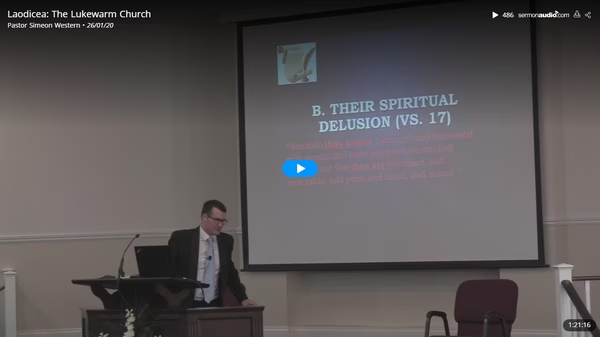
Exposition of Christ’s letter to the church of Laodicea. Powerful challenge concerning the sin of lukewarmness. Very relevant to the 21st century church.
Historically Laodicea was founded by Antiochus II in the middle of the 3rd century B.C. and named after his wife Laodice.
Geographically Laodicea is located about 40 miles (64km) south and a little East of Philadelphia in the Lycus Valley. It formed a tri-city combination with Hierapolis, six miles (10km) to the North and Colossae ten miles (16km) to the east.
Economically Laodicea was a large and important city in John’s time, being situated on the crossroads of the most important highway running from Ephesus to the East. It was famous for its wealth and has been called the “Wall Street” of Asia Minor. So great was its wealth that when the city was destroyed by an earthquake in A.D. 61 the citizens rejected help from the Roman government and rebuild at their own expense (Cloud). It was a commercial and financial center. It was also a manufacturing center, famous particularly for a soft wool that was glossy black in color. A famous school of medicine was also located in Laodicea, famous for its popular Phrygian powder for weak and sick eyes (Thomas, Cloud). “Commerce, manufacturing, and medicine combined to make Laodicea a wealth city.” (Thomas)
Spiritually Laodicea was given over to idolatry and to the sort of sins of sinful indulgence that accompany riches. The Apostle Paul familiar with this church years earlier as indicated in His Epistle to the Colossians and even wrote an Epistle to this church (Col. 4:16).
Etymologically the word ‘Laodicea’ is made up of the Greek word ‘laos’ (‘people’) and ‘dikao’ (“I rule”). Therefore, “the rule of the people.” It is referred to as “the church of the Laodiceans”. Prophetically, this church stands for that period of church history immediately prior to the second coming. We will study Christ’s letter to Laodicea under 5 headings
The Credentials of Christ (Vs. 14)
Christ is revealed as…
The Amen (Vs. 14a)
‘Amen’ = means verily, truly, certainly, it is so. It conveys the idea of firmness, stability and credibility (Linguistic Key). Used here as a title of Christ. 2 Cor. 1:20 “For all the promises of God in him are yea, and in him Amen, unto the glory of God by us.”
‘faithful and true witness’ = a further enlargement of the truth conveyed in the title ‘Amen’. “A witness is someone who testifies to what is true.” (Lyle) Christ’s testimonies are total truth as He is the very personification of truth (John 14:6). Christ’s testimony of this church’s spiritual condition would be 100% accurate.
Swete: “The solemnity of the titles adopted by the Lord for His message to Laodicea prepares the way for the searching and severe criticism that follows.”
The Author (Vs. 14b)
“the beginning” = not the beginning as in the first created but beginning as in the source, the originator, the instigator of creation. It means “that which is first of origin, of active cause. Christ is the active source and author of creation and the pre-eminent One in creation. Christ is both the Origin and the Object of creation.
- Col. 1:16 “For by him were all things created, that are in heaven, and that are in earth, visible and invisible, whether they be thrones, or dominions, or principalities, or powers: all things were created by him, and for him:”
- John 1:3 “All things were made by him; and without him was not any thing made that was made.”
- Heb. 1:2 “Hath in these last days spoken unto us by his Son, whom he hath appointed heir of all things, by whom also he made the worlds;”
Phillips: “He it was who flung the stars into space, plowed out the basins of the sea, reared against the skyline of the world the mighty Himalayan range. Not a blade of grass grows without His permission; not a speck of dust moves. He is the origin of the creation of God, the all-controlling One, the dynamic Christ. He stands before this wretched church and penetrates its little disguises and sees it through and through.”
The Censure from Christ (Vs. 15-17)
Their Spiritual Condition (Vs. 15-16)
Christ’s revelation of their condition (Vs. 15-16a)
- Historical background: Laodicea, though wealthy, had a problem with water shortage. Consequently, it had to pipe water from neighboring Hierapolis and Colossae. The water at Colossae was cold and good for drinking. The water from Hierapolis was from its famous hot springs. The problem was that by the time the hot water from Hierapolis was piped to Laodicea, it was lukewarm by the time it arrived. Similarly, by the time the cool water from Colossae arrived, it had heated somewhat, also making it lukewarm.
- This church was half and half. Half cold, half hot, it was a half- hearted church. The believers had one foot in the world and one foot in the church. They didn’t neglect all of the services; they came when it suited them. They didn’t stop reading the Bible altogether, they read it a few minutes here and there. They prayed occasionally, but the local games were generally of more interest than the mid-week prayer meeting.
- Illustration: Lot is a good biblical illustration of a lukewarm Christian.
- “I would thou wert cold or hot” = reveals the mind of Christ. He would rather either end of the extreme in regards to spiritual temperature than a halfhearted, fence straddler in the middle. Christ wants our all or nothing! It is easier to convince someone who is cold of their unspiritual condition than one who has a veneer of religiosity.
- Illustration: A Cup of Coffee – “Everything tends toward cooling down, and a source of energy is required to keep something hot.” (Cloud)
Christ’s revulsion to their condition (Vs. 16b)
- “I will spew thee” = reveals Christ’s extreme disgust with a lukewarm state. He finds it nauseating. It makes Christ feel sick!
- Challenge: How does your Christianity make Christ feel? Does it bring Him joy or holy revulsion?
Their Spiritual Delusion (Vs. 17)
Christ traces the fruit to the root, the symptom to the source. Christ rebukes their…
Arrogance (Vs. 17a) – “because thou sayest”
- There was a world of difference between “thou sayest” and “thou art”. This church was self-deceived (Jer. 17:9). Christ viewed this church totally opposite to how the church viewed itself. We have the human Vs. the Divine perspective.
- The Laodicean’s self-deception was three-fold:
- I am rich – they wrongly equated material prosperity with spiritual prosperity.
- I am increased with goods – from the same root word as previous word ‘rich’. Essentially, they said, “I am rich and have riches!”
- I have need of nothing – the false conclusion reached based on the first two points. Christ said, “…for without me ye can do nothing.” (Jn. 15:5)
- Walvoord: “A lukewarm attitude toward the things of God is often accompanied by the exaltation of material wealth in contrast to spiritual riches.”
Ignorance (Vs. 17b) – “and knowest not”
Christ’s Divine assessment revealed the polar opposite. Man looks on the outer appearance, but God looks on the heart. Christ gives 5 penetrating indictments of their true spiritual condition before Him:
- They were ‘wretched’ = means distressed, “enduring severe effort and hardship” (Mounce), oppressed with a burden. Paul uses the same word to describe himself in Rom. 7:24.
- They were ‘miserable’ = means pitiable. Refers to someone who should be pitied because of his difficult situation. (Cloud)
- They were ‘poor’ = reduced to the level of beggars, abject poverty. They were poverty stricken in light of eternity.
- They were ‘blind’ = they suffered from poor spiritual eyesight. They couldn’t see their own condition. Describes both an unbeliever and also a backslidden believer.
- They were ‘naked’ = their true condition was known by Christ. “…all things are naked and opened unto the eyes of him with whom we have to do.” (Heb. 4:13)
The Counsel of Christ (Vs. 18-19)
Praise God, Christ not only gives the diagnosis; He prescribes the cure! One of Christ’s names is the Counsellor (Isaiah 9:6) and He gives this church counsel to help it recover from its backslidden condition.
Invest Eternally (Vs. 18)
- Spiritual Values – “gold tried in the fire”
- This speaks of a purified gold that has had the dross and impurities removed in the furnace. It represents the true spiritual riches compared to earthly wealth. The gold pictures a “high quality faith, a faith capable of withstanding trials and one that results in works.” (Thomas)
- 1 Peter 1:7 “That the trial of your faith, being much more precious than of gold that perisheth, though it be tried with fire, might be found unto praise and honour and glory at the appearing of Jesus Christ:”
- How much more important is it to be “rich in faith” (James 2:5) and “rich in good works” (1 Tim. 6:18) that to be “rich and increased with goods.”
- Spiritual Vesture – “white raiment”
- Applies to salvation – White raiment symbolic of imputed righteousness (Refer Rev. 4:4, 6:11, 7:9, 7:14, 19:8). Clearly a large number in this church where unregenerate.
- Applies to sanctification – white raiment speaks of practical holiness and purity (Refer Rev. 3:4; Col. 3:12).
- Spiritual Vision – “eye salve that thou mayest see”
- These believers needed their spiritual eyesight restored by the Great Physician.
- 2 Peter 1:9 “But he that lacketh these things is blind, and cannot see afar off, and hath forgotten that he was purged from his old sins.”
Repent Fervently (Vs. 19)
The motivation behind the command (Vs. 19a)
- ‘love’ = Greek word ‘phileo’ meaning brotherly love. It is more human and emotional. Speaks of the warm, fond affection Christ has for His people.
- ‘rebuke’ = Christ’s love behind this searing rebuke. A rebuke is a verbal reproof, designed to bring a person to acknowledge his fault. (Thomas)
- ‘chasten’ = word for the training of a child. Christ will not only verbally correct us; he will also chasten in love us to bring us to repentance. Chastening a sign of sonship (Heb. 12:5-8).
The particulars of the command (Vs. 19b)
- Be revived! – “be zealous”
- ‘zealous’ = to burn with zeal (Strongs). This word is related to the word ‘hot’ in Vs. 15 & 16.
- Christ desires that this church burn with fervency, that it boil with spiritual heat for Him. Christ says to this church, “get on fire for me!”
- Be repentant! – “and repent”
- Christ requires fervent, hot-hearted repentance from a lukewarm Christian, not a lukewarm repentance! He requires 2. Cor. 7:11 repentance.
- The first step for getting on fire for Christ is repentance.
The Call of Christ (Vs. 20, 22)
The Saviour’s Call (Vs. 20)
- A Precious Call – “Behold, I stand” What humility and condescension that the Eternal Son of God, Creator of the universe would stoop to plead with me. “What a startling revelation of love, grace and longsuffering. He is the Door at which every penitent sinner should stand (Jn. 10:9) but he condescends to reverse the order and He Himself graciously and pleadingly stands at the door.” (SBBC Notes)
- A Persistent Call – “at the door and knock” Christ knocks on our hearts through preaching (His Word), people and Providence.
- A Personal Call – “if any man hear my voice”
- A Promising Call – “I will come in to him”
- “will sup with him and he with me” = a promise of warm, intimate fellowship with Christ
- Supper was the “chief meal of the day” (Vines).
The Spirit’s Call (Vs. 22)
- To the Individual Personally – “he that hath an ear” Question: Which church best resembles me as an individual?
- To the Church Collectively – “to the churches” Question: Which church best represents NBC?
The Covenant of Christ (Vs. 21)
The Promise to the Overcomer (Vs. 21a)
The overcomer is promised:
- Everlasting Fellowship – “sit with me”
- Elevated Rulership – “in my throne”
- This is an extension of the promise Christ made to the 12 disciples (Matt. 19:28; Luke 22:29-30)
- 1 Cor. 16:2 “Do ye not know that the saints shall judge the world?”
- Rev. 20:4 “…and they lived and reigned with Christ a thousand years.”
The Predecessor of the Overcomer (Vs. 21b)
- “even as I overcame” = Christ overcame the world (John 16:33) and completed the Father’s perfect will.
- “and am set down with my Father in his throne” = Christ was exalted by the Father (Heb. 1:3; Phil. 2:9)
Conclusion
How does your Christianity make Christ feel? Does it bring him joy or holy disgust and indignation?
Sermon 11 of 38 in Revelation Series