


Recently, the famous Christian actor Kirk Cameron sparked a firestorm of controversy on his podcast “Dangerous Conversations”, where he advocated a shift from the biblical doctrine of the eternal, conscious torment of the wicked in hell to the false doctrine of annihilationism1. Before we tackle this issue head-on from the Scriptures, we note the following:
- Our faith rests on the Scriptures, not on high-profile, famous people. While it is nice when someone famous embraces Christ, it makes no difference to the historicity and reliability of the Christian faith. The same applies to the field of apologetics. It is a blessing when someone with a string of Phds embraces Christ and contributes to an academic apology for the faith. But the Bible stands with or without such men and will always stand up to scrutiny. I believe God’s Word, not because Kirk Cameron or any other famous person believes it. I believe it because it is the truth. I believe it because I have personally experienced its life-transforming power.
- Kirk Cameron is to be commended for his outspoken stance on certain moral issues, such as abortion, transgenderism and the destructive influence of the public education system. However, he is very much part of the New Evangelical, lukewarm, Laodicean brand of Christianity. Scepticism, doubt and confusion are deeply embedded in lukewarm Christianity. Lukewarm, rock-and-roll, wine-sipping Christianity has never been a friend of a solid Bible position on key issues. It is a world without absolutes. As such, we are not surprised by Kirk’s departure from sound doctrine on this issue.
- Kirk’s new position is clearly influenced by his son James. Kirk admits as much in a follow-up episode on the issue. I sensed this before even watching the whole episode. I made the following comment in the comments section on YouTube: “This is what happens when parents let their kids influence them away from a biblical position. Who is mentoring who here? The error of the annihilation of the wicked is the doctrine of SDA’s, JWs, Mormons and other cultists, not the position of a Bible believer. Kirk makes much of the Old Testament in his argument, but we need to draw on the whole Bible to formulate our position, and the plain language of Christ and the Apostles is that hell is a place of conscious, eternal torment. See Luke 16 (rich man and Lazarus), Matthew 25:46; Rev. 20:10-15”
- Kirk’s position is clearly influenced by human emotion and reasoning. It highlights the danger of trying to comprehend the justice of God through the flawed and tainted lens of the natural man. How can a finite man whose understanding is severely tainted by sin and the sin nature comprehend the indescribably holiness and justice of Almighty God?!
The Bible reveals that death is not the end of our existence. Rather, it is a doorway, a gateway, into the eternal realm. There are only two destinations – heaven or hell; the broad way leading to destruction or the narrow way leading to life eternal.
The account of the rich man and Lazarus is a key passage on the subject of hell. Please note that this is not a parable!
In this lesson, we want to study what lies beyond the grave for those who die without Christ. To help us understand this subject, we will consider five truths about the reality of hell.
The Definition of Hell (Vs. 23A)
There are four key words translated as ‘hell’ in our Bible:
The Old Testament Word
- ‘sheol’ is the O.T. Hebrew word for hell, and it occurs at least 65 times in the O.T.
- It is translated three ways
- ‘grave’ 31 times
- Gen. 37:35 “And all his sons and all his daughters rose up to comfort him; but he refused to be comforted; and he said, For I will go down into the grave (sheol) unto my son mourning. Thus his father wept for him.”
- This is the first occurrence of the word ‘sheol’ in the O.T. It is interesting to note that Jacob anticipated more than the physical grave, as indicated by the phrase “unto my son”. Remember that at this point, Jacob thought a wild beast had torn apart Joseph and thus believed that Joseph was now in the region of departed spirits.
- Other references refer to the grave, but it is clear that ‘sheol’ is often used in reference to the afterlife.
- ‘pit’ 3 times (e.g. Num. 16:30 & 33)
- ‘hell’ 30 times
- Deut. 32:22 “For a fire is kindled in mine anger, and shall burn unto the lowest hell, (sheol) and shall consume the earth with her increase, and set on fire the foundations of the mountains.” This is the first time ‘sheol’ is translated ‘hell’ in the O.T. A couple of things are clear from this verse. 1. There is a place of fiery torment in hell (sheol) 2. There are divisions within hell (sheol) as this place of torment is described as the “lowest hell”
- The “lowest hell” is mentioned once more in a Psalm of David, where David praises God for having been delivered from this place. Psalm 86:13 “For great is thy mercy toward me: and thou hast delivered my soul from the lowest hell.”
- Psalm 9:17 “The wicked shall be turned into hell, and all the nations that forget God.” Another clear reference to hell (sheol) as a place of judgment for the wicked.
- Psalm 55:15 “Let death seize upon them, and let them go down quick into hell: for wickedness is in their dwellings, and among them.”
- Psalm 16:10 “For thou wilt not leave my soul in hell (sheol); neither wilt thou suffer thine Holy One to see corruption.” This is one of the Messianic Psalms that predicted the resurrection of Christ (Refer to Peter’s Pentecost Sermon in Acts 2:25-32). Does this mean Christ suffered in the flames of hell? Absolutely not! He went to the Paradise section of Sheol/Hades (Compare Luke 16:23 & 23:43).
- ‘grave’ 31 times
The New Testament words
‘Hades’ = this is the N.T. Greek equivalent to the O.T. word ‘sheol’. It is found 11 times in 11 verses in the N.T. and is translated 10 times as ‘hell’ and once as ‘grave’. Examples:
- Matt. 16:18 “…the gates of hell (hades) shall not prevail against it.”
- Luke 16:23 “And in hell (hades) he lift up his eyes being in torments…”
- Acts 2:27 “Because thou wilt not leave my soul in hell (hades), neither wilt thou suffer thine Holy One to see corruption.”
‘gehenna’ = found 12 times in the N.T. and always translated ‘hell’. Gehenna was a burning rubbish dump on the west side of Jerusalem in the valley of the sons of Hinnom. Examples:
- Matt. 5:22 “But I say unto you, That whosoever is angry with his brother without a cause shall be in danger of the judgment: and whosoever shall say to his brother, Raca, shall be in danger of the council: but whosoever shall say, Thou fool, shall be in danger of hell (gehenna) fire.”
- Matthew 23:33 “Ye serpents, ye generation of vipers, how can ye escape the damnation of hell (gehenna)?”
- Note: This word is only ever used in reference to the unsaved.
‘tartaros’ = only occurs once in the N.T. and refers to the deepest abyss of Hades; a place where evil angels are imprisoned in torment, awaiting future judgment. 2 Peter 2:4 “For if God spared not the angels that sinned, but cast them down to hell (tartaros), and delivered them into chains of darkness, to be reserved unto judgment;” (See also Jude 1:6)
The Description of Hell (Vs. 24)
Drawing on this passage as well as other key passages on hell, hell is described as:
A Place of Reality
The Bible speaks loudly and clearly, there is a hell!
-
- In the New Testament, 162 passages speak about unrepentant people going to hell, and 70 of these were described by Jesus Christ as he warned people to avoid it. (K. Piper Answers Book)
- “And in hell he lift up his eyes, being in torments…” (Vs. 23)
- “And these shall go away into everlasting punishment: but the righteous into life eternal.” (Matt. 25:46)
A Place of Fire (Vs. 23, 25, 28)
- This was a conscious torment as the rich man in hell experienced the senses of sight (Vs. 23a), feeling (Vs. 23b), taste (Vs. 24), and hearing (Vs. 29-30)
- This was a place of fire, as he refers to being “tormented in this flame”.
- Other Bible passages call it:
- A furnace of fire: Matt. 13:41-42, 50 “The Son of man shall send forth his angels, and they shall gather out of his kingdom all things that offend, and them which do iniquity; And shall cast them into a furnace of fire: there shall be wailing and gnashing of teeth…And shall cast them into the furnace of fire: there shall be wailing and gnashing of teeth.”
- An Unquenchable fire: Mark 9:43-48 “And if thy hand offend thee, cut it off: it is better for thee to enter into life maimed, than having two hands to go into hell, into the fire that never shall be quenched: Where their worm dieth not, and the fire is not quenched. And if thy foot offend thee, cut it off: it is better for thee to enter halt into life, than having two feet to be cast into hell, into the fire that never shall be quenched: Where their worm dieth not, and the fire is not quenched. And if thine eye offend thee, pluck it out: it is better for thee to enter into the kingdom of God with one eye, than having two eyes to be cast into hell fire: Where their worm dieth not, and the fire is not quenched.”
- A Tormenting Fire
- Luke 16:23 “And in hell he lift up his eyes, being in torments…”
- Rev. 14:9-11 “And the third angel followed them, saying with a loud voice, If any man worship the beast and his image, and receive his mark in his forehead, or in his hand, The same shall drink of the wine of the wrath of God, which is poured out without mixture into the cup of his indignation; and he shall be tormented with fire and brimstone in the presence of the holy angels, and in the presence of the Lamb: And the smoke of their torment ascendeth up for ever and ever: and they have no rest day nor night, who worship the beast and his image, and whosoever receiveth the mark of his name.”
- Rev. 20:10 “And the devil that deceived them was cast into the lake of fire and brimstone, where the beast and the false prophet are, and shall be tormented day and night for ever and ever.”
- Excerpt from “The Infernal Dungeon of Hell”, a sermon by John Bunyan.“Those in the infernal dungeon of hell will undergo a variety of torments…the unquenchable fire to burn them, a lake of burning brimstone ever choking them, eternal chains to bind them, utter darkness to affright them and a worm of conscience that gnaws upon them eternally…In hell, each member of the soul and body is tormented. The eye is tormented with the sight of the devils who appear in all the horrid and black shapes that sin can give them. The ear is tormented with the loud yellings and continual outcries of the damned. The nostrils are smothered with sulphureous flames. The tongue is covered with burning blisters, and the whole body is rolled in flames of liquid fire. The imagination is tormented with thoughts of what heaven has been lost. The memory is tormented with reflecting on those opportunities they had of being saved. The mind is tormented with considering how vainly precious time has been wasted. The understanding is tormented with the thoughts of present pains and future sorrows, which are to last forever. The conscience is tormented with the continual gnawing worm. Another thing that makes the misery of hell so dreadful is the extremity of the torments. The fire which burns is so violent that all the water in the sea can never quench it. The pains suffered are so extreme that it is impossible that they should be known by any but those who feel them. Another part of hell’s misery is the ceaselessness of the torments as various as universal, and as extremely violent as they are, they are continual…The place in which they suffer is another thing that increases the sufferings. Hell is the epitome of all misery – a prison, a dungeon, a bottomless pit, a lake of fire and brimstone, a furnace of fire that burns to eternity, a blackness of darkness forever.”
- An Eternal Fire: Jude 1:7 “Even as Sodom and Gomorrah, and the cities about them in like manner, giving themselves over to fornication, and going after strange flesh, are set forth for an example, suffering the vengeance of eternal fire.”
- An Everlasting Fire
- Matt. 18:8 “Wherefore if thy hand or thy foot offend thee, cut them off, and cast them from thee: it is better for thee to enter into life halt or maimed, rather than having two hands or two feet to be cast into everlasting fire.”
- Matt. 25:41 “Then shall he say also unto them on the left hand, Depart from me, ye cursed, into everlasting fire, prepared for the devil and his angels.”
A Place of Memory (Vs. 25)
- Abraham said “son remember”. The rich man could remember his life on earth and that he had rejected Christ’s way of salvation.
- Receive Christ now! Don’t go to hell and live for eternity with the memory that you refused Christ.
A Place of Separation (Vs. 26)
- Separation from the saints. Note the word ‘fixed’. The saints in glory cannot access hell, and the sinners in hell cannot access heaven. The gulf is fixed for eternity. What a sobering thought! There is no exit door from hell and no escape route.
- Separation from the Saviour. 2 Thess. 1:9 “Who shall be punished with everlasting destruction from the presence of the Lord, and from the glory of his power.”
- If you reject Christ, you will be separated for all eternity – separated from the light of God’s presence; separated from everything pure, holy and lovely; separated from that godly mother who prayed and wept for your salvation; separated from that friend who shared Christ with you; separated forever from God himself.
A Place of Unanswered Prayer (Vs. 27)
- He prayed for mercy, a drop of water for his tongue (Vs. 24)
- He prayed for a miracle, for Lazarus to rise from the dead and warn his five brethren (Vs. 27-28). If you have a friend or family member in hell, they don’t want you to join them!
- Note: This passage also refutes the false Catholic doctrines of purgatory and prayers to the saints. Abraham was powerless to help the rich man in hell.
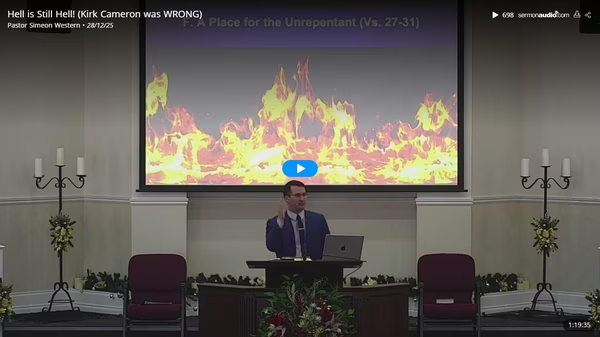
A Place for the Unrepentant (Vs. 27-31)
- The rich man knew that repentance was required to stay out of hell! (Vs. 30)
- This is why the “no repentance” gospel being preached today is so damnable and dangerous.
The Damnation of Hell (Vs. 19-23)
The word ‘damnation’ appears 11 times in the New Testament, and it comes from the Greek word ‘krima’, meaning ‘judgment’ or the word ‘krisis’, meaning ‘justice’. Sometimes the word refers to the eternal punishment of the unsaved (Mt. 23:14, 23; Mk. 3:29; Jn. 5:29; 2 Thess. 2:12). Sometimes it refers only to judgment in a general sense to which even Christians are subject (Rom. 13:2; 14:23; 1 Cor. 11:29; 1 Tim. 5:12). Context determines which sense is in view.
The Deeds that lead to Damnation (Rom. 6:23)
- Secret sins – Rom. 2:16 “In the day when God shall judge the secrets of men by Jesus Christ according to my gospel.” Secret sins committed and no one knew or found out. Secret sins of the heart. Secret lusts, secret thoughts, secret hatred, etc…
- Spoken sins – Matthew 12:36 Jesus said, “But I say unto you, That every idle word that men shall speak, they shall give account thereof in the day of judgment.” This is more than just words spoken carelessly. The word also means ‘barren’ and ‘useless’. It includes every dirty joke, swear word and blasphemy.
- Statute Sins – 1 John 3:4 “Whosoever committeth sin transgresseth also the law: for sin is the transgression of the law.” Romans 3:19 “Now we know that what things soever the law saith, it saith to them who are under the law: that every mouth may be stopped, and all the world may become guilty before God.”
- Specified Sins – Rev. 21:8 “But the fearful, and unbelieving, and the abominable, and murderers, and whoremongers, and sorcerers, and idolaters, and all liars, shall have their part in the lake which burneth with fire and brimstone: which is the second death.” These are some of the sins that will be found recorded in the books and form the basis of God’s judgment of the lost.
- Fearful = those who refuse to trust Christ because of the fear of man. E.g. the fear of opposition from family and friends.
- Unbelieving = unbelief is a sinful choice that damns the soul (Mk. 16:16).
- Abominable = the root word is “I pollute” and refers to that which is unclean before God, both spiritual and physical. Refers to those who live and practice abominable sins.
- Murderers = those who break the 6th commandment (Ex. 20:13).
- Whoremongers = a user of whores (prostitutes). The word encompasses all forms of sexual sins which are against the 7th commandment, such as fornication, adultery, pornography, sodomy and bestiality.
- Sorcerers = those involved in witchcraft and the dark arts in all their forms. The word encompasses “every type of dark craft, enchantment, astrology, fortune telling, necromancy, and consulting with familiar spirits.” (Cloud)
- Idolaters = those who break the first and second commandments – “Thou shalt have no other gods before me” and “Thou shalt not make unto thee any graven image.” It includes those who create their own imaginary god.
- Liars = notice the word ‘all’. It covers lying in all its forms. God is truth, so to lie is to put yourself in direct opposition to His very character. Lies are of the devil (Jn. 8:44). Lies plunged God’s creation into darkness. Fallen man is a liar by nature (Ps. 58:3). The fallen heart is “deceitful above all things” (Jer. 17:9).
- Self-righteous Sins – the sin of trusting in your good works instead of receiving God’s free gift of salvation by faith (Eph. 2:8-9; Isaiah 64:6; Rom. 3:20; 4:4-5).
The Duration of Hell (Vs. 23)
The Bible is crystal clear that hell is eternal, conscious torment.
The Declarations of the Bible prove Hell is Eternal
- Matt. 25:46 “And these shall go away into everlasting punishment: but the righteous into life eternal.”
- 2 Thess. 1:9 “Who shall be punished with everlasting destruction from the presence of the Lord, and from the glory of his power.”
- Rev. 14:10 “The same shall drink of the wine of the wrath of God, which is poured out without mixture into the cup of his indignation; and he shall be tormented with fire and brimstone in the presence of the holy angels, and in the presence of the Lamb.”
- Matt. 18:8 “Wherefore if thy hand or thy foot offend thee, cut them off, and cast them from thee: it is better for thee to enter into life halt or maimed, rather than having two hands or two feet to be cast into everlasting fire.”
- Matt. 25:41 “Then shall he say also unto them on the left hand, Depart from me, ye cursed, into everlasting fire, prepared for the devil and his angels.”
The Illustrations in the Bible prove it is Eternal
- The illustration of the rich man in hell (Lk. 16:23). Note the words “being in torments”. The word ‘being’ is a present, active participle with the sense “to be in a state – to be or exist in a state or condition; often of states that are enduring as opposed to temporary.” (Logos Exegetical Guide)
- The illustration of the inhabitants of Sodom & Gomorrah (Jude 1:7). Note the present tense ‘suffering’ which is a present, active participle. It does not say ‘suffered’ (past tense) but ‘suffering’ (present tense).
- The illustration of the beast and the false prophet (Rev. 20:10). Observe that the devil is cast into the lake of fire 1,000 years after the beast and the false prophet, and they are still there (‘are’)! The torment then goes on “forever and ever”. Words could not be plainer.
The Deliverance from Hell
The Provision of Salvation (John 3:16; Rom. 5:8; 2 Pet. 3:9; 1 Tim. 2:4)
- Christ paid for our sins on the cross (1 Cor. 15:4-5)
- Christ paid the penalty of our sin (death) (Rom. 6:23
The Priority of Soul-winning (Jude 1:22-23)
- The false doctrine of annihilationism diminishes the saint’s motivation for soul-winning. If sinners are not going to suffer consciously for eternity in hell, soul-winning becomes less urgent. Beliefs affect practice! But the truth that the lost will spend eternity in conscious suffering makes soulwinning the most important thing a believer can be involved with.
- The false doctrine of annihilationism diminishes the sinner’s motivation to repent. If rejecting Christ means I get nuked at the end and don’t suffer eternally in hell, why not just enjoy a life of sin? After all, if annihilationism is true, I won’t exist after the judgment and will essentially be asleep for eternity. Many would prefer this option to repenting of their sin and spending eternity with a Holy God!
Conclusion
- To the lost: Repent or perish!
- To the saved: Rescue the perishing!
References
- Definition: The doctrine of annihilation (or annihilationism) in Christian theology is the belief that the unrighteous or impenitent, after judgment, will be completely destroyed, ceasing to exist rather than suffering eternal conscious torment in hell, offering a final, irreversible end to their being.
Sermon Audio Id: 12272573857900