


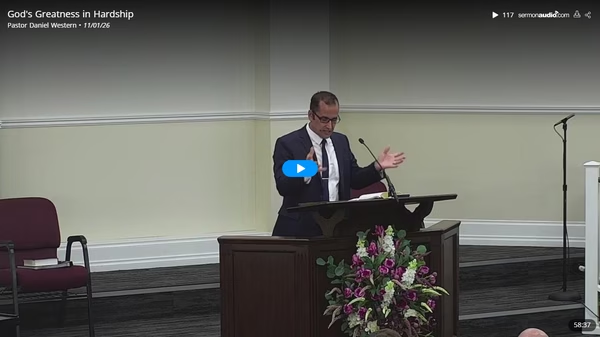
Have you ever looked at a painful situation in your life and asked, why me? Romans 8:28-39 speaks directly into that question – not with empty reassurance, but with the settled confidence that the God who gave His only begotten Son for you is actively working all things together for good in your life. His plan is to shape you into the likeness of Christ; His power stands as your protector against every adversary, every lack, and every accusation; and His love holds you with a grip that nothing in all creation can break. You are not merely surviving – you are more than a conqueror through Him that loved you. Whether your trial is major or just a daily frustration, the invitation is to stop, trust God by faith, and let Him do something special even with the pieces that don’t seem to fit.
Romans 8:28 opens with three often-overlooked words: “and we know.” The assurance that all things work together for good is not wishful thinking or a vague platitude – it is a settled confidence grounded in the character of an unchanging God. The world offers many philosophies for coping with hardship. Some people say they just take one day at a time. Others insist that everything happens for a reason, though they have no foundation for knowing that apart from God. Buddhist detachment proposes two simple questions – can I do something about it? If yes, don’t worry; if no, don’t worry – but real suffering is not that tidy. Every human philosophy eventually buckles under sufficient weight. Only a faith anchored in God’s revealed word can bear the full load, because the believer knows who stands behind the promise. When your faith is in an unchanging God, you don’t have to discard it when circumstances turn desperate. You can know – truly know – that God is working all things together for good.
The scope of that promise is breathtaking. “All things” does not merely include the obviously good – the financial deal that works out, the friendship that flourishes. It encompasses the painful, the unwanted, and the seemingly pointless. Loss of relationships, health, finances, employment, loved ones, reputation through slander, friends, dignity at someone else’s hands, an increase of enemies, verbal and physical attacks, temptations of every kind. These are the things that cause grief in body, soul, spirit, or all three. How could any of these work together for good? It is different when they are in the hands of a God who can do no wrong – who can take the wrong and use it for something right. That takes faith to believe.
Like a jigsaw puzzle piece that appears misshapen and useless until the full picture emerges, every element of the believer’s life has a place in God’s design. Even the piece you tried to throw away has a spot. God can take busted pieces and make beautiful things, the way a damaged railway sleeper full of spike holes and termite damage can be filled with resin, sanded back, and turned into something beautiful. All of us, to varying degrees, are like that damaged timber – busted up because of our own sin, perhaps damaged further by what others did to us – and yet God takes us and makes something glorifying to Christ. Your life is not for the firebox; it is for the glorification of His Son.
The purpose behind God’s design is sanctification – conformity to the image of Christ. God’s foreknowledge is not causative; free actions are not foreseen because God caused them, but because they will take place. He looked forward, saw who would trust Christ as Saviour, and from that point predetermined to shape each one into the likeness of His Son. God is no less powerful for giving man a free will. What was it that God predestined believers to? Not to salvation in the Calvinistic sense, but to be conformed to the image of His Son – the greatest work of God using all things together for good.
That shaping is not comfortable. Like a sculptor who was asked how he carved a beautiful horse from marble – “Everything that doesn’t look like a horse, I knock it off” – God takes His hammer and chisel to the things in our lives that look nothing like His Son. This is who I am, the believer protests. That’s the problem, God replies. Your identity is supposed to be Christ, not you. The difficult colleague who pushes your buttons, the situation that reveals how un-Christlike your responses really are, the health problem, the workplace frustration – these are God’s tools for fashioning and shaping. The choice is whether to submit to the process or resist it and have God bring the same lesson back again and again. It really is a blank contract – your name on it, a place for your signature, and the details to be confirmed as the situation requires. Christlike, or not Christlike?
God’s power also protects His children in the midst of hardship. “If God be for us, who can be against us?” is not a promise of immunity from trouble but an assurance that no adversary can ultimately prevail. A strong ally changes everything – the little bloke who would never pick a fight suddenly has courage when his big mates are standing behind him; the small country speaks freely when backed by a powerful nation. God is the ultimate ally. He is able to allow some blows to fall on us – to teach us and mould us – but He is also able to discriminately deflect others. He is not asleep while we are in various perils. Satan could not touch Job without God’s permission.
“He that spared not his own Son, but delivered him up for us all, how shall he not with him also freely give us all things?” The God who gave the most precious gift of all will certainly supply every lesser need – though often not until the precise moment it is required. Never early, never late, always just on time. The believer’s charges have also been cleared by the supreme Judge of the universe. Before salvation, every person carries a list of charges they cannot even remember – every wrong thought, word, and action. But at salvation, God clears it all: you’re pardoned, you’re free. Who can accuse when the supreme Judge has acquitted? And Christ Himself, the very one who will one day condemn the unbelieving world, now stands on the believer’s side, making intercession before the throne.
Nothing can sever the bond of divine love that holds God’s children. Paul catalogues every conceivable threat – tribulation, distress, persecution, famine, nakedness, peril, sword – and declares them all powerless. Human love is fragile and conditional; people walk out when feelings change. But God’s love is altogether different. The believer is not merely surviving but “more than a conqueror.” In God’s economy there is no wastage – not even breaking even, but profit over and above the normal. People miss out on God showing Himself strong to them because they refuse to trust Him by faith.
Paul then expands the scope to its absolute limit: neither death, nor life, nor angels, nor principalities, nor powers, nor things present, nor things to come, nor height, nor depth, nor any other creature can separate the believer from the love of God in Christ Jesus. Death means being present with the Lord – truly victorious. Life with all its frustrations, disappointments, broken dreams, and tiredness cannot break the bond. Present circumstances may be terrible, but they cannot separate. The future is unknown, but it holds no power to sever God’s love. No created being, no spiritual force, no dimension of space or time can touch it. Although still upon this earth, the believer is bound to God Himself by an eternal, non-severable cord of divine love. The only question is whether you will trust God by faith in the trial or resort to your own means and fail of the grace of God.
Sermon Audio Id: 11126721204190