


Exposition of the final exhortations of the Book of Revelation.
We now come to the concluding section of the Book of Revelation. It contains a number of very powerful, rousing exhortations and instructions. Some striking resemblances between the prologue the epilogue can also be noted.
The text alternates between the voice of the angel, Christ and the Apostle John as follows:
- Vs. 6, 9-11 – THE REVEALING ANGEL
- Vs. 7, 12-20 – THE LORD JESUS CHRIST
- Vs. 8, 20-21 – THE APOSTLE JOHN
Throughout this section there is a tone of urgency to the reader, both saved and unsaved to respond appropriately to the challenge of the Book. These verses present the grand finale not only to the Book of Revelation but also to the whole Bible.
We will study these final words of the Book of Revelation in 5 sections:
Final Exhortations (Vs. 6-11)
The focus of these verses is upon the “sayings” (Vs. 6, 7, 9, 10), the “things” (Vs. 6, 8) and “this book” (Vs. 7, 9, 10). There are four exhortations that can be discerned in relation to the truths that have been revealed in the Book of Revelation:
The Certainty of the Message (Vs. 6)
It is certain because of…
- The Divine Declaration (Vs. 6a)
- The Word of God is Trustworthy – ‘faithful’
- The Word of God is True – ‘true’
- “Nothing in life is more certain than the Word of God.” (D. Cloud)
- The Divine Inspiration (Vs. 6b)
- “the Lord God of the holy prophets” = God is the source of Divine truth.
- “to shew unto his servants” = the recipients of the truth. The truth was “once delivered unto the saints” (Jude 1:3). The truth is revealed for our edification and benefit that we might know God and His ways.
The Immanency of the Message (Vs. 6b-7; 10)
- The Revelation events are looming (Vs. 6b; 10)
- The events prophesied in this Book are pictured as being on the verge of happening. The storm clouds of God’s wrath are gathering over this wicked world, and will suddenly burst forth in the judgments of the tribulation. “The Revelation of Jesus Christ, which God gave unto him, to shew unto his servants things which must shortly come to pass; and he sent and signified it by his angel unto his servant John:” (Rev. 1:1) “…for the time is at hand.” (Vs. 10)
- Vs. 10 – Revelation is declared to be an unsealed Book on account of their imminent fulfilment. This is in contrast to the command that was given to Daniel the prophet – “But thou, O Daniel, shut up the words, and seal the book, even to the time of the end: many shall run to and fro, and knowledge shall be increased.” “The Old Testament prophecies of the end times were sealed until the time of their fulfillment drew nigh. This is why prophecy took on a new light in the 19th century and began to be understood more clearly than ever before in church history.” (Cloud)
- The Return of Christ is looming (Vs. 7)
- The theme of the imminent return of Christ is oft repeated in the New Testament in general and in the Book of Revelation in particular. See Rev. 3:11; 16:15; 22:7, 12 & 20.
- “blessed is he” = the sixth beatitude in the Book is pronounced. A blessing is promised to those who obey the commands of the book. Revelation promises a blessing to those who will read, hear and obey its truth (See Rev. 1:3).
The Potency of the Message (Vs. 8-9)
The power of the message of Revelation is illustrated by John’s response to it. Note two things about John’s response:
- What was right with his response (Vs. 8)
- John was rightly overwhelmed and deeply in awe of the truths that had been revealed to him by God that he felt compelled to worship.
- This is how all believers should respond in heart to the Book of Revelation. As we see Christ revealed in such breathtaking majesty and glory in this Book, our hearts should be filled with awe, wonder and worship.
- What was wrong with his response (Vs. 9)
- John was about to misdirect the glory to the messenger rather than to the Author.
- This is a good reminder that truth is to govern our worship, not our feelings alone. Our feelings must be channeled in the right direction towards the throne of God.
- This verse also makes it very clear that angels are never to receive worship. This refutes the Roman Catholic practice of praying to angels. It refutes the practice becoming increasingly popular in some Charismatic circles to seek to engage angelic involvement in their lives (e.g. Bill Johnson and Bethel Church in the USA).
The Urgency of the Message (Vs. 11)
This verse states in a dramatic and forceful way the eternal permanence of one’s decision concerning salvation.
- The eternal state of the unrepentant (Vs. 11a)
- The eternal state of the repentant (Vs. 11b)
- David Cloud: “The angel pronounces the condition that will exist after the judgment. Those who are unjust and filthy will be unjust and filthy still because there will be no possibility of conversion and salvation. In this present life there is the possibility of conversion but not in the next.”
- John Walvoord: “By this he does not mean that people should remain unmoved by the prophecies of this book, but rather that if the prophecies are rejected, there is no other message that will work…The evil must continue in their evil way and be judged by the Lord when He comes. It is an either/or proposition with no neutrality possible. There is a sense also in which present choices fix character; a time is coming when change will be impossible. Present choices will become permanent in character.”
- Robert L. Thomas: “The word ‘let’ is the ‘let’ of withdrawal instead of the ‘let’ of positive exhortation. The invitation of 22:17 makes it clear that an opportunity for the right choice remains. The teaching is simply that once a person makes that choice, he has sealed his eternal destiny for better or worse.”
Final Declarations (Vs. 12-16)
These declarations come from the lips of Christ Himself. Christ declares…
His Coming (Vs. 12)
- The immanency of Christ’s return is again emphasized.
- The rewards Christ brings with Him is emphasized. For the church age believers, this points us to the judgment seat of Christ where our service for the Lord is reviewed and rewards are either given or lost, depending on how we have lived our Christian lives (See 1 Cor. 3:11-15; 2 Cor. 5:10-11).
His Character (Vs. 13, 16)
- Christ the Eternal One (Vs. 13)
- The truth of Christ’s eternality is stated in three phrases. “The three pairs of titles given in verse 13 all connote the same truth, that Christ is the beginning and source of all things, as well as the goal and consummation of all; in a word, the eternal God.” (Walvoord)
- Christ is before all things, above all things and after all things. From eternity past through to eternity future, HE IS! He is the great, eternal I AM.
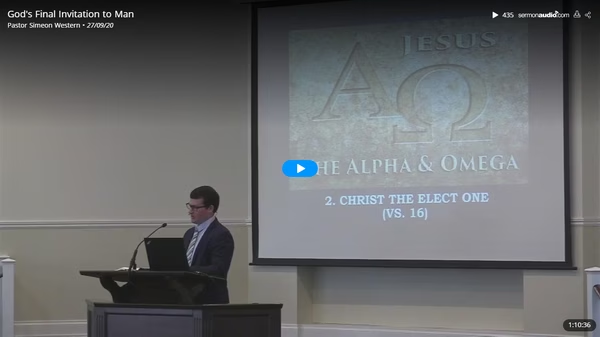
- Christ the Elect One (Vs. 16a) Christ calls Himself by the Name Jesus, which is the Name of His incarnation.
- Christ is the root of David – in His Divinity, he Predates David and is David’s Creator.
- Christ is the offspring of David – in His humanity, Christ was born in the line of David as promised in the Old Testament prophecies.
- Christ is the bright and morning star – “the morning star precedes and predicts the dawn. Likewise, the Lord Jesus Christ will come for the New Testament saints at a time when the world is still dark before the Millennial dawn.” (Cloud) “He is the one whose return will remove the cold and dark hour before the sunrise and bring in the perfect day of God. As the bright morning star, He is explicitly the brightest star in the whole galaxy.” (Thomas)
A Comparison (Vs. 14-15)
Christ contrasts the destinies of the saved and the unsaved:
- The destiny of the saved (Vs. 14) This is the 7th and final blessing pronounced in Revelation.
- The evidence of their salvation – they keep the commandments (See Eph. 2:10; James 2:26).
- The privileges of their salvation – access to the tree of life and the heavenly city.
- The destiny of the unsaved (Vs. 15)
- Their separation (15a)
- ‘without’ = what a vivid description of the eternal plight of those who reject Christ and the Gospel. 2. Thess. 1:7-9 “And to you who are troubled rest with us…Who shall be punished with everlasting destruction from the presence of the Lord, and from the glory of his power;”
- The wages of sin is death (Rom. 6:23) and death means eternal separation from God in the lake of fire (Rev. 20:14-15).
- Their sins (15b) The sins of the unrepentant are described in six ways (See Rev. 21:8):
- Dogs = a description of someone who is of low moral and spiritual character. The word is used to illustrate a fool in Prov. 26:11 and to describe false teachers in Phil. 3:2.
- Sorcerers = those involved in witchcraft and the dark arts.
- Whoremongers = the sexually immoral.
- Murderers = those who murder, shed innocent blood and shed the blood of war in a time of peace (1 Kings 2:5).
- Idolaters = those who worship false gods. Your idol is really whatever is most important to you, whatever comes before the One True God in your life. For you that could be your sinful pleasures, sport, money, career etc…
- Liars = the verse describes not just the act of lying itself but the heart behind the lies. For some, they not only lie, they actually love their lying. It becomes an integral part of their lives. The verse also reveals how sophisticated lying can be – “maketh a lie.” Lies are often cleverly constructed and developed.
- Their separation (15a)
Final Invitations (Vs. 17)
How the loving, compassionate heart of God is revealed in this verse. Right at the climax of the Bible, God gives a final, heart stirring appeal to the sinner to “come” and received salvation before it is too late.
The Ones Inviting (Vs. 17a)
- The Spirit Invites – “And the Spirit”. The Holy Spirit has been striving with sinful humanity from the beginning (Gen. 6:3). In relation to the lost before salvation, the Holy Spirit has two ministries:
- The Holy Spirit convicts you about your sin (John. 16:7-11).
- The Holy Spirit convinces you of the Saviour (John 15:26; 2 Thess. 2:13-14).
- ‘come’ = the word is repeated three times for emphasis. This is a fervent and passionate invitation. From the time that man fell into sin, God has been calling men to be reconciled to Himself through His provision of salvation. The word ‘come’ is the great invitation word of the Gospel (Is. 1:18; Matt. 11:28; John 7:37).
- The Saints Invite – “and the bride”
- The church, which is the bride of Christ, is God’s primary instrument of witness in this present age. Her primary mission is to call a sinful world to repentance (Matt. 28:18-20; Mk. 16:15; Lk. 24:46-49; John 20:21).
- 2 Cor. 5:20 “Now then we are ambassadors for Christ, as though God did beseech you by us: we pray you in Christ’s stead, be ye reconciled to God.”
- Challenge: Are you involved in this great ministry of inviting people to the Saviour? Our studies in Revelation should make us more fervent soul-winners as we become more conscious of the lateness of the hour.
- Note: The practice of public invitations in church is based on this principle of invitation found throughout the whole Bible. We are to invite and urge people to trust Christ as Saviour!
- The Saved Invite – “him that heareth”. The one who heeds the call and responds is to pick up the cry and pass it on!
The Ones Invited (Vs. 17b)
- The waterless are invited – “him that is athirst”
- Is your heart thirsty? Salvation is for those who recognize their need. You must want salvation like a thirsty man wants water.
- Illustration: The thirst you experience working outside on a hot summer’s day.
- The world is invited – “and whosoever will”
- ‘whosoever’ = a broader invitation could not be given. Salvation is for anyone who will receive it.
- 1 Tim. 2:4 “Who will have all men to be saved, and to come unto the knowledge of the truth.”
- 2. Peter 3:9 “The Lord is not slack concerning his promise, as some men count slackness; but is longsuffering to us-ward, not willing that any should perish, but that all should come to repentance.”
- 1 John 2:2 “And he is the propitiation for our sins: and not for ours only, but also for the sins of the whole world.”
- “let him take” = all are called and invited but only those who drink are saved. Salvation must be received. Illustration: “If a man is dying of thirst and one offers him a jug of pure, cold water, that man must pick up the jug and drink from it or he will die even though the water is available and perfectly sufficient to save him.” (Cloud)
- ‘freely’ = salvation is a free gift which was purchased by the blood of Christ. Salvation can only be received, not earned (See Rom. 11:6).
- ‘whosoever’ = a broader invitation could not be given. Salvation is for anyone who will receive it.
- Challenge: You can either respond to the word “come” or one day hear the word “depart”.
Final Admonitions (Vs. 18-19)
This is the most solemn warning in the Bible against tampering with it. There is a solemn warning to those who…
Add to the Book (Vs. 18)
- In the event of a sinful action by man, in both verses, a corresponding action from God is promised. In this verse, if men add to God’s Word, they are warned that the penalty will be God adding to them the judgments described in Revelation.
- This warning applies not only to the Book of Revelation but being among the last verses of the last chapter of the Bible, it applies also to the Bible as a whole.
- Adding to God’s completed Revelation is a serious and sinful thing. For example:
- The modern versions with their tampering with the Scriptures. Mostly the modern versions are full of deletions but they also contain some harmful additions in places.
- The elevation of tradition to the same level as truth (e.g. the Roman Catholic Church).
- The “new revelations” of the Charismatic movement.
- The books and writings of the cults such as the book of Mormon.
Subtract from the Book (Vs. 19)
- Notice it says “the words”. Every Word of God is inspired of God and to remove any word from the Bible is absolute wickedness (Prov. 30:5; Matt. 4:4; 2. Tim. 1:13; 3:16)!
- The modern versions are a classic example of this with their deletions of words, phrases and even whole verses. It is seen in their footnotes that question other verses or even whole sections (e.g. the second half of Mark 16).
- David Cloud writes, “The modern critical Greek text removes 2,886 words, including 45 entire and 185 partial verses, that were previously included in the Received Text that held sway from the Protestant Reformation to the 20th century. This is equivalent to removing the entire books of 1 and 2 Peter.”
- The warning is severe and sobering – those who take away from God’s Word will be eternally damned.
- Note: This is not teaching loss of salvation as the Bible is clear on that in other verses but it is teaching that tampering with God’s Word is an activity of the unregenerate and carries the penalty of eternal damnation. “It is not that he was saved and loses it, but he was never saved and never will be saved because of his damnable deed.” (Cloud)
- Deut. 4:2 “Ye shall not add unto the word which I command you, neither shall ye diminish ought from it, that ye may keep the commandments of the LORD your God which I command you.”
- Prov. 30:5-6 “Every word of God is pure: he is a shield unto them that put their trust in him. Add thou not unto his words, lest he reprove thee, and thou be found a liar.”
Final Benedictions (Vs. 20-21)
Christ’s Final Words (Vs. 20a)
John’s Final Words (Vs. 20b-21)
- “Amen. Even so, come, Lord Jesus.” = John’s response to Christ’s words. This is the heart response of the child of God to the truth of Christ’s coming.
- “the grace” = Revelation begins and ends with grace (Rev. 1:4; 22:21). We could say that it is “bookended” by God’s grace.
- The Bible begins with God (Gen. 1:1) and ends with grace (Rev. 22:21). God is a God of grace and that truth runs like a golden thread in the Scriptures from start to finish. God delights in grace whereas judgment is His strange work (Is. 28:21).
Conclusion
To the lost: Is this God’s final invitation to you? Will you come to Christ and receive His gift of salvation right now?
To the saved: Is the truth of Christ’s return transforming your life? Are you living in light of His return? Are you looking for His return? Are you being a witness for Christ, calling the lost to come to Christ?
Sermon 37 of 38 in Revelation Series