


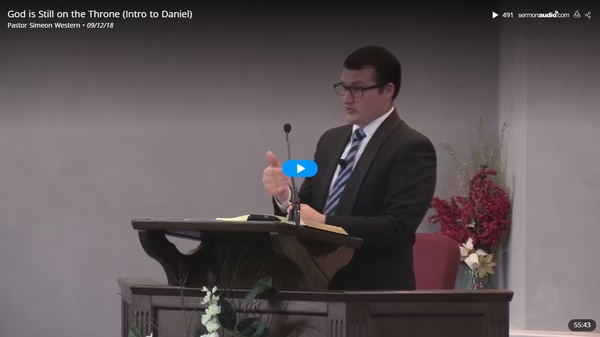
Overview and introduction to the Book of Daniel with practical challenges. The Book of Daniel is one of great significant in the area of Bible prophecy. It also contains much inspiration and encouragement for the believer in the area of practical Christian living as we consider the godly example of Daniel, a man living for God in a difficult place.
- Daniel was likely written around 536 B.C. towards the end of his life
- Daniel’s ministry was in Babylon during the period of the captivity. There are three main periods of the prophets:
- Pre-Exilic = prior to the captivity (e.g. Isaiah)
- Exilic = during the captivity (e.g. Ezekiel & Daniel)
- Post-Exilic = after the captivity
- The Book of Daniel is one of great significant in the area of Bible prophecy. It also contains much inspiration and encouragement for the believer in the area of practical Christian living as we consider the godly example of Daniel, a man living for God in a difficult place.
- In this introductory lesson, we will endeavor to acquaint ourselves with the background and theme of the Book under four headings.
The Authorship of Daniel
The Attack of his Authorship
- The Book of Daniel has been subjected to vicious and relentless attacks from the liberal critics. Some suggest more so than even the Book of Genesis. They say that Daniel is a fictitious book, written after the events that occurred during the period of the Maccabees. This is because of the startling accuracy of Daniel’s prophesies. They assert that it is not possible for the future to be predicted, therefore it must have been written afterwards!
- “Their attacks can be traced back to a man by the name of Porphyry who was born in A.D. 233 in Tyre, Syria. He wrote fifteen books with the revealing title “Against the Christians.” Porphyry became a polytheist, which means he worshipped many gods. One of his favourite targets was Daniel. He did everything he could to prove that this book was written about 165 B.C. and that of all the events which the book of Daniel predicted were written after they had already come to pass. Now all of the modern critics have taken Porphyry’s arguments and rehashed them.” (Denis Lyle)
- Sir Robert Anderson, author of the famous work “Messiah the Prince”, wrote a book entitled “Daniel in the Critics Den” to defend his authorship.
- W.A. Criswell said, “There is not a liberal theologian in the world past or present who accepts the authenticity of the Book of Daniel.”
The Affirmation of his Authorship
Daniel’s authenticity is affirmed biblically:
- In the Old Testament by Ezekiel
- Ezekiel was a contemporary of Daniel and obviously held Daniel in high esteem as a man of God, linking his name with two other giants of the faith, Noah and Job.
- Ezekiel mentions Daniel three times (Ez. 14:14, 20; 28:3)
- In the New Testament by Christ
- In the Olivet discourse, Christ refers to “Daniel the prophet” (Matt. 24:15; Mark 13:14)
- I’ll take Christ’s word over the critics any day!
Daniels authenticity is affirmed archeologically Consider some archeological discoveries that disprove the critics:
- Nebuchadnezzar’s storing of the temple treasures in the house of his god (1:2): The modernists criticized this saying that this was an unknown custom and couldn’t find a reference to it in ancient history. They have now discovered an inscription that proves Nebuchadnezzar always put his choicest spoils into his house of worship. It was one of his peculiar habits. How accurate is the Word of God! (Lyle)
- Ashpenaz, master of the critics: The sceptics asserted he was another fictional character in this fictional book. However, in the last quarter of a century, the name Ashpenaz has been found on the monuments of ancient Babylon which are now in the Berlin Museum. It says, “Ashpenaz, master of eunuchs in the time of Nebuchadnezzar.” (Lyle)
- Nebuchadnezzar’s “image of gold”: Discovered records show that it was Nebuchadnezzar’s custom to make public the worshipping of huge images. Excavators at Babylon found this furnace, with an inscription: “This is the place of burning where men who blaspheme the gods of Chaldea die by fire.”
- The Dead Sea scrolls contain 8 copies of Daniel, more than any other manuscript.
The Attributes of Daniel
Consider it Linguistically
- Daniel is written in both Hebrew and Aramaic.
- Sections by language:
- 1:1 to 2:3 – Hebrew
- 2:4 to 7:28 – Aramaic (Chaldean)
- 8:1 to 12:13 – Hebrew
- Aramaic was the Gentile language of commerce and diplomacy over the whole known world at that time. Interestingly, Daniel 2-7 gives the general outline of the whole course of the “times of the Gentiles” whereas the latter visions foretell the future especially in relation to the Jewish people. So the section relating particularly to the Gentiles was written in Aramaic and the section relating particularly to the Jews was written in Hebrew.
Consider it Divisionally
Daniel has 12 chapters and divides fairly neatly into two sections:
- The Historical Section (Chapter 1-6) – Daniel interprets others dreams
- The Prophetical Section (Chapter 7-12) – Daniel receives his own dreams and they are interpreted for him by the angel
Consider it Prophetically
- Daniel is a very important Book for understanding Bible prophecy
- For example, Daniel’s 70-week prophecy in Chapter 9 is foundational to understanding an overview of last things. In fact, tit has been called “the backbone of prophecy”
- It has been said that prophecy is “history written in advance” (See Isaiah 46:9-10)
Consider it Practically
- Daniel’s life is a tremendous challenge to us in many areas such as living for God in a hostile world. Daniel is an example of the truth “them that honour me, I will honour” (1 Sam. 2:30) Daniel and his friends did not allow their circumstances to dictate their convictions
- Spurgeon: “The lions would not have enjoyed Daniel if they could have eaten him as he was 50% grit and 50% backbone.”
The Audience of Daniel
The Place – Babylon (How did they get there?)
- Chapter 1:1-2 details in brief the occasion whereby the people of God arrived in Babylon
- Nebuchadnezzar conquered Jerusalem around 605 B.C. after defeating the Egyptian army at Carchemish on the upper Euphrates River. Egypt and Babylon were the two superpowers at this time in history and were competing with each other over control of that part of the world.
- Nebuchadnezzar received word that his father (Nabopolassar) had died and cut short his campaign in Palestine, taking home with him some of the temple vessels as well as the cream of the Jewish young men. Daniel and his companions were among those captives.
- There were three Babylonian invasions of the kingdom of Judah
- First invasion – took place around 605 B.C. Daniel and a few other seed royal taken to Babylon with some of the temple vessels
- Second invasion – in 598 B.C. A young priest by the name of Ezekiel carried captive in this group (2 Kings 24:10-17)
- Third invasion – in 587 B.C. where city, temple and nation destroyed (2 Kings 25:1-21)
The People – Jews in captivity (Why were they there?)
Because of their insubordination (disobedience):
- Every 7th year the Israelites were to observe the Sabbatical year. That is, they were not to farm the land for that year but allow the land to rest (Lev. 25:1-7). God had warned that if they failed to obey Him, they would be taken into captivity so that the land could “enjoy her sabbaths” (Lev. 26:32-35)
- The Israelites had neglected to observe this command for 490 years. This meant that 70 Sabbatical years were owed the land so God sent them to Babylon for 70 years!
- Challenge: God says what He means, and means what He says! Disobedience to the Lord is a serious matter. You can’t disregard the Word of God without there being consequences.
Because of their idolatry:
- The people of God had stubbornly persisted in their pursuit of idol worship and its associated, evil practices (creed & practice). The captivity mentioned in 1:2 came in the days of Jehoiakim. Though he was son to godly Josiah, he “did that which was evil in the sigh of the LORD, according to all that his fathers had done.” (2 Kings 23:37) God had warned his people repeatedly through the ministry of the prophets, giving them an opportunity to repent and avert judgment. See Jeremiah 25:1-14 on the 70- year captivity. God’s patience has its limits!
- Babylon was the centre of idol worship in that day. The people of God wanted idols so eventually God placed them in the capital city of idolatry for 70 years so that they would eventually hate the idols they once loved! Sometimes when we fail to take God at His Word, He eventually gives us what we want and lets us have our gutful of it until we again long for fellowship with Him. “By the rivers of Babylon, there we sat down, yea, we wept, when we remembered Zion.” (Psalm 137:1-9)
The Aim of Daniel
Daniel reveals God to us in a special way. The dominant themes are:
The Dominion of God (4:17, 25 & 32)
- This is the key theme in the Book of Daniel. It teaches us the truth of God’s sovereign rulership. God is on the throne! God rules in the affairs of men!
- Examples
- Jehoiakim (1:2)
- Nebuchadnezzar (2:37; 4:34-35)
- Belshazzar (5:23-28)
- Psalm 115:3 “But our God is in the heavens: he hath done whatsoever he hath pleased.”
- Psalm 99:1-3 “The LORD reigneth; let the people tremble: he sitteth between the cherubims; let the earth be moved. The LORD is great in Zion; and he is high above all the people. Let them praise thy great and terrible name; for it is holy.”
The Designation of God
- The most frequent title of God in the Book is “the most High” occurring 13 times in the Book (e.g. 3:26; 4:2 17, 24, 25, 32, 34; 7:18, 22, 25 & 27).
- We get a sense for the significance of this Title in Abraham’s words (one of the first uses of this Title of God) to the king of Sodom in Genesis 14:22 “I have lift up mine hand unto the Lord, the most high God, the possessor of heaven and earth.” The universe is the property of our Sovereign, Almighty God and it is His Divine Prerogative to execute His will in that universe.
- Isaiah 6:1 “In the year that king Uzziah died I saw also the Lord sitting upon a throne, high and lifted up,”
- Isaiah 57:15 “For thus saith the high and lofty One that inhabiteth eternity, whose name is Holy; I dwell in the high and holy place, with him also that is of a contrite and humble spirit, to revive the spirit of the humble, and to revive the heart of the contrite ones.”
- Psalm 86:10 “For thou art great, and doest wondrous things: thou art God alone.”
Conclusion
Are you pushing past God’s warnings against sin? Are we resting in the sovereignty of God? Will we stand for God when the circumstances are hostile to our Christian faith?
Sermon 1 of 23 in Daniel Series
Sermon Audio Id: 12818221046706