


In our last message we watched Noah as he constructed the ark, an ocean-liner sized vessel with more than sufficient capacity to carry Noah’s family, the required number of animals and the food supplies for all on board. We now come to the account of the flood itself. The flood account is a powerful reminder that God is a just and Holy God who will judge unrepentant men who refuse His offer of grace. Never forget the backdrop to this account of the longsuffering and mercy of God that was rejected by the pre-flood world.
Henry Morris: “God had spoken to Noah nearly one hundred years earlier giving instructions concerning the Ark and the animals, and assuring him that the flood indeed would come on schedule. There had been no further word from heaven, but Noah had proceeded steadily and faithfully with his unique mission and ministry, obeying God’s commandments without question. With all the urgency possible, he preached the coming judgment, year after year, but to no avail, so far as converts were concerned. Finally, the Ark was completed and all the animals were assembling. The 120 years would be up in a few days, and Grandfather Methuselah, who had served the Lord longer than any man who ever lived, was on his deathbed. Then it was, after a century of silence, that God once again spoke to Noah.”1
We have divided the account into three sections for our study:
The Directives Before the Flood (Vs. 1-9; 13-16)
Let’s break down what God said to Noah just before the flood came. There was:
The Final Invitation into the Ark (Vs. 1)
- The reach of the invitation – “come thou and all thy house” (Vs. 1a)
- Noah was invited – “come thou”. Note that God said ‘come’, not ‘go’. God would be in the ark with them, preserving them from the watery judgment.
- Noah’s family was invited – “all thy house”. Noah’s entire household was saved. His children all made an individual decision to enter the ark of safety (Vs. 13). Acts 16:31 “And they said, Believe on the Lord Jesus Christ, and thou shalt be saved, and thy house.”
- You are invited! God is an invitational God so His invitation extends to you too. All down through history, God has issued the salvation call for sinners to repent and be reconciled to Himself.
- Matt. 11:28 “Come unto me, all ye that labour and are heavy laden, and I will give you rest.”
- Revelation 22:17 “And the Spirit and the bride say, Come. And let him that heareth say, Come. And let him that is athirst come. And whosoever will, let him take the water of life freely.” The Spirit and the saints invite the sinner to come and avail themselves of the water of life.
- The rescue in the invitation – “into the ark” (Vs. 1b)
- The ark was the only place of safety from the judgment that was about to fall.
- The ark is a wonderful picture of salvation.
- The ark was pitched (Heb. ‘atonement’) within and without protecting those inside from the waters of judgment outside. In like manner it is only the atoning blood of Christ that has the power to cover the sinner and protect him from God’s wrath. Eph. 1:7 “In whom we have redemption through his blood, the forgiveness of sins, according to the riches of his grace;”
- The ark’s window provided light. Jesus Christ is the light of the world (John 8:12; 9:5).
- You had to be in the ark to be rescued from the flood. Knowing about the ark or viewing it from afar would not save you. In like manner, you must be “in Christ” in order to escape God’s judgment. 2 Cor. 5:17 “Therefore if any man be in Christ, he is a new creature: old things are passed away; behold, all things are become new.”
- You had to make a personal decision to enter the ark. In like manner, you must make a choice to receive Christ’s offer of salvation. You are not forced!
- You had to enter through the ark’s only door, accepting God’s only way of salvation. The ark was God’s design, revealed to Noah. You could not invent your own way to escape the flood. In like manner, Jesus Christ is the door, the only way of salvation.
- John 10:9 “I am the door: by me if any man enter in, he shall be saved, and shall go in and out, and find pasture.”
- John 14:6 “Jesus saith unto him, I am the way, the truth, and the life: no man cometh unto the Father, but by me.”
- Acts 4:12 “Neither is there salvation in any other: for there is none other name under heaven given among men, whereby we must be saved.”
- The reason for the invitation – “thee have I seen righteous” (Vs. 1c)
- Remember, this was not Noah’s own righteousness. Noah was saved by grace (Gen. 6:8), through faith (Heb. 11:7) and was therefore made righteous in the sight of God (Gen. 6:9).
- Once saved, Noah lived a godly, separated, sanctified and obedient life for God’s glory. Walking with God is the truly blessed life and comes with great rewards and blessings. All those long years of faithfully serving God were worth every minute of sacrifice for Noah and His family.
The Final Instructions for the Ark (Vs. 2-9; 13-16)
- The Creatures for the Ark (Vs. 2-3; 14-16)
- Clean beasts – by sevens. This would mean three pairs instead of one, leaving a spare animal for sacrifice. Another possibility is that the word ‘sevens’ refers to seven pairs making 14 in total. “The larger number of clean animals would also encourage the greater numerical proliferation of the clean animals after the Flood.”2
- Unclean beats – by two.
- Fowls of air – by sevens.
- Note: We see God’s mercy not only upon mankind in saving Noah’s family but also upon the animals in that representatives of each kind were preserved.
- The Countdown to the Flood (Vs. 4)
- Evidently by this time the construction of the flood is complete. Methuselah has probably just died, a sign that God’s judgment was about to fall. It could be that the remaining seven days served as a period of mourning for Methuselah (See Gen. 50:10).
- God reveals to Noah that there is only seven days to go before the rain would begin to fall. Time was almost up for the pre-flood world!
- Challenge: Time is running out for the world. God has not revealed to us the exactly how much time is left on His Divine timetable before the rapture comes and the judgments of the tribulation period are unleashed on this wicked world. But we do know that it is imminent (could happen at any moment) and that it is nearer with each passing day (Rom. 13:11).
- Challenge: Time is running out for you. Hebrews 9:27 “And as it is appointed unto men once to die, but after this the judgment:”
- “I will cause it to rain” = God was the cause of the flood! We do not need to seek a purely naturalistic explanation for what got the rains started.
- “every living substance” = lit. “all substance” or “all that grows up”. Seems to include plants as well as animals.
- The Compliance of Noah (Vs. 5-9; 13) Observe the following qualities of Noah’s obedience:
- The Totality of Noah’s Obedience (Vs. 5). No partial obedience there! Most Christians want to obey God selectively. Like Saul of old, they obey some things but not all things that God requires.
- The Trust of Noah’s Obedience – “because of the waters of the flood” (Vs. 7) At this point the waters of the flood had not come upon the earth but Noah obeyed in faith. He believed God’s Word! Heb. 11:7 “By faith Noah, being warned of God of things not seen as yet, moved with fear, prepared an ark to the saving of his house; by the which he condemned the world, and became heir of the righteousness which is by faith.”
- The Timing of Noah’s Obedience – “the selfsame day” (Vs. 13). The word ‘selfsame’ means “the very same”. So, it means that Noah and his family took God’s Word seriously about the seven days left and entered the ark the very same day the flood began (day 7). They believed in the absolute accuracy of the Word of God.
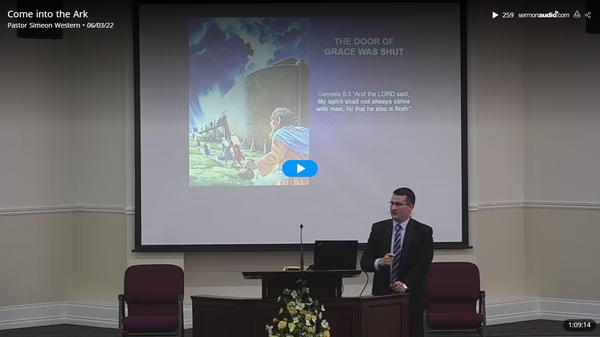
- The Closing of the Ark (Vs. 16) The closing of the Ark’s Door by the hand of God teaches two lessons:
- The salvation of Noah’s family. God’s shutting of the door is a wonderful picture of the security of the believer. God invited them into the ark of salvation and sealed them safely inside it. “The old world was forever dead to them from that moment on. Their life was henceforth a new life and they were to live in a new world.”3
- The damnation of Noah’s world. God’s shutting of the door of the ark is a sobering reminder of the truth that the day of grace will not last forever. From this moment on, those outside the ark were doomed. There comes a time when the door of opportunity is closed forever to those who are hardened in their unrepentant state and judgment comes.
- Challenge: Come into the ark of salvation (Jesus Christ) while the door is open for you. “…behold, now is the accepted time; behold, now is the day of salvation.” (2 Cor. 6:2) Isaiah 55:6-7 “Seek ye the LORD while he may be found, call ye upon him while he is near: Let the wicked forsake his way, and the unrighteous man his thoughts: and let him return unto the LORD, and he will have mercy upon him; and to our God, for he will abundantly pardon.”
The Description Of The Flood (Vs. 10-12)
The Day the Flood Came (Vs. 10-11a)
Two time markers are given, adding to the historicity of the flood account. This was a significant day in human history. It was:
- The sovereign timing of God (Vs. 10). The judgment fell exactly at God’s appointed time. God had revealed over a century earlier that there would be 120 years left before the flood (See Gen. 6:3). At the end of that period, God revealed to Noah the final week before the flood would come.
- The six hundredth year of Noah (Vs. 11a).
- The seventeenth day of the second month (Vs. 11b). We do not know which calendar Moses was referring to when he wrote Genesis so it is difficult to pinpoint the exact month the flood came.
The Way the Flood Came (Vs. 11b-12)
The floodwaters came from two sources:
- Waters from below the earth – “fountains of the great deep”.
- “all the fountains” = all the underground reservoirs involved. Not hard to see how the floodwaters would eventually cover the whole earth.
- “the great deep” = clearly a reference to subterranean water reserves. Since there was no rain in Eden, it would be reasonable to assume Eden’s River was fed from one of these underground water sources.
- “broken up” = a strong word meaning “to split, break open, burst open, burst forth. It has the basic idea of something splitting or dividing with force” (Baker & Carpenter) Speaks of the fracturing of earth’s crust, resulting in widespread volcanic activity, earthquakes and tsunamis. Imagine the scene. Not only do you have torrential rains from above but large volumes of water shooting into the air from below the earth along with magma etc…
- Waters from above the earth – “the windows of heaven were opened”.
- The place from which the rains fell – the water canopy above the firmament is dumped on the earth. The word ‘opened’ means “to loosen”. God released the waters from above the firmament (Gen. 1:7).
- The period for which the rain fell (Vs. 12). The rains persisted for 40 days and 40 nights. Significant local flooding can occur in a matter of hours in a torrential downpour. Imagine nonstop rains worldwide for 40 days and nights. “A worldwide rain lasting forty days would be quite impossible under present atmospheric conditions. This is explained by the dumbing of the water canopy on the earth.”4 In the Bible the number 40 “regularly describes a period of trial terminating in the victory of good and the overthrow of evil.”5
The Devastation of the Flood (Vs. 17-24)
The Progression of the Flood (Vs. 17-20)
- The Rising of the Waters (Vs. 17)
- The waters increased until the ark was lifted up above the earth.
- This tends to indicate the ark was constructed inland and that it took some time for the waters to rise to the point of lifting it off the ground. Imagine if you were in Noah’s ark when that happened. You hear the rain pelting down outside and the shouts and screams of those hoping to scramble to safety. Eventually you hear the lap of the water against the side of the ark and then it begins to move.
- The Prevailing of the Waters (Vs. 18-20)
- Four times the word ‘prevailed’ is used in relation to the flood waters.
- “the waters prevailed and were increased greatly” (Vs. 18).
- “the waters prevailed exceedingly upon the earth” (Vs. 19).
- “Fifteen cubits upward did the waters prevail” (Vs. 20).
- “the waters prevailed upon the earth” (Vs. 24).
- The word means “to be strong” (Baker & Carpenter), to conquer. It means “were overwhelmingly mighty”.6 These were powerful floodwaters that conquered the earth.
- “all the high hills, that were under the whole heaven” = words could not be plainer as to the fact this flood was world-wide. Fifteen cubits would be close to 7 meters. Note: Remember that the topography of the pre-flood world was different to what we have now in the post-flood era. Therefore, it is a mistake to take a mountain from the post-flood era such as Mount Ararat as the benchmark for the depth of the flood.
- Four times the word ‘prevailed’ is used in relation to the flood waters.
The Punishment of the Flood (Vs. 21-23)
These verses specify in great detail the universal death that came upon the planet.
- Those who were destroyed in the judgment (Vs. 21-23a). There was:
- The complete destruction of animal life.
- The complete destruction of bird life.
- The complete destruction of human life.
- The complete destruction of plant life. The phrase “every living substance” appears to include vegetation as well as animals. God had said, “I will destroy man with the earth.” (Gen. 6:13)
- We could summarize it this way. In the flood, there was the burial of fossils and the blotting out of mankind.
- It is important to note that “the fossil record is not a record of a succession of ages, but a sequence of burial. At the beginning, when the ‘fountains of the great deep’ were bursting, this would have generated underwater mudslides, or turbidity currents. Huge amounts of bottom- dwelling marine life would have been buried and fossilized right away. It is thus not surprising that we see marine invertebrates at the bottom of the fossil record. Also, about 95% of all fossils are shellfish. It should also not be surprising that we also find many fish buried near the bottom of the fossil record. Also ‘low’ in the record are those creatures at the boundary of water and land – the amphibians. After that, land creatures would be buried. So the fossil record reflects a successive burial of ecosystems as the Flood encroached upon the land from the sea.”7
- Most of the world rejects catastrophism in favor of uniformitarianism. Uniformitarianism “is a geological belief that existing processes acting the same way as at the present time are sufficient to account for all geological changes.” (Butler) Oxford dictionary defines the word as follows: “The theory that changes in the earth’s crust during geological history have resulted from the action of continuous and uniform processes.”8 However, fossils form rapidly, not gradually over time. The evidence actually supports the Biblical view of catastrophism.
- Mount St. Helens is a good case study in catastrophism. It demonstrated that significant topographical and geological changes can occur in just a matter of hours.
- “Wrong geological ideas have also led people to wrong ideas about the Bible—that the events it describes were mythological and did not actually happen. Mount St Helens changed that, which is why I have been so interested in what happened. The eruption demonstrated that geologic catastrophe can produce in hours and days geologic features previously believed to have taken millions of years. When we see what the volcano did in such a short time, we can better appreciate how the catastrophe of Noah’s Flood formed the much larger geological features on planet Earth.”9 Mount St. Helens demonstrated for example that geological layers can form in hours and canyons can be carved out very quickly. So in reality it was rapid and catastrophic, not slow and gradual for the fossil record.
- John Butler writes, “Some folk with the Scripture in hand are afraid of science, but it is science that needs to be afraid of Scripture. For Scripture speaks of heaven and hell and our eternal destiny and how to secure heaven as one’s eternal destiny. Science has no answers for the soul. Many in modern science do not like to admit the credibility of the Scripture, for then they must admit to God and sin and His judgment upon it. Many in modern science do not want to admit these things, for they want a universe without God.”10
- Those who were spared the judgment (Vs. 23b).
- The human life that was spared – Noah and his family.
- The animal life that was spared – 2 of each kind (7 for clean animals).
The Period of the Flood (Vs. 24)
- The floodwaters prevailed over the whole earth for 150 days before beginning to recede.
- It would be over an entire year (compare 7:11 and 8:13) before enough land had been exposed to permit the occupants to leave the ark.
- There are five significant date notations in the flood account:
- 2nd month, 17th day – The Beginning of the Flood (Gen. 7:11- 12).
- 7th month, 17th day – The Grounding of the ark (Gen. 8:4).
- 10th month, 1st day – The tops of the mountains become visible (Gen. 8:5).
- 1st month, 1st day – Noah removes the Ark’s covering (Gen. 8:13).
- 2nd month, 27th day – Noah and his family disembark from the Ark (Gen. 8:14-18).
- There are also five significant day notations in the flood account:
- 7 days – Countdown to the flood (Gen. 7:10).
- 40 days – Rain upon the earth (Gen. 7:12, 17).
- 150 days – waters prevail on the earth (Gen. 7:24).
- 40 days – waiting in the ark (Gen. 8:6-7).
- 7 days – week long intervals (Gen. 8:10-12). “These seven-day periods refer to the intervals of Noah sending out the dove who was sent out three times to ascertain the degree of drying that had taken place on the earth.”11
Conclusion
Have you entered the ark of salvation? Are you sheltering under his atoning blood? Will you come to Christ today and escape the coming wrath and judgment of God?
How important is obedience to God’s Word to you as a Christian?
References
- H Morris, The Genesis Record, p. 189.
- Ibid, p. 191.
- Ibid, p. 198.
- Ibid.
- Leupold, cited by J Sarfati, The Genesis Account, p. 524.
- Morris, p. 200.
- Sarfati, p. 561.
- https://www.lexico.com/definition/uniformitarianism Viewed 5.3.22.
- https://creation.com/lessons-from-mount-st-helens Viewed 5.3.22.
- J Butler, Noah the Ark Builder, pp. 81-82.
- Butler, p. 96.