


The key theme in this section is unity (See Vs. 3 and 13). Paul now outlines the leadership/ministry gifts Christ has bestowed upon the church to help preserve this unity.
This chapter: We enter the second major part of the Epistle dealing with the believer’s walk. We go from position to practice, doctrine to duty, beliefs to behavior, creed to conduct, worldview to walk etc. Truth is transforming! There are somewhere in the order of 41 imperatives/commands (H. Hoehner) in this section. In brief, God says in chapters 1-3, “I have made you a saint.” In chapters 4-6, He says, “Now, live a saintly life.” You are a saint now live like a saint!
This section (Vs. 1-16): The key theme is unity (See Vs. 3 and 13).
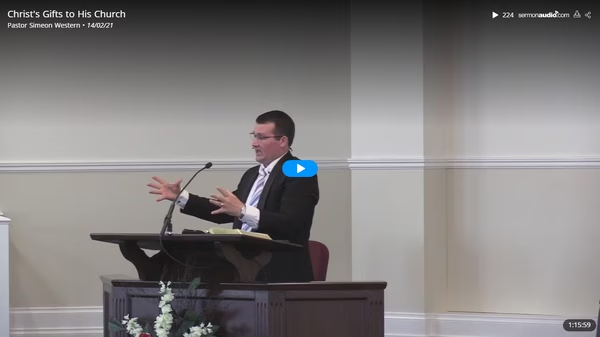
This lesson (Vs. 7-16): Paul now focuses on the gifts Christ has bestowed upon His church to help preserve this unity. “Paul moves now from what all Christians have in common to how Christians differ from each other. He is discussing variety and individuality within the unity of the Spirit.” (Wiersbe) We will study this section under three headings:
The Provision of the Gifts (Vs. 7-10)
The Recipients of the Gifts (Vs. 7)
- ‘but’ = “marks a contrast from the preceding context, going from the whole church to every individual within the church. In the oneness of the body there is also diversity.” (Hoehner)
- “unto every one of us is given grace” = grace is the Gospel in a word. We experience saving grace when we trust Christ as Saviour. Then we experience enabling grace for the Christian life and that is what is in view here. Spiritual gifts are not limited to a select few. Every Christian has received a spiritual gift to exercise for God’s glory and the edification of others.
- “measure of the gift of Christ” = the word ‘measure’ means “specific portion” (Macarthur). The Lord has sovereignly measured out the exact proportion of each believer’s gift (Rom. 12:3). Expositors explains, “Each gets the grace which Christ has to give, and each gets it in the proportion in which the Giver is pleased to bestow it; one having it in larger measure and another in smaller, but each getting it from the same Head and with the same purpose.” Christ not only “gives each believer a gift but he also determines the amount of the gift. Each believer has received from Christ a measure of a gift to be used in a particular function in the body.” (Hoehner)
The Rights of the Giver (Vs. 8-10)
- The quotation (Vs. 8)
- The quotation is from Psalm 68:18, a Messianic Psalm of victory.
- The emphasis is upon the credentials of the One giving the gifts. It is Christ’s Divine prerogative by virtue of His victorious ascension. “The central thought in Vs. 8-10 is that the Giver of the gifts is the ascended Christ.” (Macdonald)
- The explanation (Vs. 9-10)
- There is a parenthesis covering two verses where the Apostle provides a commentary on the quotation in the previous verse. A parenthesis is used to “mark of an interjected explanatory or qualifying remark.”
- Again, the emphasis is on Christ’s exalted position. The exalted, ascended, glorified Christ has Divinely bestowed gifts upon His church.
- “fill all things” = the object of Christ’s ascension. He ascended to occupy the position of supreme sovereign over the entire universe and in that position, he has the Divine right to bestow gifts to His church as He sees fit.
The Particulars of the Gifts (Vs. 11)
There are 5 gifts listed. We will divide them into two categories:
Foundational Gifts (Vs. 11a)
- Apostles = primary reference is to the original 12 apostles chosen by Christ. To qualify as an Apostle, you had to be an eye witness of the resurrection (Acts 1:21-22; 1 Cor. 9:1). The office of an Apostle was by its very nature, a temporary office, ordained of God for the establishment of the church (Eph. 2:20).
- Prophets = the N.T. prophets who had a special function of receiving and communicating direct Revelation from God prior to the completion of the New Testament. This was also a temporary gift. The prophet gift only exits now in the sense in which it is described in Romans 12. The prophet gift today is a forthtelling gift, not a foretelling gift.
Operational Gifts (Vs. 11b)
- The Evangelist Gift = the Evangelist gift involves:
- The evangelization of the lost. The root word is ‘Gospel’ so primarily an Evangelist is one who is gifted in the reaching of others with the good news. Philip is a good illustration of this in Acts 8:5 where he preaches Christ in Samaria. From Philip’s example we can also see that opening new areas for the Gospel is a part of the Evangelist’s role. Remember! All Christians are to be involved in the work of Evangelism but some have a special gift from God in that area. Paul exhorted Timothy as a pastor at Ephesus to “do the work of an Evangelist” (2 Tim. 4:5).
- The edification of the saints (Vs. 12).
- The Pastor Gift = the pastoral gift is that of shepherding the flock. It is both a gift and one of the two offices in the local church (See 1 Tim. 3). Christ equips those He calls to that office. There are several truths about the New Testament pastor worth remembering:
- There are three titles but one office. This is demonstrated in passages such as Phil. 1:1 and Titus 1:5-8. All three words are used in Acts 20:17, 28 and 1 Peter 5:1-2.
- Your pastor plays an important role in your life as a believer! He is God’s gift to the church for its protection and edification. The anti-pastor attitude today that says “I don’t need a pastor” is ignorance.
- Get the most out of your gift!
- Place yourself under your pastor’s preaching faithfully and regularly.
- Seek your pastor’s council and input in your life and ministry.
- Maintain a right attitude to your pastor. Guard your heart against falling prey to the rumor machine! If the devil can get you disconnected from your pastor and harm your spiritual life, he will.
- Be willing to receive correction as well as encouragement.
- See the pastor as your co-laborer, friend and ally in the service of the local church. His involvement in your area of ministry is to be welcomed!
- The Teacher Gift = the gift of teaching the Word of God. Every pastor must be able to teach (1 Tim. 3:2) but not every teacher is necessarily a pastor. It can exist as a separate gift in the local church and can be very helpful in the area of biblical instruction.
The Purpose of the Gifts (Vs. 12-16)
We now get to the reason why Christ gave these gifted men to the church. They were given to the church for:
Equipping the Saints (Vs. 12-13)
- The Definition of this equipping (Vs. 12a)
- ‘perfecting’ = the word means “complete furnishing, equipping.” (Strongs) The word is used in New Testament times for the furnishing of a house (Robertson) or the preparation of a garment (Hoehner). It means to “equip for service” (Wuest).
- These gifted men are placed there by God to furnish you with the tools from God’s Word to be a better servant.
- The Direction of this equipping (Vs. 12b-13) There are two by products intended to flow out of this equipping of the saints:
- The work of the ministry (Vs. 12b). These gifted men are to specialize in equipping the saints for Christian service. Sometimes we read this incorrectly as “the pastor and church staff are there to do the work of the ministry.” While it is true that a pastor’s whole life is dedicated to laboring in the ministry for the Lord, that is not what is in view here. The ‘saints’ are in view. So, it means the saints are to be equipped for service.
- The edifying of the body (Vs. 12c-13). As the saints are furnished in the truth by God’s gifted men and they put it into practice in Christian service, the church is built up (edified). This involves:
- Unity – “the unity of the faith”. Through the teaching and preaching ministry of God’s gifted men, the church grows in unity. Again, we note that this unity is achieved through the truth (“the faith”) not in disconnection from the truth. This unity is achieved as we grow in the “knowledge of the Son of God” who is the object of our faith. The word ‘knowledge’ refers to a full, precise and correct knowledge (Wuest). Observe the word ‘all’. This goal is for every believer, not a select few.
- Maturity – “a perfect man”. The word ‘perfect’ means “mature, full grown.” The picture is of the church as a whole being matured and more and more reflecting the image of Christ. This process will ultimately be finished when the church is glorified in heaven but what a thrill to be a part of that process of becoming more like Christ in company with other believers in the local church right now.
Establishing the Saints (Vs. 14)
This verse presents the contrasting picture to the mature man who has come of age in the previous verse.
- The stability of immature saints is encouraged (Vs. 14a)
- “be no more children” = ‘children’ refers to infants, young children. The reference is to a “child’s gullibility, lack of understanding or lack of perception.” (Hoehner) Christ gave gifted men to the church not only to help believers grow into Christ’s stature but also to protect them from error and deception. It is vital that you place yourself and your family under a trustworthy man of God in a biblical church for your spiritual safety.
- To further illustrate this state of instability to be avoided, the Apostle employs two metaphors from nature:
- Water – “tossed to and fro”. The word picture conveys the idea of being thrown around by the waves of the sea. Hebrews 13:9 says, “Be not carried about with divers and strange doctrines. For it is a good thing that the heart be established with grace;”
- Wind – “carried about with every wind of doctrine”. These winds of error are designed to blow the believer in a different direction to the sound teaching of the pastor- teacher.
- In both examples the individual is under the influence and control of external forces. What hurricane winds of false doctrine are sweeping the world today through the medium of technology!
- The methodology of false teachers is exposed (Vs. 14b) Notice the words describing the deceitful modus operandi of the false teacher:
- ‘sleight’ = the word lit. means “dice throwing” and could have indicated dice that were loaded to fall a certain way. The word therefore refers to the trickery, craftiness and slyness of the false teacher. Webster defines the word as “An artful trick; sly artifice; a trick or feat so dexterously performed that the manner of performance escapes observation; as sleight of hand.”
- “cunning craftiness” = clever, skillful deceptions. False teachers are often intelligent people and are skilled in the art of deception.
- “lie in wait to deceive” = the phrase “lie in wait” comes from the Greek word ‘methodeia’ which forms the basis of our word English word ‘method’. It refers to a “deliberate planning or system” (Wuest). The word ‘deceive’ means to lead astray, cause to err. The false teacher has a methodology, a scheme and a strategy to lead you astray. The cults are masters at such schemes. They are trained to twist the Scriptures and to lead you into their false doctrines.
- Note: Satan is the master deceiver and false teachers are cut out of the same mould as their master – 2 Cor. 11:13-15 “For such are false apostles, deceitful workers, transforming themselves into the apostles of Christ. And no marvel; for Satan himself is transformed into an angel of light. Therefore it is no great thing if his ministers also be transformed as the ministers of righteousness; whose end shall be according to their works.”
Edifying the Saints (Vs. 15-16)
- Edification from the Truth (Vs. 15)
- “speaking the truth” = the best defense against false teachers and false teaching as described in the previous verse is the truth. We all have a role to play in building one another up in the truth.
- “in love” = the motivation behind our words. This love is others centered, a love that has the highest good of the other person as its goal. While warmth and emotion accompany this love, this love has more to do with one’s actions (See 1 Cor. 13:4-8). Note that it does not say “avoid speaking the truth because of love”! The philosophy of today’s culture is that you love by not speaking the truth if it is likely to offend someone, the result being that less and less truth is being spoken in the public square. True love will speak the truth even if it offends because you have the ultimate good and well-being of the individual in view.
- “may grow up into him” = the truth drives our growth into Christlikeness. We are to grow up in “all things”, that is, we are to develop in all areas of spiritual growth, not just some. Think of a child. The desire is for that child to not just develop in one or two areas but all areas of life.
- Edification from the Head (Vs. 16)
- “From whom” = refers back to ‘Christ’ in the previous verse. Christ is the head of the church and He ministers His life and blessing to the body through its individual members. Col. 2:19 “And not holding the Head, from which all the body by joints and bands having nourishment ministered, and knit together, increaseth with the increase of God.”
- “fitly joined together” = from the same word translated “fitly framed together” in 2:21. “It means to join or fit together. Today stones in a building are fitted together with mortar but in that day, there was an elaborate process of cutting and smoothing the stones so that they fit exactly next to each other.” (Hoehner) Christ is the Master Craftsman. He takes our lives and with loving tenderness and perfect skill, shapes and molds us into living stones and places us in His building. You will not grow properly as a Christian alone in isolation from other believers!
- “compacted by that which every joint supplieth” = the word ‘compacted’ means to knit, join or put together. This is achieved by the working of the ‘head’ (Christ) through every ‘joint’ (member) as each one allows Christ to use them according to the gifts He has given them (“according to the effectual working in the measure of every part”).
-
- The word ‘joint’ “has the idea of ‘touch’ and ‘contact’. The union and growth of the body can only come when there is contact with other members of the body…the interaction or contact between members, as the gifts are exercise, promotes both individual and corporate growth. Every believer is necessary to this process, not just a select few.” (Hoehner)
- Practically this means that the extent to which a church grows in spiritual oneness and unity will largely be determined by the willingness of each individual member to yield to the headship of Christ. Wuest comments, “The life of the Head flowing through the bands of supply, is constantly joining together and causing to grow together the individual members…the degree to which this life of the Head flowing through the members operates, joining the members of the Body more closely together into a more compact organic union, is determined by the individual saint’s fellowship with the Lord and with his fellow saints. This more compactly built Body will show in the closer ties of Christian love and brotherhood as exhibited by the saints in their Christian experience.”
- “maketh increase of the body” = the result is the growth and building up of the body.
-
- “in love” = this all takes place in the environment of love. Note the emphasis of love in this section. We are to forbear one another in love (Vs. 2), speak truth to one another in love (Vs. 15) and edify one another in love (Vs. 16).
Conclusion
- Are you using the gift God has given you in your local church? How much are you contributing to the growth of the body? Are you allowing Christ as head of the church to work through you to the blessing of others?
- How is your relationship to the leaders God has place over you in the local church? Do you value them as God’s gift for your help and benefit?
Sermon 13 of 31 in Ephesians Series
Sermon Audio Id: 21321102196489