


This account reveals the love and compassion of Christ for the lost and the fact that His ultimate purpose in coming into the world was to save sinners! We are also challenged in the area of Evangelism by the example of Matthew (Levi) who opened his home as a venue to reach out to fellow publicans and sinners.
Christ’s conflict with the religious leaders comes into focus in chapter 2 & 3.
This account reveals the love and compassion of Christ for the lost and the fact that His ultimate purpose for coming into the world was to save sinners!
We are also challenged in the area of Evangelism by the example of Matthew (Levi) who opened his home as a venue to reach out to fellow publicans and sinners.
We will consider the text before us under 3 divisions:
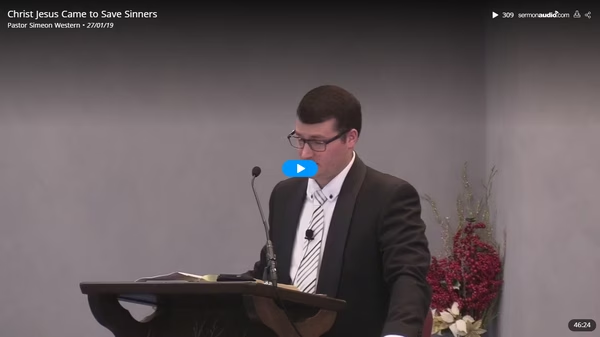
The Order of the Saviour (Vs. 13-14)
These verses record the Saviour’s calling of Levi (Matthew) to be one of his disciples.
The Setting of the Call (Vs. 13)
- “by the sea side” = the Sea of Galilee. One of our Lord’s favorite places to minister
- “the multitude resorted” = crowds gathered again to the Lord
- “he taught them” = Christ again takes the opportunity to proclaim the truth. Christ was a Herald before He was a Healer!
The Servant of the Call (Vs. 14a)
- The Man
- His identity – Levi. More commonly known as Matthew (Matt. 9:9) Matthew means “gift of the Lord.” May have been given to him by the Saviour or adopted by Levi after his salvation and call to ministry. Mark uses the name ‘Matthew’ in his list of the 12 disciples in 3:18.
- His industry – publican (tax collector)
- “receipt of custom” = a toll/taxation booth. Likely the customs office at Capernaum which was the landing place for many ships that traversed the Sea of Galilee (Wuest). “He would collect dues on exports from Capernaum and import taxes on goods passing through.
- Tax collectors (called publicans in the Bible) were despised and hated by the Jewish people on account of their collaboration with the hated Romans and their greedy misuse of their position to extract extra money for themselves. (See Luke 19:8)
- The Mandate
The Submission to the Call (Vs. 14b)
- The speed of his obedience – “and he arose”
- The disciples are a good example to us in their responsiveness to the Lord’s call to discipleship. We do not find them hesitating or objecting. Christ called, they followed!
- The time to be surrendered is now, before a call of this nature comes to you!
- The sacrifice of his obedience – “And he left all” (Luke 5:28)
- “Unlike a fisherman, a publican who abandoned his position could not later return to it.” (Hiebert)
- A call to ministry is a call to sacrifice.
The Outreach of the Saviour (Vs. 15)
The Place of the Outreach (Vs. 15a)
- Matthew’s house – “And Levi made him a great feast in his own house…” (Luke 5:29) Appears he was a man of some means. His house probably had an Eastern style dining hall or court yard to accommodate the great crowd.
- The purpose was obviously for Matthew to introduce his acquaintances to the Lord Jesus. “…and there was a great company of publicans and of others that sat down with them.” (Luke 5:29) For Levi, “having been graciously delivered from the bondage of sin, he wished others also to be set free.” (J.C. Ryle). A desire to see others saved is a good sign of the new birth.
- It seems Levi’s conversion and call to ministry had impacted those within his previous industry. “…for there were many, and they followed him.” (Mark 2:15)
- Practical lessons:
- God can use us to impact others within our sphere of influence (e.g. family, friends and work contacts)
- The home is a great place for ministry, including soul-winning. Why not invite an unsaved visitor back for a meal and share Christ with them!
- While never compromising on the message and methods of biblical Evangelism, there is a lot of scope for being creative in our outreaches to the lost. In Matthew’s case, he basically had a work luncheon and invited the Saviour to be the guest speaker!
The People of the Outreach (Vs. 15b)
- “publicans and sinners” = the word ‘publicans’ comes from the same root word translated “receipt of custom” in Vs. 14.
- “there were many” = a large number, a “great company” (Luke 5:29)
- Christ’s love and compassion for sinners so beautifully highlighted in this verse. Here we have the Lord of glory, the incarnate Word, the Creator of the Universe, the One who is the embodiment of all that is holy and pure, surrounded by sinners!
The Opposition to the Saviour (Vs. 16-17)
The Men of the Opposition (Vs. 16)
Look at their…
- Religiosity – the scribes and Pharisees were full of religious pride and arrogance. They considered themselves not only the custodians of the Scriptures, but also the guardians of the so called “oral law” that eventually would be contained in the Mishnah. Their faith was in law-works for salvation. Works based religion has never been a friend of the Saviour and of salvation by grace alone.
- Hostility – they were watching Christ, not with a humble spirit to learn from Him but with a critical spirit to attack Him. They ‘saw’. The Pharisees were fault finders, looking for something they could lay hold of to discredit the Saviour. Note: A Pharisaical, fault-finding spirit is very damaging in a local church. Godly, Spirit-filled discernment and watchfulness is to be encouraged. If there is sin it should be exposed lovingly and dealt with but that is very different to the Pharisee spirit that is motivated by ungodly motives.
The Method of the Opposition (Vs. 16)
- Subtilty – they targeted the disciples, rather than the Lord Himself. This was due to the fact it is easier to target the follower rather than the leader and also to try and undermine the disciple’s relationship to the Lord.
- Butler makes an insightful comment on this point:
The faultfinders did not come to Christ personally and make their criticism; rather they went through Christ’s disciples. This was not cowardly as some think but cunning. It was a cunning technique of evil critics to drive a wedge between the disciples and Christ. This divisive technique is also a practice of church dissidents which often succeeds well. It is why, as an example, dissidents will go to a board member of the church to criticize the pastor rather than go to the pastor. Going to the board member is to get the board member dissatisfied with the pastor and on the side of the dissident. If the dissident simply went to the pastor to criticize, he would not accomplish nearly as much in stirring up people against the pastor as the dissident does when going to some other member of the church, especially some influential member of the church. (Pg. 42; Jesus Christ: His Parables)
The Objective of the Saviour (Vs. 17)
Christ silences the opposition by explaining His purpose with…
A Quotation – (Matt. 9:13)
- Matthew’s account includes the Lord saying, “go ye and learn what that meaneth, I will have mercy, and not sacrifice.” This was a quotation from Hosea 6:6.
- G. Campbell Morgan:
Jesus looked at these men who thought they knew the law and the prophets, and said to them: You do not understand the God who is revealed in your own writings. He was talking to the teachers, to the men who were interpreting the prophets, and He said, “Go ye and learn what this meaneth, I desire mercy and not sacrifice.” Go and learn what the heart of God is; go and find out, that according to your own writings, God is far more anxious to have mercy than He is to receive any offering that a man brings to Him. When you have learnt this, then you will understand why I sit down with publicans and sinners, why I recline and eat in the midst of them.
An Illustration (Vs. 17)
- “They that are whole have no need of the physician” = this was truth or maxim no one could deny and a well-known proverb at the time.
- “I came not to call the righteous” = the Pharisees were full of self- righteousness. Their “righteousness” was not something that existed in reality but was a delusion in their own minds. In John 9:40-41 the Pharisees asked Christ, “Are we blind also?” (Vs. 40). Christ replied, “If ye were blind, ye should have no sin: but now ye say, We see; therefore your sin remaineth.” (Vs. 41) Religious pride is one of the biggest obstacles to salvation.
- “but sinners”
- We need to be convinced of our disease before we can appreciate the cure Christ offers. Here Christ is pictured as the Physician seeking out the sick, the reverse to what normally occurs. Some of the most dangerous sicknesses are the ones that develop subtly undetected (e.g. cancer).
- The universal sinfulness of man is clearly spelled out in Scripture (Ecc. 7:20; Rom. 3:10-18, 23; 5:12)
- The good news is that Christ came for sinners! That means you and that means me! 1 Tim. 1:15 “This is a faithful saying…” Rom. 5:7-8 “For scarcely for a righteous man…” 1 Cor. 15:3-4 “…Christ died for our sins…”
- “to repentance”
- Christ did not come to confirm and support men in their wicked, sinful ways. He came to rescue and transform them!
- This refutes the idea that Christ compromised on holiness in order to reach people. We do not find Christ boozing around the wine pots or loafing in the harlots’ dens. The setting He was in was not a compromised one and His purpose and intent was to see souls delivered from their sin, not encouraged in it!
- “There is a companionship with sinners which confirms them in their sin – this must be avoided. There is a companionship with sinners that lifts them out of their sin – this was the type of companionship here.” (Lockyer)
- This refutes the idea that repentance not required from salvation.
Conclusion
Will you come to Christ who is calling you out of a life of sin to repentance? Whose attitude do we have towards the lost? Christ’s or the Pharisees? Are our homes open to the Lord Jesus for ministry use?
Sermon 11 of 59 in Mark Series
Sermon Audio Id: 124190589535