


Introduction and overview of the Book of Ezra in preparation for a verse by verse series through the Book.
In this introductory message we will seek to do a brief overview of the Book of Ezra that will help prepare us for a fruitful study of the Book.
Ezra is one of the historical Books of the Old Testament and deals with the end of the Babylonian captivity with the return of the exiles to the land. Ezra, Nehemiah, and Esther record God’s dealings with the Jews after their going into captivity and then returning to Palestine. God raised up three prophets among His people during the post-exilic period: Haggai, Zechariah and Malachi. So there are six post-captivity (restoration) books in the Old Testament – Ezra, Nehemiah, Esther, Haggai, Zechariah and Malachi.
A suggested outline for Ezra, Nehemiah and Esther is:
- Ezra – Restoration.
- Nehemiah – Reconstruction.
- Esther – Preservation.
Denis Lyle notes, “There are two “exodus” movements in the Old Testament. The first was from Egypt to Canaan and the second was from Babylon to Canaan – with almost a millennium lying between the two events. Both these exiles and returns were the subject of prophecy, the first in Genesis 15:13-14 and the second in Jeremiah 25:11-12 and 29:10-11.”
M.K. Hall in the “What the Bible Teaches” commentary series provides a helpful introductory overview: “The book of Ezra continues the history of the nation of Israel by following on from the immediately preceding Second Chronicles. The last two verses of that book (36.22-23) are then virtually repeated in the opening verses of the book of Ezra (1:1-3). Ezra having closed his book (10:44), the account of the nation’s history is then continued in the book of Nehemiah, which is the last historical book in the Old Testament. The events of the book of Esther, which follows Nehemiah in the English Bible, fall chronologically between chapters 6 and 7 of the book of Ezra. Old Testament history closes with Nehemiah and was followed by the 400 years of the Intertestamental Period during which there was no further Divine written revelation. The prophets Haggai and Zechariah prophesied to the Jews in Jerusalem and Judah with positive results as Ezra records in his book (5:1; 6:14). It is generally agreed that the prophecy of Malachi was given in the time of Nehemiah.”
We will consider the introductory material under 3 main headings:
The Penman of the Book
The Title of the Writer
- The Book bears the title of its author – Ezra. The name ‘Ezra’ means “help, aid”. Indeed, Ezra would be wonderfully use of God to be a spiritual help and aid to the people of God.
- Ezra was a descendent of Aaron (Ezra 7:1-5) and was therefore of the priesthood. In Babylon, he was not able to fulfill his priestly function without the temple but he gave himself to the study of the Word.
- Robert Boyd in his “World’s Bible Handbook” provides a helpful summary of the writer of Ezra. It is “generally accepted by Jews and Christians that Ezra was the author of the book which bears his name. He was a descendant of Hilkiah, the high priest (7:1), who found a copy of the Law during the reign of Josiah (2 Chr. 34:14). As a priest, Ezra was not able to serve during the captivity, but gave his time to a study of the Word of God – “a ready scribe in the Law of Moses” (7:6). He was a great revivalist and reformer. He was the writer of the Chronicles. It is also suggested that he wrote Psalm 119 which exalts the Word of God itself. He also organized the synagogue, was the founder of the order of Scribes, helped settle the canon of Scripture, and arranged the Psalms.”
The Time of the Writing
- Ezra likely wrote Ezra sometime after his arrival in Jerusalem so an approximate date for the writing of Ezra would be 458 B.C. (H. Richard Hester)
- Ezra is also the likely author of the Chronicles (compare similarity of Ezra 1:1-3 & 2 Chr. 36:22-23).
The Text of the Writing
- The Book of Ezra is similar to Daniel in that it contains some sections in the Aramaic language.
- M.K. Hall summarizes, “The Book of Ezra shares with the Book of Daniel the distinction that some sections of these books were written in the Aramaic language, sometimes referred to as Chaldee. The Aramaic passages in Ezra are 4:8-6:18 and 7:12-26. These sections largely, but not entirely, consist of letters written to and by the Persian kings, Darius and Artaxerxes.”
The Testimony of the Writer
If there was one word that could summarize the life and character of Ezra it would be the word ‘Scripture’. The reason God used Him so mightily was because of his relationship to God and God’s Word. Ezra was:
- A Studier of the Scriptures (Ezra 7:6). “This Ezra went up from Babylon; and he was a ready scribe in the law of Moses, which the LORD God of Israel had given:”
- The word ‘ready’ means “skillful, diligent”.
- 2 Timothy 2:15 “Study to shew thyself approved unto God, a workman that needeth not to be ashamed, rightly dividing the word of truth.” Interestingly the word ‘study’ here literally means “to give diligence, make haste, exert one’s self, be earnest”.
- Do you want to be used of God? Be a Studious Scripture- soaked Saint!
- True success is determined by our relationship to the Scriptures. There is much talk about ‘success’ today but interestingly, the only time the word appears in the Scriptures is in Joshua 1:8 – “This book of the law shall not depart out of thy mouth; but thou shalt meditate therein day and night, that thou mayest observe to do according to all that is written therein: for then thou shalt make thy way prosperous, and then thou shalt have good success.”
- A Lover of the Scriptures (Ezra 7:10). “For Ezra had prepared his heart to seek the law of the LORD…” Ezra studied God’s Word diligently because He loved the Word of God and most importantly the God who gave the Word. “If you love God for who He is, you will love Him for what He says.”
- A Doer of the Scriptures (Ezra 7:10). For Ezra had prepared his heart to seek the law of the LORD, and to do it…” Ezra was not just a hearer of the Word, he was a Doer of the Word (James 1:22- 25).
- A Teacher of the Scriptures (Ezra 7:10). “For Ezra had prepared his heart to seek the law of the LORD, and to do it, and to teach in Israel statutes and judgments.”
- Ezra had a zeal to impart the truths of God’s Word to others. Each believer seek the learn the Word of God, not only for their own benefit but that they might be a channel of blessing to others also.
- Hebrews 5:12-14 “For when for the time ye ought to be teachers, ye have need that one teach you again which be the first principles of the oracles of God; and are become such as have need of milk, and not of strong meat. For every one that useth milk is unskilful in the word of righteousness: for he is a babe. But strong meat belongeth to them that are of full age, even those who by reason of use have their senses exercised to discern both good and evil.”
- A Defender of the Scriptures (Ezra 9-10). Ezra was prepared to take a stand for the Word of God against the compromise and disobedience that was taking place amongst God’s people. Jude 1:3 “Beloved, when I gave all diligence to write unto you of the common salvation, it was needful for me to write unto you, and exhort you that ye should earnestly contend for the faith which was once delivered unto the saints.”
The Period of the Book
Let’s consider a number of background facts so we can contextualize the Book of Ezra in Biblical History:
The Captivity of Judah (2 Chr. 36:1-23; See also 2 Kings 24-25)
Ezra deals with the conclusion of the 70-year Babylonian Captivity and the beginning of the return of the exiles to Jerusalem. It follows on chronologically from the last chapter of 2 Chronicles. Consider four truths about the captivity:
The Stages of the Captivity (Vs. 1-20)
The captivity of Judah transpired in 3 stages with three deportations of Judah:
- Stage 1: Nebuchadnezzar and Jehoiakim (Vs. 1-8; 2 Kings 23:6- 24:7)
- This was in 605 B.C. Nebuchadnezzar invaded the land and took away Jehoiakim and the leading nobles (See Dan. 1:1-4).
- He also took some of the temple vessels (compare with Vs. 10 & 18-19; Also, Daniel 1:1-2).
- Daniel and his three godly friends were among those taken in this first raid. Daniel 1:1-4 “In the third year of the reign of Jehoiakim king of Judah came Nebuchadnezzar king of Babylon unto Jerusalem, and besieged it. And the Lord gave Jehoiakim king of Judah into his hand, with part of the vessels of the house of God: which he carried into the land of Shinar to the house of his god; and he brought the vessels into the treasure house of his god. And the king spake unto Ashpenaz the master of his eunuchs, that he should bring certain of the children of Israel, and of the king’s seed, and of the princes; Children in whom was no blemish, but well favoured, and skilful in all wisdom, and cunning in knowledge, and understanding science, and such as had ability in them to stand in the king’s palace, and whom they might teach the learning and the tongue of the Chaldeans.”
- Stage 2: Nebuchadnezzar and Jehoiachin (Vs. 8-10; 2 Kings 24:8-17)
- This deportation took place in 597 B.C. when Babylon came and besieged Jerusalem for a second time.
- This time the Babylonians took Jehoiachin, his mother, the palace officials and the majority of the remaining population, leaving only the poorest in the land.
- 2 Kings 24:8-17 explains this second deportation in detail:(8) “Jehoiachin was eighteen years old when he began to reign, and he reigned in Jerusalem three months. And his mother’s name was Nehushta, the daughter of Elnathan of Jerusalem.
(9) And he did that which was evil in the sight of the LORD, according to all that his father had done. (10) At that time the servants of Nebuchadnezzar king of Babylon came up against Jerusalem, and the city was besieged. (11) And Nebuchadnezzar king of Babylon came against the city, and his servants did besiege it. (12) And Jehoiachin the king of Judah went out to the king of Babylon, he, and his mother, and his servants, and his princes, and his officers: and the king of Babylon took him in the eighth year of his reign. (13) And he carried out thence all the treasures of the house of the LORD, and the treasures of the king’s house, and cut in pieces all the vessels of gold which Solomon king of Israel had made in the temple of the LORD, as the LORD had said. (14) And he carried away all Jerusalem, and all the princes, and all the mighty men of valour, even ten thousand captives, and all the craftsmen and smiths: none remained, save the poorest sort of the people of the land. (15) And he carried away Jehoiachin to Babylon, and the king’s mother, and the king’s wives, and his officers, and the mighty of the land, those carried he into captivity from Jerusalem to Babylon. (16) And all the men of might, even seven thousand, and craftsmen and smiths a thousand, all that were strong and apt for war, even them the king of Babylon brought captive to Babylon. (17) And the king of Babylon made Mattaniah his father’s brother king in his stead, and changed his name to Zedekiah.”
- Stage 3: Nebuchadnezzar and Zedekiah (Vs. 10-20; 2 Kings 24:18-25:21)
- This siege and subsequent deportation took place in 586 B.C. This would be the final destruction of Jerusalem.
- The Babylonians brutally slew many, including Zedekiah’s sons in front of him before they put out his eyes.
- They took what remained of the temple vessels, treasures and resources.
- They then burnt the house of God and the city and broke down the wall of Jerusalem.
The Sins that led to the Captivity (Vs. 11-14)
This brings us to the root of the problem. There was:
- Sin in the Palace – Judah’s Sovereign was wicked (Vs. 12-13). Zedekiah, the final Judean king, is illustrative of the spiritual condition of the final kings of this period. We can summarize Zedekiah’s spiritual condition in four words:
- Wickedness – “he did that which was evil” (Vs. 12a).
- Pridefulness – “humbled not himself” (Vs. 12b).
- Rebelliousness – “he also rebelled” (Vs. 13a).
- Stubbornness – “stiffened his neck, and hardened his heart” (Vs. 13b).
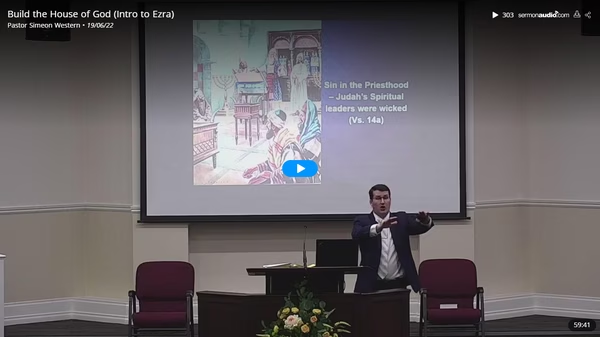
- Sin in the Priesthood – Judah’s Spiritual leaders were wicked (Vs. 14a). We get a bit of a window into the wickedness of those who were supposed to be the spiritual leaders of Judah through Jeremiah’s prophesy.
- Jeremiah 5:30-31 “A wonderful and horrible thing is committed in the land; The prophets prophesy falsely, and the priests bear rule by their means; and my people love to have it so: and what will ye do in the end thereof?” Why are compromised leaders rewarded with loyalty from the people? Because such leaders will indulge rather than reprove the lusts of the people.”
- Jeremiah 23:9-11 “Mine heart within me is broken because of the prophets; all my bones shake; I am like a drunken man, and like a man whom wine hath overcome, because of the LORD, and because of the words of his holiness. For the land is full of adulterers; for because of swearing the land mourneth; the pleasant places of the wilderness are dried up, and their course is evil, and their force is not right. For both prophet and priest are profane; yea, in my house have I found their wickedness, saith the LORD.”
- Sin in the Populace – Judah’s Society was wicked (Vs. 14b). Not surprisingly, the wickedness of Judah’s leadership led to the wickedness of her citizens. Proverbs 29:12 warns, “If a ruler hearken to lies, all his servants are wicked.” Both the leadership and the laity of Judah were involved in:
- The abominations of the heathen. Rather than being a distinct and holy people in the midst of heathen nations, Judah had slid down to the depraved level of those nations. Sadly, this was not an occasional engagement in the depraved perversions of the heathen. The text highlights that they “transgressed very much after the abominations of the heathen.” They were sold out to commit abominable wickedness.
- The pollution of the house of God. The temple which was supposed to be the center for the worship of the One tree God had been polluted with the evil practices of its priests and attendees. The house of God had degenerated with the times rather than standing in purity and faithfulness against the tidal wave of wickedness that had swept the land. How true this is of the New Testament “house of God”, the local church (1 Tim. 3:15) in the wicked and apostate hour we live in. Sin and error is openly tolerated, or worse still, endorsed and promoted.
- Note: Praise God there was a godly remnant which had not bowed the knee to idolatry and its associated perversion. There were men like Daniel, his three friends and Ezekiel who were still standing for godliness in a time of spiritual apostasy. They were burning lights at a time of great spiritual and moral darkness in their nation.
The Seers that warned of the Captivity (Vs. 15-16)
- The Summary of the Prophets Warnings (Vs. 15)
- The timeliness of the warnings (Vs. 15a). The word ‘betimes’ means “early, seasonably, in a short time; before it is too late.” (D. Cloud) A meaning of the word is highlighted in Genesis 26:31 “And they rose up betimes in the morning, and sware one to another: and Isaac sent them away, and they departed from him in peace.”
- The tenderness behind the warnings (Vs. 15b). The compassion of God was what moved the heart of God to move the lips of His messengers to warn the people. Always remember that God’s judgment is always proceeded by an abundant display of His forbearance, longsuffering, mercy and grace. God is not a capricious, bloodthirsty and cruel God like the false gods of the heathen. He is Just nonetheless and will mete out perfect judgment if His offers of mercy are repeatedly refused.
- The Spurning of the Prophets Warnings (Vs. 16) Sadly, the majority had an unrepentant response to the godly warnings. The people:
- Mocked God’s messengers (Vs. 16a).
- Misused God’s messengers (Vs. 16b).
The Season of the Captivity (Vs. 20-23)
- The timeframe of the captivity (Vs. 20-21)
- The captivity would last for 70 years according to the prophecy of Jeremiah (See Jer. 25:11-12; 29:10-11).
- The reason for the number of 70 years is also given. It was so the land could “enjoy her sabbaths”. This is a reference to the law found in Leviticus 25:1-7. Evidently this was also another area of disobedience on the part of God’s people. Over the years this law had been neglected and the land was now owed a total of 70 years.
- The termination of the captivity (Vs. 22-23). The 70-year period terminated just as God had predicted with the end of the Babylonian Empire and the decree of Cyrus to allow the Jews to return to their land.
The Chronology of the Period
- A suggested timeline of the main events of this period by Wiersbe is as follows:
- 605 BC – First Jewish exiles deported to Babylon.
- 597 BC – Second deportation to Babylon.
- 586 BC – Jerusalem destroyed by Nebuchadnezzar – Third deportation to Babylon.
- 539 BC – Cyrus, King of Persia, conquers Babylon.
- 538 BC – Cyrus issues his decree to the Jewish exiles.
- 537 BC – About 50,000 Jews return to the land, led by Zerubbabel and Joshua.
- 536 BC – Foundation of the temple laid.
- 536-520 BC – Work interrupted because of official opposition.
- 520 BC – Work resumed; ministry of Haggai and Zechariah.
- 515 BC – The temple completed and dedicated.
- 476 BC – Esther becomes queen of Persia.
- 458 BC – Ezra the scribe arrives in Jerusalem.
- 445 BC – Nehemiah comes to Jerusalem; walls rebuilt; gates restored.
- The Book of Ezra divides into two distinct sections with a gap of fifty-seven years between the parts1.
- CHAPTERS 1-6: The return of some of the captives of Judah from exile IN Babylon to Jerusalem under Zerubbabel, and the re-building of the House of God (536-515 BC).
- CHAPTERS 7-10: The return of further Jews under Ezra, and the expulsion of the heathen wives (454-457 BC).
- Note: Chronologically the story of Esther occurs between Ezra 6 and 7 during that 57-year gap.
The Plan of the Book (Outlines)
A Suggested Outline
- The Return of the Saints (Chap. 1-2)
- The Raising up of the Saints (1)
- The Registry of the Saints (2)
- The Rebuilding of the Sanctuary (Chap. 3-6)
- The Work Commenced (3)
- The Work Ceased (Opposed) (4)
- The Work Continued (Resumed) (5)
- The Work Completed (6)
- The Reformation of the Saints (Chap. 7-10)
- The Reformer (7-8)
- The Reformation (9-10)
A Simple Outline
- The Building up of the Sanctuary (Chap. 1-6)
- The Building up of the Saints (Chap. 7-10)
Some Supplemental Outlines
Wiersbe’s Outline
- The Nation is Restored (Ezra 1-6)
- A Remnant returns with Zerubbabel and Joshua (1-2)
- The Temple is rebuilt (3-6)
- The People are Rededicated (Ezra 7-10)
- A second group arrives with Ezra (7-8)
- Confession of sin (9)
- Cleansing of sin (10)
Hester’s Outline
- The Return to the Land (1-2)
- Cyrus’ Proclamation (1:1-4)
- Temple Treasures returned (1:5-11)
- The people who went (2)
- The Rebuilding of the Temple (3-4)
- Altar established first (3:1-6)
- Foundation put in place (3:11-13)
- Facing enemies (4)
- Compromise (4:1-3)
- Political interference (4:4-5)
- Temple work resumed after long delay (5)
- Temple work completed (6)
- Ezra’s visit to Jerusalem (7-8)
- Sins of people confessed (9)
- Cleansing and revival (10)
Boyd’s Outline
- Return under Zerubbabel (Chap. 1-6)
- Restoration of the Jews (1-2)
- Opposition to the Word (3-4)
- Dedication of the Temple (5-6)
- Return under Ezra (Chap. 7-10)
- Proclamation of Artaxerxes (7)
- Liberation of the Jews (8)
- Intercession of Ezra (9)
- Reformation of the People (10)
The Point of the Book (Theme)
- The Key Text: The key verse appears to be Ezra 1:5. The key word is ‘build’ occurring 13 times in the Book.
- The Key Theme: The Book deals with the restoration of the Temple and Temple worship. It therefore teaches us God’s method of restoring His people to a place of fellowship and blessing (Robert T. Boyd)
- The Key Thoughts
- Ezra teaches us many lessons about spiritual revival and reformation.
- Ezra teaches us many helpful principles for doing the work of God effectively.
- Ezra reminds us of God’s Providence and Sovereignty. God is still on the throne! “The book demonstrates the truth that God is in control, and the actions of rulers cannot thwart His overall purposes for this world.” (M.K. Hall)
- Ezra reminds us that God’s work done in God’s way will not lack God’s supply.
Conclusion
Are you a builder up or tearer down of God’s work? Are you seeking to build your own life on the Word of God?
References
- Details from M.K. Hall’s commentary.
Sermon 1 of 19 in Ezra Series
Sermon Audio Id: 61722821406137