


Introduction to a series in the Book of Revelation with exposition of the prologue (Vs. 1-3). This series will follow the normal, literal method of interpretation. It will therefore be expounded as a prophetic Book. The word ‘prophecy’ appears 7 times in Revelation (1:3; 11:6; 19:10; 22:7,10,18,19). Five of these specifically refer to Revelation as a Book of Prophecy.
The importance of the Book of Revelation:
- It is the consummation, capstone and climax of God’s Word. “Revelation is the crown and capstone, the grand finale in the revelation of God’s plan.” (Cloud)
- B.H. Carroll: “Not merely in date of composition, but in fitness of content it closes the canon of the Scriptures. It finishes. It completes. It perfects. It not only dispenses with all need of further revelation, but is not susceptible of subtraction. Ignorance, impiety, or blasphemy alone would undertake to add to or take from its finality of content. It is the climax of history embodied in prophecy. We may indeed expect new light to continuously break out of God’s Word, but we may not expect a new word.”
- The first and last Books of the Bible are of critical importance. Someone has described them as the two bookends that hold the entire Bible together.
- Illustration: The two strainer posts in a fence are vital if things are to line up properly in between
Comparison between Genesis & Revelation. There is a tie between Genesis and Revelation, the first and last books of the Bible. Genesis presents the beginning and Revelation presents the end (By J. Vernon McGee)
- In Genesis the earth was created; in Revelation the earth passes away.In Genesis was
- Satan’s first rebellion; in Revelation is Satan’s last rebellion.
- In Genesis the sun, moon, and stars were for earth’s government; in Revelation these same heavenly bodies are for earth’s judgment.
- In Genesis the sun was to govern the day; in Revelation there is no need of the sun.
- In Genesis darkness was called night; in Revelation there is “no night” (See Rev. 21:25; 22:5)
- In Genesis the waters were called seas; in Revelation there is no more sea.
- In Genesis was the entrance of sin; in Revelation is the exodus of sin.
- In Genesis the curse was pronounced; in Revelation the curse is removed.
- In Genesis death entered; in Revelation there is no more death.
- In Genesis was the beginning of sorrow and suffering; in Revelation there is no more sorrow or tears.
- In Genesis was the marriage of the first Adam; in Revelation is the marriage of the Last Adam.
- In Genesis we saw man’s city, Babylon, being built; in Revelation we see man’s city, Babylon, destroyed, and God’s city, the New Jerusalem, brought into view.
- In Genesis Satan’s doom was pronounced; in Revelation Satan’s doom is executed.
We will study the Prologue to the Book (Vs. 1-3) under 4 points. In a sense, the three opening verses of Revelation act like a table of contents for the Book.
The Person of the Book (Vs. 1a)
The Spotlight of the Revelation – “Jesus Christ”
- ‘Revelation’ = comes from the Greek word ajpokavluyiV (apokalupsis) meaning to unveil.
- Elsewhere it is translated ‘lighten’ (Lk. 2:32); ‘manifestation’ (Rom. 8:19) and ‘appearing’ (1 Pt. 1:7). It is a compound word in the Greek made up of apo (away from) and kalupto (to cover or hide. So to take away the covering, to unveil, to reveal. It means “taking away a cover; an uncovering or a laying bare.” (Thomas) It is not intended to conceal truth but to reveal truth.
- Newell: “What a rebuke to the negligence, the neglect, the sneering, ignorant arrogance, shown by most of Christendom toward the Revelation. Our Lord Jesus may declare it an open, unsealed, understandable book; men say it is filled with ‘unintelligible language’ and ‘mystic symbols.’ Christ says: ‘Blessed is he that readeth’; men say: ‘Let it alone, you cannot understand it’. Some day all these will give an account of their insolent, insulting attitude toward this holy, open book of plain prophecy, given by God to Christ for us, and distinctly left unsealed.”
- “of Jesus Christ” = Christ is the focus of the Book
- Christ is the central Person and theme of the Bible (Lk. 24:44)
- Christ is the central theme of history
- Christ is the central theme of Revelation
- Revelation is both Eschatological (doctrine of last things) and Christological (doctrine of Christ)
- In the Gospels Christ is revealed as Saviour and sin bearer; in Revelation He is revealed as Judge, Sovereign and coming King. The climax of the Book is the Second Coming of Christ.
- Theodore Epp: “If after studying this Book of the Revelation, the Lord Jesus Christ does not mean more to you than He did before, either I have failed in teaching it, or the Holy Spirit has not been able to reveal this glorious truth to you. The unveiling of Jesus Christ is the central content of the Book.”
The Source of the Revelation – “which God gave unto him”
- Attributed to God the Father. God is the Divine Author of the Revelation.
- Wiersbe: “The Father gave the revelation to the Son, and the Son shared it with the apostle, using “His angel” as intermediary.”
The Purpose of the Book (Vs. 1b)
Christological – It Reveals Christ
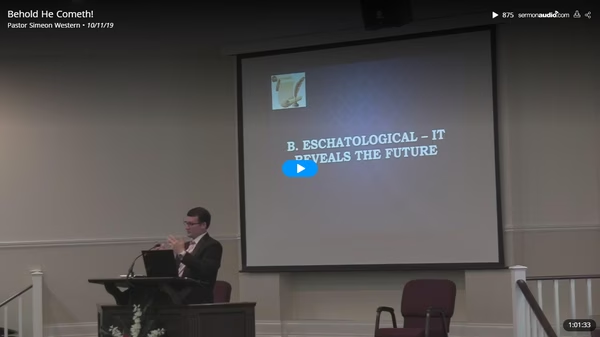
Eschatological – It Reveals the Future
- “shortly come to pass” = the word ‘shortly’ means ‘suddenly’, ‘quickly’. Rev. 22:6 “…the things which must shortly be done.”
- “for the time is at hand” (Vs. 3) = means near. Your hand is always nearby. Illustrations: Judas, Christ’s betrayer, was said to be “at hand” (Matt. 26:46). Paul said “the time of my departure is at hand” (2 Tim. 4:6).
- Four times the expression “Behold, I come quickly” is repeated (Rev. 3:11; 22:7, 12, 20).
- The doctrine of immanency runs consistently through the N.T. Scriptures. Immanency combines both certainty and uncertainty – the event itself is certain but the timing is uncertain, creating a spirit of watchfulness and expectancy in the believer. “It pictures the events of Revelation on the verge of happening.” (Cloud)
- Once the judgments begin the events will unfold in rapid succession over the 7-year tribulation period.
- “signified it” = to show by a sign.
- Revelation is rich in symbolism and thereby the truth is communicated in a powerful and timeless manner. These symbols convey literal truth and it is the interpreter is not at liberty to attach any meaning to the symbols according to his own whim and fancy.
- Much of the symbolism consists of simile and is self-interpreting. A simile (‘like’ & ‘as’) is a comparison of two things. E.g. Rev. 1:13-16
- Much of the symbolism is explained within the Book of Revelation itself (e.g. compare Rev. 1:12, 16 & 20)
- Much of the symbolism is explained elsewhere in the Bible (comparing Scripture with Scripture). Revelation is packed full of imagery from the Old Testament so the more familiar you are with the O.T. Scriptures, the better positioned you will be to properly interpret the Revelation. “Of the 404 verses in the Apocalypse, 278 allude to the OT Scriptures. No other NT writer uses the OT more than this…His allusions are to the books from each of the three divisions of the OT, with Daniel leading in number of citations proportionately followed by Isaiah, Ezekiel, and Psalms.”
- Summary: Symbolism in Revelation is interpreted
- By the verse itself
- By the context
- By comparing Scripture with Scripture
- The word ‘prophecy’ appears 7 times in Revelation (1:3; 11:6; 19:10; 22:7,10,18,19). Five of these specifically refer to Revelation as a Book of Prophecy. According to John Walvoord, “as many as fifty different interpretations of the book of Revelation have appeared.” But the matter is settled simply when we take the Book at its own word that it deals with prophetic truth.
- The Early Church interpreted Revelation literally. Lutheran historian Philip Schaff admits: “The most striking point in the eschatology of the ante-Nicene age (before 325 A.D.) is the prominent chiliasm, or millenarianism, that is the belief of a visible reign of Christ in glory on earth with the risen saints for a thousand years, before the general resurrection and judgment.” (History of the Christian Church, 1884, II, p. 614)
- J. Vernon McGee speaks of the foolishness of the allegorical approach to interpretation: “I went to a seminary that was amillennial, where they attempted to fit the rest of Revelation into the historical, or the amillennial, viewpoint. It became ridiculous and even comical at times. For example, when we reached the place where Scripture says that Satan was put into the bottomless pit, we were taught that that has already taken place. I asked the professor, ‘How do you explain the satanic activity that is taking place today?’ He replied, ‘Satan is chained, but he has a long chain on him. It is like when you take a cow out into a vacant lot and tether her out on a long rope and let her graze.’ That was his explanation! And my comment was, ‘Doctor, I think Satan’s got a pretty long chain on him then, because he is able to graze all over the world today!’ It really makes some Scriptures seem rather ridiculous when you follow the historical viewpoint.”
- When you try and make revelation about fulfilled things, the book becomes a confusing enigma but when we recognize it is about future things, it unfolds before us breathtakingly.
- The Key to this Book of prophecy is found in Rev. 1:19 (see charts). The Apostle John puts a key at the front or back door of his books to unlock their meaning (e.g. John 20:30-31; 1 John 5:13). In Revelation the key is at the front door (1:19).
The Penman of the Book (Vs. 1c – 2)
The Context of John’s Writing (Vs. 1c)
- The time – John wrote the Revelation approx. A.D. 95 during the reign of the Roman Emperor Titus Flavius Domitian. He was “the second Roman Emperor after Nero to persecute Christians. Banishment was one of his favourite modes of punishment.” (Walvoord) “Domitian demanded that he be worshiped as “Lord and God” and the refusal of both Christians and Jews to obey his edict led to severe persecution.” (Wiersbe) John was banished to Patmos by Domitian for his Christian faith (Vs. 9).
- The topography – Patmos is a rugged volcanic island off the coast of Asia Minor (modern day Turkey). It is about 10 miles long (16 km) and 6 miles (9.6 km) wide. At that time, it was a penal colony. John may well have been involved in hard labour as a part of his punishment.
The Content of John’s Writing (Vs. 2)
John faithfully bear record of…
- The Word of God – Revelation is a part of God’s Word; it is Divine Scripture!
- The Testimony of Jesus Christ – “The Word of God in a nutshell, is the testimony of Jesus Christ. To study the Bible and miss seeing Jesus is to miss the main thing.” (Cloud)
- All things he saw – the phrase “I saw” occurs 35 times in the Book. “The phrase points to the fact the general character of the book is that of prophetic vision.” (Robert L. Thomas)
The Congregation for John’s Writing (Vs. 4a)
- All Christians generally (Vs. 1) Believers are described in this verse as ‘servants’
- Seven churches specifically (Vs. 4)
- Letters are written in the order a messenger might visit them (refer map).
- The seven churches are pictured as lampstands, each giving light in a dark world (Phil. 2:15; Matt. 5:14-18).
The Promise of the Book (Vs. 3)
A blessing is promised for all who will…
Read it! (Vs. 3a)
- ‘blessed’ = Revelation is the only Book of Scripture containing such a direct promise of blessing. This blessing is the first of 7 in the Book. The other 6 are Rev. 14:13; 16:15; 19:9; 20:6; 22:7, 14. Revelation begins with blessing (1:3) and ends with grace (22:21).
- “he that readeth” = notice ‘he’ singular. In those days the Books of the Bible were hand written so a church would typically only possess one copy. It would be read publicly and the people would listen attentively.
- Challenge: Imagine if our church only possessed one Bible and the only time you could hear it was when you came to church. Do you think you would listen to it more carefully when it was being read? Don’t you think you would be at church every time the doors were open to get another chance to hear the Blessed Book?
Hear it! (Vs. 3b)
- “they that hear” = the audience. Just to hear the Book of Revelation read is a blessing in itself.
- The phrase “he that hath an ear, let him hear what the Spirit saith unto the churches” occurs 7 times in chapters 1 and 2.
- Illustration: My earliest real memory of Revelation was when my mother read it to me as a child and explained key parts. It was imprinted on my heart and mind!
Keep it! (Vs. 3c)
- We should hear the Word of God with a view to obey it. Our tendency today is to listen with the mindset that we will decide what we will accept or reject. A discerning mindset is to be commended (e.g. Acts 17:11; 1 Thess. 5:21) but the Word of God is to be received “not as the word of men, but as it is in truth, the word of God, which effectually worketh also in you that believe.” (1. Thess. 2:13)
- The real blessing comes when the Word of God is applied to the life.
- James 1:22-25 “But be ye doers of the word, and not hearers only, deceiving your own selves. For if any be a hearer of the word, and not a doer, he is like unto a man beholding his natural face in a glass: For he beholdeth himself, and goeth his way, and straightway forgetteth what manner of man he was. But whoso looketh into the perfect law of liberty, and continueth therein, he being not a forgetful hearer, but a doer of the work, this man shall be blessed in his deed.”
Conclusion
- Are you Ready? Saved and serving?
- Are you Revived? Living in light of Christ’s return?
Sermon 1 of 38 in Revelation Series