


Exposition of the command to be filled with the Holy Spirit.
We have encountered the word ‘walk’ five times in this practical section of Ephesians. We have been exhorted to:
- Walk worthy of the Lord (Eph. 4:1)
- Not walk as the unsaved (Eph. 4:17)
- Walk in love (Eph. 5:2)
- Walk in light (Eph. 5:8)
- Walk in wisdom (Eph. 5:15)
In this section (5:15-6:9) the Apostle now issues a call for us to walk in wisdom. Note the emphasis on wisdom in these verses – “not as fools, but as wise” (Vs. 15); “Wherefore be ye not unwise” (Vs. 17). “The challenge in this section is to walk in wisdom. This serves as the basis for the many exhortations found in 5:15-6:9…the metaphor of darkness and light is dropped, and the contrast is now between ‘wise’ vs ‘unwise’.” (Harold Hoehner)
In this sermon we are going to spend some time considering the command to be filled with the Spirit. Before we get into that, we need to remember what the Epistle has taught us so far about the Person and work of the Holy Spirit:
- The Holy Spirit indwells and seals the believer at the moment of salvation (Eph. 1:13-14). The word ‘earnest’ means “a pledge, a down payment, a deposit that guarantees the full amount will be paid at the appropriate or due time.” (Hester) “It was the first instalment with a guarantee that the rest would follow.” (Hoehner)
- The Holy Spirit strengthens the believer in answer to prayer (Eph. 3:16).
- The Holy Spirit can be grieved by the believer (Eph. 4:30).
- The Holy Spirit produces godly fruit in the believer (Eph. 5:9).
- The Holy Spirit fills the obedient, yielded believer (Eph. 5:18).
- Note: There is a very real sense in which these are sequential. You can’t be filled unless you are first indwelt by the Spirit (salvation). The Spirit of God will not fill us when we are constantly grieving him and walking in carnality.
We will consider this theme of being filled with the Spirit under 3 headings:

The Contrast to the Spirit’s Filling (Vs. 18A)
“Going from the general to the specific, Paul explains how this wisdom works out in the believer’s conduct.” (Hoehner)
The Command
- “be not drunk” = lit. “to be being made drunk.” “Paul prohibits them from a course of action.” (Hoehner) The word translated “drunk” is the verb, “Methusko”. It is related to the verb “Methuo,” which, according to W.E. Vine, “signifies to be drunk with wine”. In contrast, “Methusko” “signifies to make drunk, or to grow drunk (an inceptive verb, marking the process of the state expressed in No.1, Methuo (Expository Dictionary of New Testament Words). The verb is in the present tense and the passive voice. The present tense views the action as currently taking place in time. The passive voice indicates that the subject is the recipient of the action. “Here the Holy Ghost forbids, not only the final state of drunkenness, but also the process that leads to that state. The believer is forbidden to place himself in the passive state where he allows alcohol to lead him to intoxication.” (I.W., Jan 2021)
- “wherein is excess” = means “riot.” The word ‘excess’ is translated ‘riot’ in Titus 1:6 and 1 Peter 4:4. It refers to an abandoned, dissolute life. This type of life is in the direction in which fermented wine (‘wherein’) leads.
- “The word literally means “not to save”. That is, that which has nothing of a saving quality about it, but rather, a destructive one. It expresses the idea of an abandoned, debauched, profligate life.” (Wuest).
- It refers to “a wild and undisciplined life; a life lived without restraint and in a wasteful manner. It refers to people who waste their resources to gratify their own sensual desires.” (Hoehner)
The Contrast
- Paul uses a startling contrast but, in some areas, there are some parallels/similarities (adapted from William Macdonald):
- In both conditions, the person is under a power outside himself. In one case it is the power of intoxicating liquor (sometimes called “spirits”); in the other case it is the power of the Spirit.
- In both conditions, the person is bold/fervent; it affects his speech.
- In both conditions the person’s walk is affected – his physical walk in the case of drunkenness and his moral behaviour in the other instance.
- In other ways there is a sharp contrast between the two:
- In the case of drunkenness, there is dissipation and debauchery. The Spirit’s filling never produces these.
- In the case of drunkenness, there is loss of self-control. But the Fruit of the Spirit is self-control (Gal. 5:23).
- Harold Hoehner notes, “Persons controlled by alcohol no longer control their actions, as exhibited when asked to walk a straight line and are unable to do so. Likewise, those filled by the Spirit no longer control their actions but rather relinquish their will to the Lord.”
- Alexander Maclaren summarizes it well: “Paul makes a daring, and, as some would think, an irreverent, comparison, when he proposes being “filled with the Spirit” as the Christian alternative or substitute to being “drunken with wine.” But the daring comparison suggest deep truth. The spurious exhilaration, the loosening of the bonds of care, the elevation above the pettiness and monotony of daily life, which the drunkard seeks, and is degraded and deceived in proportion as he momentarily finds, are all ours, genuinely, nobly, and to our infinite profit, if we have our empty spirits filled with that Divine Life. That exhilaration does not froth away, leaving bitter dregs in the cup. That loosening of the bonds of care, and elevation above life’s sorrows, does not flow from foolish oblivion of facts, nor end in their being again roughly forced on us. ‘Riot’ bellows itself hoarse, and is succeeded by corresponding depression; but the calm joys of the Spirit-filled spirit last, grow, and become calmer and more joyful every day.”
The Command for the Spirit’s Filling (Vs. 18B)
As we study this command (“be filled with the Spirit”) we can note several valuable lessons from the grammar of the command as well as some helpful illustrations of how the word is used elsewhere in the New Testament. The command “be filled” is present tense, passive voice and imperative mood. To summarize, there is…
A Process to Follow (pres. tense)
- “be filled” = lit. “be being filled”. It therefore means “be constantly filled with the Spirit; be constantly, moment by moment being controlled by the Spirit” (Wuest).
- “Men are said to be filled with wine when completely under its influence; so, they are said to be filled with the Spirit when He controls all their thoughts, feelings, words and actions.” (Hodge)
- The filling of the Spirit is not a steady-state condition like the indwelling of the Spirit or the sealing of the Spirit. It is a constant, ongoing process, a moment by moment walk. We cannot rely on yesterday’s filling!
A Person to whom we Yield (pass. voice)
- The imperative mood places the responsibility on the believers. The passive voice suggest that believers cannot fill themselves by their own efforts but that it must be accomplished by Someone apart from ourselves. This One is the same Person who desires to fill us.
- Unknown author (quoted by Macdonald): “Just as you have left the whole burden of your sin, and have rested on the finished work of Christ, so leave the whole burden of your life and service, and rest upon the present inworking of the Holy Spirit. Give yourself up, morning by morning, to be led by the Holy Spirit and go forth praising and at rest, leaving Him to manage you and your day. Cultivate the habit all through the day, of joyfully depending upon and obeying Him, expecting Him to guide, to enlighten, to reprove, to teach, to use, and to do in and with you what He wills. Count upon His working as a fact, altogether apart from sight or feeling. Only let us believe in and obey the Holy Spirit as the Ruler of our lives, and cease from the burden of trying to manage ourselves; then shall the fruit of the Spirit appear in us as He wills to the glory of God.”
A Precept to Obey (imp. mood)
- The imperative mood places the responsibility on the believers. We are to consciously and obediently yield to the Spirit’s ministry in our lives.
- The word ‘filled means “to fill up, to cause to abound, to furnish or supply liberally, to flood, to diffuse throughout.” (Wuest) The word is used “of something which is filled with content. For example, “to fill containers.” (Hoehner)
- The word was used in the following three senses:
- Of the wind filling a sail and thereby carrying the ship along. Hence it refers to the Holy Spirit being our direction in life.
- Of the salting of meat in order to flavor and preserve it. Hence, the Holy Spirit’s desire is to permeate the life of each believer so that they reflect Christlikeness.
- Of total control. As believers, we are to be dominated and controlled by the Holy Spirit.
- “The idea of the word is ‘control’. The indwelling Spirit of God is the one who should continually control and dominate the life of the believer.” (Linguistic Key)
- “With the indwelling each Christian has all of the Spirit, but the command to be filled by the Spirit enables the Spirit to have all of the believer. The wise walk, therefore, is one that is characterized by the Holy Spirit’s control.” (Hoehner)
Some Pictures to Illustrate
Studying some examples of how the word ‘filled’ is used elsewhere in the N.T. helps give us a further sense of what it means:
- John 12:3 “…The house was filled with the odour of the ointment.”
- Acts 2:2 “…a rushing mighty wind and it filled all the house where they were sitting.”
- Acts 5:28 “…ye have filled Jerusalem with your doctrine…”
- It is also used to describe being filled with ‘wisdom’ (Lk. 2:40), ‘sorrow’ (John 16:6), ‘joy’ (Acts 13:52), ‘knowledge’ (Rom. 15:14) and ‘comfort’ (2 Cor. 7:4).
- A number of men in Acts were said to be full of the Holy Spirit
- Stephen – “a man full of faith and of the Holy Ghost” (Acts 6:5); “full of faith and power” (Acts 6:8); “But he, being full of the Holy Ghost” (Acts 7:55).
- Barnabas – “For he was a good man, and full of the Holy Ghost and of faith”
- It is the word used in Ephesians 3:19 concerning the believer being “filled with all the fulness of God”.
- Illustration: The glove and the hand. On its own, the glove is powerless and useless but when it is filled with a hand, a work can be accomplished.
The Complement to the Spirit’s Filling (Col. 3:16)
The filling of the Spirit and the filling of the Word work hand in hand. In this verse we note that the Word is to:
Dominate our Lives – ‘dwell’
- The word ‘dwell’ means “to be at home in”. It means “to dwell in one and influence him (for good)” (Strongs).
- “It is one thing for the believer to be in the Word; it is another for the Word to have free access to all parts of his life.” (Gromacki)
- “Do not suffer the Word of God, as a stranger, to stand without; but let it enter into the chamber of your heart, and constantly abide in your minds.” (Davenant)
Saturate our Lives – ‘richly’
- The word ‘richly’ means “greatly or abundantly”.
- The Word of God is to be our passion in life. Read it, study it, memorize it, meditate on it, hear it preached regularly etc…
Transform our Lives – “in all wisdom”
- Wisdom is knowledge applied. It is not enough to simply have a head full of Bible if there is no real attempt to apply it to our lives. We need to allow the Word of God to change us.
- Moule: “They were not merely to know “the word” verbally, but to handle and apply it with spiritual fitness and rightness.”
- Note: Those who claim to know the Spirit’s filling and yet demonstrate a disregard for God’s Word are deceived.
Conclusion
Illustration: The Equilateral Triangle (Stephen Olford). At the base of the triangle, we have “The Lordship of Christ”. Then on one side “The Word of God” (Col. 3:16) and then on the other side “The Spirit of God” (Eph. 5:18).
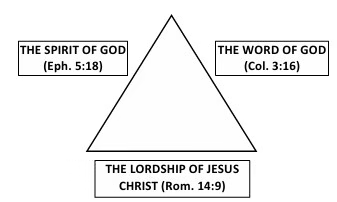 John Phillips writes, “With this simple figure in mind (above), note what happens. As we begin to read the Word of God, the Spirit of God brings some divine truth to our attention; a promise to claim, a sin to confess and avoid, a command to obey. Because we have established the basic premise that Jesus is Lord and made that the foundation of all our behaviour, our immediate response is to obey. We yield on whatever issue in the Word of God the Spirit of God has brought to our attention. As we yield, He fills us and we receive the power to turn that teaching into practical reality.”
Challenge: Do we have any desire to know the filling of the Spirit in our lives? Or have we grown content in our carnality?
Sermon 21 of 31 in Ephesians Series
Sermon Audio Id: 52821613233300