


Exposition of the Millennial kingdom as described in Revelation by the Apostle John, the final revolt from Satan after the 1,000-year reign and his final judgment in the lake of fire for eternity. The main views of the Millennial are discussed and the reasons for adopting the biblical view of the Pre-millennial return of Christ are explained.
This chapter outlines in brief the Millennial reign of Christ on earth and the great white throne judgment that comes at the end of the 1,000-year reign.
The word ‘millennium’ comes from two Latin words – ‘mille’ (thousand) and ‘annum’ (year), so 1,000 years.
This passage of Scripture is one of the most hotly debated due to the differing views on the Millennium. There are three main views as follows:
- The Amillennial Viewpoint: The word means “no millennium”. In other words, they deny a literal thousand-year reign of Christ on earth contending that we are in the millennium now between the first and second advent of Christ. Augustine was the main architect of this view and it was the predominant view held by the reformers. The main problems with this view are:
- It denies the plain statements of Scripture concerning a 1,000-year reign of Christ on earth. The phrase “a thousand years” occurs six times these verses. If the plain sense makes sense, seek no other sense! Numbers in the Book of Revelation are always used in a literal sense.
- It denies the many promises in God’s Word that guarantee a literal kingdom of Christ on earth. E.g. 2 Sam. 7:12-13; Psalm 2:8; Luke 1:31-33.
- The Postmillennial Viewpoint: Like the Amillennial view, they deny a literal 1,000-year reign. The belief is that Christ will come after the Millennium. They believe the world will get better and better and more and more Christianized and then Christ will come. This theory was popularized by Daniel Whitby (1628-1725), a British Unitarian. It was a popular view until World War I and II where it fell into disfavor. However, of recent years it has had a resurgence in popularity under the labels “Christian reconstructionism” and “dominionism”. This is particularly popular in some Pentecostal/Charismatic circles. The main problems with this view are:
- Like the Amillennial viewpoint, they fail to interpret the Bible in its normal, literal sense.
- The Bible predicts the exact opposite to this view concerning the days immediately preceding the coming of Christ. They will be days marked by great apostasy (1 Tim. 4:1; 2 Tim. 3:1-7; Luke 18:8).
- The Premillennial Viewpoint: This is the Biblical view that takes the Bible’s plain statements and promises concerning the kingdom literally! It was the predominant view of the early church (refer quote by Schaff).
With these things in mind, we will consider 4 truths revealed in our text about the Millennium:
The Restraining of Satan (Vs. 1-3)
The Particulars of the Restraint (Vs. 1)
- The Individual restraining (Vs. 1a)
- “an angel” = appears he is no extraordinary angel like the ones mentioned in Rev. 5:2; 10:1 & 18:1.
- Reveals just how limited the power of Satan is that one angel from heaven has enough power to completely subdue him.
- The Instruments for restraining (Vs. 1b)
The angel carries two pieces of equipment with which to restrain Satan:- A key to the bottomless pit.
- A great chain. The same word is used in Mk. 5:3; Acts 12:7; Acts 28:20 and 2 Tim. 1:16. Some scoff at a literal understanding of this. They say how can a spirit being be bound with a literal chain? Answer: Don’t you think the Lord of glory has the ability to make a chain that will work for Satan?! This will be a chain manufactured in no other place but heaven itself!
The Person in the Restraint (Vs. 2a)
There are four titles of the evil one in this verse and each one describes His evil character and deeds. Satan is…
- The Devourer/Murderer – “the dragon”. Satan is pictured as an evil, murderous, monstrous, vicious and dangerous enemy (Rev. 12:3- 4). “He was a murderer from the beginning…” (John 8:44).
- The Deceiver/Supplanter – “that old serpent” This title takes us all the way back to the Garden of Eden (Gen. 3) where Satan first deceived mankind into sin. Satan is a liar (John 8:44) and deception is one of his primary activities (2 Cor. 4:4).
- The Defamer/Accuser – “the Devil” Satan is the accuser and the slanderer of God and God’s people (Gen. 3:5; Rev. 12:10). The same Greek word is translated ‘slanderers’ (1 Tim. 3:11) and “false accusers” (2 Tim. 3:3; Titus 2:3).
- The Defier/Opposer – “Satan”. The word appears 49 times in the Bible and means ‘adversary’. Satan is the adversary of God and God’s people. Satan is NOT for you as much as he may pretend otherwise! The first time the word ‘Satan’ appears in the Bible is in 1 Chr. 21:1 – “And Satan stood up against Israel…”
- Walter Scott: “As the dragon he is the embodiment of cruelty. As the serpent he is the personification of guile. As the devil he is the arch tempter of men. As Satan he is the declared opponent of Christ and His people.”
The Period of the Restraint (Vs. 2b)
- “bound him a thousand years” = The fact of the thousand years is mentioned 6 times (Rev. 20:2, 3, 4, 5, 6, 7). This presents a problem for the Amillennial and Postmillennial views. “If the millennium is now between Christ’s first and second advents, then Satan must be bound now! But in reality, the Word of God bears out that Satan is as active as ever (1 Pet. 5:8). Instead of being bound, Satan is on the loose, seeking prey to devour.” (Walvoord)
- Christ’s earthly kingdom will last for 1,000 years but it will not only last for 1,000 years. Christ’s eternal reign will be ushered in soon after the 1,000-year reign is complete.
The Place of the Restraint (Vs. 3a)
The picture is one of total imprisonment:
- “cast him into the bottomless pit” = a place of torment for evil spirits. It was from this pit that the horde of demonic locusts was released in Rev. 9:2 under the fifth trumpet. It was this place of torment that was feared by the demons possessing the man Legion (Luke 8:31).
- “shut him up” = the pit is closed so there is no escape.
- “a seal upon him” = seals were used in the ancient word to cordon off an area. For example, the lion’s den into which Daniel (Dan. 6:17) was cast and the tomb of Christ (Matt. 27:66).
The Purpose of the Restraint (Vs. 3b)
- “deceive…no more” = again highlights Satan’s primary activity in the world.
- “the nations” = the question arises at this point, where do these nations come from since the majority of the unsaved will be slaughtered at the battle of Armageddon (19:21) and the unbelievers that are still alive will be gathered to the sheep and goat judgment and will be cast into everlasting punishment (Matt. 25:31- 46)? Answer: The millennium will be populated with the tribulation saints who survive the tribulation (the sheep). With the curse removed from the earth for 1,000 years, people will live incredibly long lives and will therefore be able to populate the earth again. Evidently many of the children will not be saved as they will be stirred up by Satan at the end of the Millennium to come against Christ in an attempt to overthrow His reign.
The Reigning of the Saints (Vs. 4)
The saints are…
Elevated Saints (Vs. 4a)
- Elevated to a Position – ‘thrones’
- Elevated to a Function – “judgment was given”
- Question: Which group of saints will have a ruling function in the Millennium? The Bible indicates at least three groups:
- Jewish Saints (12 Apostles): Matthew 19:28 “And Jesus said unto them, Verily I say unto you, That ye which have followed me, in the regeneration when the Son of man shall sit in the throne of his glory, ye also shall sit upon twelve thrones, judging the twelve tribes of Israel.”
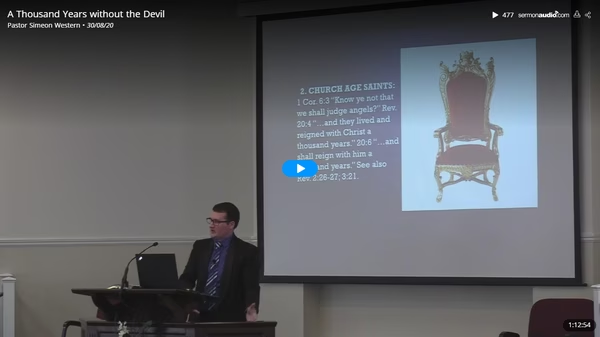
- Church age Saints: 1 Cor. 6:3 “Know ye not that we shall judge angels?” Rev. 20:4 “…and they lived and reigned with Christ a thousand years.” 20:6 “…and shall reign with him a thousand years.” See also Rev. 2:26-27; 3:21.
- Tribulation Saints: Rev. 20:4 “…and I saw the souls of them that were beheaded for the witness of Jesus…” A special emphasis is given in this context to the tribulation saints. They experience unspeakable horrors during antichrist’s reign of darkness but now they will experience unimaginable honors in Christ’s reign of light.
Esteemed Saints (Vs. 4b)
- The reasons for their martyrdom
- For the Witness of Jesus
- For the Word of God
- Note: The word ‘beheaded’ is a derivative of the Greek word ‘pelekys’ which means “axe”, the traditional weapon for execution in republican Rome.
- The refusals in their martyrdom They refused…
- To worship the beast and his image
- To receive the beast’s mark
- The reward of their martyrdom – “they lived”. The word ‘lived’ refers to resurrection in this verse. This is made clear by the way the same word is used in Vs. 5.
The Resurrection of the Saints (Vs. 5-6)
The Description of the Two Resurrections (Vs. 5)
- The first resurrection (the resurrection of life – Jn. 5:29). Who will be in the first resurrection?
- In the immediate context, the tribulation saints are in view.
- It includes previous bodily resurrections of the saints prior to this point:
- First fruits resurrection – Christ and many of the O.T. saints (Matt. 27:53-54).
- Raptured saints of the church age (1 Thess. 4:16-18).
- Walvoord: “It would seem clear from these facts that the term “the first resurrection” is not an event but an order of resurrection including all the righteous who are raised from the dead before the millennial kingdom begins. They are “first” in contrast to those who are last, after the millennium, when the wicked dead are raised and judged.”
- David Cloud: “The term ‘first resurrection’ does not describe a single event but is used rather to contrast the resurrection of the saved with the ‘second resurrection,’ which is the resurrection of the unsaved.”
- Note: Verses like Daniel 12:2 and John 5:28-29 declare the fact of resurrection but not that the two events take place at the same time.
- The final resurrection (the resurrection of damnation – Jn. 5:29). Who will be in the second resurrection? Answer: the lost souls of all the ages (See Vs. 11-15).
The Commendation of the First Resurrection (Vs. 6)
There are at least 5 wonderful things mentioned about those who are in the first resurrection. Look at their…
- Privilege – ‘blessed’. Can there be a greater blessing?
- Purity – ‘holy’. Their holiness is not something they have produced themselves but is a holiness that has been given them through God’s work of salvation on their behalf.
- Protection – “second death hath no power” They will not appear at the great white throne judgment nor will they ever be cast into the lake of fire.
- Priesthood – “priests of God and of Christ” The key thought is that of privileged access.
- Position – “and shall reign with him a thousand years.”
The Revolt of Satan (Vs. 7-10)
The Devil’s Deception (Vs. 7-9)
- The Provocation of the Rebellion (Vs. 7-9a)
- The moving of the army (Vs. 8a)
- Those deceived will be the descendants of the tribulation saints who survive the tribulation and enter the millennium in their natural bodies. “The rate of population growth during this period will be far higher than ever before because physical death will be the exception rather than the rule throughout this ideal period (Is. 65:20). So, a new set of nations will come to exist on earth in a relatively short period.” (Robert L. Thomas)
- Walvoord: “This ends the false theory that human beings in a perfect environment will willingly serve the God who created and redeemed them. Even in the ideal situation of the millennium, innumerable people respond to the first temptation to rebel.”
- Wiersbe: “A perfect environment cannot produce a perfect heart.”
- The magnitude of the army (Vs. 8b)
- “Gog and Magog” = the same people that attack Israel from the North during the tribulation (Ez. 38-39). It appears they will play a leading role in this final worldwide rebellion.
- Interestingly the name ‘Magog’ comes from the Hebrew ‘rosh’ which is the ancient name from which modern Russia derives her name (Cloud Pg. 493).
- The mission of the army (Vs. 9a)
- The moving of the army (Vs. 8a)
- The Destruction of the Rebellion (Vs. 9b)
The Devil’s Damnation (vs. 10)
- The Description of his Damnation (Vs. 10a)
- The Duration of his Damnation (Vs. 10b)
- “where the beast and the false prophet are” = they are still there after 1,000 years! The lake of fire was created for the satanic trinity and not for you. Don’t join them there!
- “day and night for ever and ever” = the punishment of the devil and the lost (Vs. 14-15) is stated “in the strongest, most absolute terms” (Walvoord). It “expresses the unbroken continuity of their torment.” (Thomas)
Conclusion
- Which resurrection will you be a part of? The first resurrection to life or the second resurrection to damnation? Will you spend eternity with Christ in glory or eternity with Satan in the lake of fire?
- If you are saved, are you bold for the Word of God and the witness of Jesus despite the cost? Are you living with eternity in view? Are you seeking to reach out to the lost to see them rescued from the lake of fire?
Sermon 33 of 38 in Revelation Series