

We now enter the second section of the Book according to the outline in chapter 1:19 – “the things which are” which is Christ’s letters to the seven churches. Exposition of Christ’s letter to the church of Ephesus.
The word ‘church’ occurs 15 times in these two chapters but after that it isn’t mentioned until the very end of the Book in chapter 22:16. This is because the church is NOT on earth for the 7-year period of God’s judgment!
The message of these letters has a four-fold application:
- Historically – these letters were written to instruct seven actual, historical churches in the Roman province of Asia Minor.
- Continually – these letters designed to instruct every church throughout the entire church age – “he that hath an ear, let him hear what the Spirit saith unto the churches” (Rev. 2:7, 11, 17, 29; 3:6, 13, 22).
- Individually – the challenge goes to the church as a whole AND to the individuals within each church. The church is made up of individuals and each contributes something to the spiritual temperature of the local church.
- Prophetically – the seven letters appear to present a general overview of church history. This is in keeping with the prophetic nature of the Book (Rev. 1:3). For example, “Revelation 3:10 obviously looks beyond anything that was experienced by the historical church at Philadelphia in the first century…This clearly refers to the hour of the Tribulation described in Revelation 6-18, and the historical church at Philadelphia did not live to see that day…ultimately it looks down the long corridor of time to the faithful Bible-believing congregations of the last hours of the church age, congregations that serve Christ faithfully in the midst of the terrible apostasy and compromise described in 2 Timothy 3-4.” (Cloud)
- Theodore Epp: “If I were to give a title to this section, I would call it ‘The Great Apostasy of the Last Days Traced from the Beginning of the Church’s History.’ We will see how Satan uses what I call ‘the whittling method’ of cutting away the essential features that make a church a church and finally makes it an arm of apostasy.”
Outline of messages to Seven Churches (taken from Bible College Notes)
- Ephesus: The Loveless Church
- Smyrna: The Lacerated Church
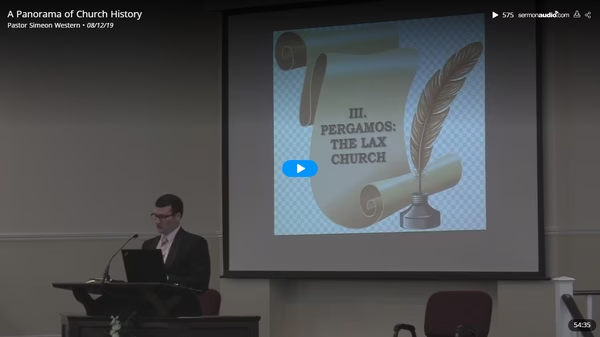
- Pergamos: The Lax Church
- Thyatira: The Licentious Church
- Sardis: The Lifeless Church
- Philadelphia: The Loyal Church
- Laodicea: The Lukewarm Church
Let’s consider the prophetic application in further detail.
Ephesus: The Loveless Church (Rev. 2:1-7)
Definition – the word Ephesus means ‘desired’
Description – pictures the era of the early Apostolic churches with their zeal for doctrinal purity.
- Ironside: “Ephesus means ‘desirable’, such a term as a Greek applied to the maiden of his choice. Ephesus gives us a picture of the church as it was in the beginning, when the Lord held the stars (his servants) in His hand and controlled their ministry. He sent them here and there, just as He would, to proclaim the glad gospel of His grace and to minister to His saints…The early church was walking in separation from the world…In the days of Ephesus, believers could not bear those who were evil…More than that, they were loyal to the truth.”
- By the time John writes to the church at Ephesus, it was around 40 years old. This means the church would be entering the second- generation phase, with the original converts passing off the scene. The waning of passionate love for Christ is a real danger to the second generation.
Smyrna: The Lacerated Church (Rev. 2:8-11)
Definition – “The word Smyrna means ” myrrh,” which was a fragrant spice used to make perfume. What happened was this. When the bark of the flowering myrrh tree was crushed it released a sweet aroma. The more these believers were crushed by the world for their faith in Christ, the more the sweet aroma of their testimony was released.” (Denis Lyle)
Description – describes the suffering church of the second and third centuries
- It was predicted that this church would have “tribulation ten days”. There were ten distinct outbursts of persecution under the pagan Caesars:
- Nero (AD 54-68)
- Domitian (AD 81-96)
- Trajan (AD 98-117)
- Marcus Aurelius (AD 161-180)
- Severus (AD 193-211)
- Maxinium (AD 235-238)
- Decius (AD 240-251)
- Valerian (AD 253-260)
- Aurelian (AD 270-275)
- Diocletian (AD 285-305)
- Phillips: “The final outbreak lasted ten years. All former persecutions of the faith were forgotten in the horror of the last and greatest – the tenth wave of that storm obliterated all traces that had been left by others. The cruelty of Nero, the fears of Domitian, the dislike of Marcus, the plans of Decius, the intrigues of Valerian – all fell into obscurity when compared with the concentrated terrors of that final struggle resulting in the destruction of the old Roman Empire and the establishment of the cross as the symbol of the world’s hope. Eusebius was a witness of this persecution. According to him, even the wild beasts refused at last to attack the Christians, the bloody swords became dull and shattered, the executioners grew weary; but the Christians went singing to their deaths with hymns of praise, thanksgiving, and worship on their lips.”
Pergamos: The Lax Church (Rev. 2:12-17)
Definition – the word ‘Pergamos’ means ‘married’.
Description – It describes the marriage of the church to the world under Emperor Constantine who joined the church and state in an unholy union (Ecob).
- The ‘deeds’ of the Nicolaitans (Vs. 6) had progressed to a ‘doctrine’ (Vs. 15). ‘Nicolaitan’ means “to conquer the people” and “refers to the rise of the unbiblical hierarchical doctrine of church government that developed into the papacy.
- The doctrine of Balaam is the teaching that Christians are at liberty to indulge in sin. When Balaam couldn’t curse Israel, he instructed Balak king of Moab to seduce the Israelites into fornication with the Moabite women. God’s wrath came upon Israel and 24,000 perished (See Num. 22 to 25).
- Ironside: “Constantine’s patronage did what Diocletian’s persecution could not do: it corrupted the church, and she forgot her calling as a chaste virgin espoused to an absent Lord. Then she gave her hand in marriage to the world that had crucified Him, thus entering into an unholy alliance of which she has never really repented.”
- “Let us beware of the favours of the world even more than of its threats.” (H.L. Rossier)
Thyatira: The Licentious Church (Rev. 2:18-29)
Definition – the word ‘Thyatira’ means “continual sacrifice”.
Description – describes the Roman Catholic Church with its idolatrous sacrifice of the Mass
- This church noted for its immorality (Jezebel). Immoral perversion has dominated the Catholic church since its inception.
- Phillips: “Corruption and wickedness in the professing church rose to such height that the infidel historian Gibbon could write, ‘The history of the church is the annals of hell.’ The church became the home of heathendom. Pagan feast days became Christian festivals; pagan gods became Christian saints’ pagan rituals received new life as Christian rites; and pagan priests and nuns became the ordained servants of the church. In short, paganism was baptized and incorporated into Christianity.”
- Walvoord: “During this period also there began that exaltation of Mary the mother of our Lord which has tended to exalt her to the plane of a female deity through whom intercession to God should be made, and apart from whose favor there can be no salvation. The prominence of a woman prophetess in the church at Thyatira anticipates the prominence of this unscriptural exaltation of Mary.”
Sardis: The Lifeless Church (Rev. 3:1-6)
Definition – the word ‘Sardis’ means “escaping few”
Description – describes the Reformation church beginning with Luther’s protest at Whittenburg Cathedral in 1517.
- Christ appears to Sardis as He “that hath the seven Spirits of God and the seven stars.” The Reformation was a work of the Spirit of God that broke the power of the Roman Catholic church and put the Scriptures back into the hands of the common people.
- However, Christ says “I have not found they works perfect before God.” Sadly, the Reformation churches retained a number of Rome’s errors such as Infant Baptist, the concept of a state church and an allegorical interpretation of prophecy (a-millennialism).
- Christ warns this church of not being watchful for His return (Vs. 2 & 3). The Reformation church is not watching carefully for the Lord’s return because she is largely a-millennial. Prophetic Books like Revelation are either ignored entirely or misinterpreted through the lens of replacement theology.
- Christ describes this church as having a good profession but lacking in spiritual life – “thou hast a name that thou livest, and art dead.” This is an apt description of much of Protestantism.
Philadelphia: The Loyal Church (Rev. 3:7-13)
Definition – the word ‘Philadelphia’ means “brotherly love.”
Description – the “open door” of this church suggests the era of revivals and missions.
- Ecob: “The great missionary era of Church History, beginning about 1700 with the Moravian revival and ending about 1900. During this era the second advent message was revived. The Moravian brethren were protected from persecution by Count Zinzendorf and sent missionaries out to the heathen. John Wesley was on convert and the Methodist Church was started. General Booth started the Salvation Army, and the Baptists and Brethren flourished. “Faith Missions” spread the Gospel all over the globe – Hudson Taylor had 1,500 missionaries in China alone, William Carey, C.T. Studd, Judson of Burma, Oriental Missionary Society, Unevangelized Fields Mission, Egypt General Mission, World-wide Evangelization Crusade (WEC), New Tribes Mission and many many more. A great door was opened by the British Empire all over the globe. Dr. Oswald Smith’s Church of the Open Door in Toronto supported 1,000 missionaries.”
- Revelation 3:10 indicates that Philadelphian churches will exist at darkest hours at the end of the church age. Arno Gaebelein said, “Philadelphia is not a defined church-period, but rather a description of a loyal remnant called out by the Spirit of God and bearing the final testimony to the whole counsel of God by word and deed.”
Laodicea: The Lukewarm Church (Rev. 3:14-22)
Definition – the word ‘Laodicea’ means “people rule”.
Description – describes the apostate church of the end times.
- Ironside: “Laodicea is a compound word meaning ‘the rights of the people.’ Could any other term more aptly set forth the condition of modern affairs? Is it he era of democratization in both the world and the church…The spirit of this ultra-democratic age has invaded a large portion of the professed church. The authority of God and His Word is rapidly being denied.”
- J.A. Seiss: “It is Laodicean, conformed in everything to the popular judgment and will, the extreme opposite of Nicolaitan. Instead of a Church of domineering clericals, it is the Church of the domineering mob.”
- Cloud: “Prosperity is a danger to the spiritual life of the church. The two churches that were most prosperous were in the worst spiritual condition (Sardis and Laodicea), while the two churches that were the weakest and poorest were in the best condition, spiritually (Smyrna and Philadelphia).
- Christ is pictured as standing outside of this church
Conclusion
- Summary (refer graph)
- What kind of church are we seeking to be?
Sermon 4 of 38 in Revelation Series