

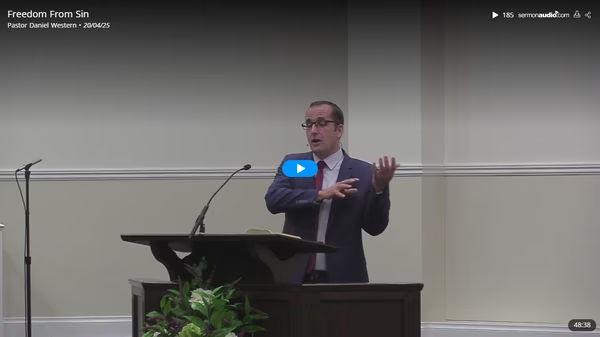
What does it mean to be truly free from sin – not just forgiven, but actually liberated from its power? Romans 6:1-14 reveals that every believer has been united with Christ in His death, burial, and resurrection, breaking the old sin nature’s stranglehold. The key lies in three steps: knowing that you are dead to sin and alive to God, reckoning or counting that truth as fact even when feelings say otherwise, and yielding every part of yourself to God rather than to sin. Freedom is not found in giving in to temptation but in surrendering wholly to the One who conquered it. Whatever the struggle – anger, addiction, bitterness, impurity, or discontent – the same victory is available through the power of the risen Christ.
The children of Israel offer a striking picture. After generations of anguish in Egypt – all the sorrow, bondage, and crying out to God for deliverance – it was not long after their rescue that their minds reversed. They began to think the wilderness was the place of bondage and that freedom lay back in Egypt. It was lunacy, and yet believers do the same thing. God sets His people free from sin’s penalty at salvation, delivering them out from under its lordship. But sadly, many place themselves back under sin’s power. They do not know how to overcome it, and they begin to think it would be better simply to submit to what sin would have them do.
Romans 6 addresses this head-on. The word “sin” appears seventeen times across the chapter’s twenty-three verses, and words associated with death – dead, died, crucified – appear eighteen times. It is death to sin that is the great theme here. David H. Sorenson calls Romans 6 a chapter of climax: though the epistle continues with further truth, everything developed so far comes to a head in this passage. The overriding truth is that believers ought not to live in sin. All other thoughts are subordinate to that basic conclusion.
Three stages mark every Christian’s experience. Justification is salvation from sin’s penalty – the sufferings, death, burial, and resurrection of Christ paying the debt in full. Sanctification is salvation from sin’s power, where the Spirit of God takes the Word of God and works within, moulding and shaping the believer to be like Christ. Glorification is salvation from sin’s very presence, taking place at either the rapture or at death, after which the believer will never fall into sin again. Romans 6, 7, and 8 deal with the second of these – sanctification – and here in chapter 6 the focus is on how God has a plan for the saved to walk in a different and new life. It would be a very weak salvation if God were to save but not change.
An objection is raised in verse 1: if where sin abounded, grace did much more abound, should we not simply continue in sin so that grace increases? Paul answers with the strongest possible language – God forbid, may it not be, perish the thought. He argues that it is impossible to keep living in sin because the believer is dead to it. When someone truly calls upon Christ, it is not merely a religious ritual. God does something major at that point. More firm than any contract, it is an eternal work. And yet some believers adopt a soft version of this objection, thinking it does not matter what they do because God loves them. They turn the grace and love of God into a licence for sin. But Titus 2:11-12 teaches that the grace of God that brings salvation also teaches believers to deny ungodliness and worldly lusts, to live soberly, righteously, and godly in this present world.
The logic is quite simple: dead people do not sin. A dead man lying on a platform could be kicked, spoken to, insulted – and would not respond at all, because the dead know nothing. God says the believer is dead to sin. The old life, the old self, is finished. Dead people do not lie, steal, hate, murder, commit adultery, or cheat. They are dead – and God says that believers are dead to sin but alive to Him. Ephesians 2:4-6 describes how God, who is rich in mercy, quickened those who were dead in sins together with Christ, raised them up, and seated them in heavenly places in Christ Jesus. Once immersed in the sphere of sin, the believer has been taken out and placed into Christ.
This is what baptism in Romans 6 refers to – not water baptism following conversion, but being placed into Christ at salvation. At that moment the believer was severed from the old nature and made free. First Corinthians 12:12-13 says that by one Spirit all were baptised into one body. Once in the world and not in Christ, now placed into Him. It is a new beginning in the truest sense. The past may haunt, but Christ makes things new. “Therefore, if any man be in Christ, he is a new creature: old things are passed away; behold, all things are become new” (2 Corinthians 5:17).
This new position involves union with Christ in His death, burial, and resurrection. Two thousand years ago, when Christ died, every believer who would later be placed into Him was identified with Him in that death. God is not hemmed in by time. Being in Him, we die to sin. Our old sin nature, which used to rule, has been dealt a death blow. There is nothing in it worth preserving – Paul said, “I know that in me (that is, in my flesh,) dwelleth no good thing” (Romans 7:18). It is like a brown snake that has had its back broken. It is still there, but it has lost its power. The ability to sin remains, but God has rendered it inoperative. The old person is dead and gone. And not only does the death of Christ make the believer dead to the old sin nature, but the resurrection of Christ gives newness of life. United in crucifixion, united in resurrection – raised with Him to walk in a brand-new way.
This freedom must first be known. When temptation comes – when anger arises, when the eyes want to turn toward something sinful, when bitterness or ungratefulness surfaces – the believer must know: I am dead to that. “If the Son therefore shall make you free, ye shall be free indeed” (John 8:36). What a tragedy to think that sin is freedom when it binds and blinds, takes you further than you want to go, keeps you longer than you want to stay, and charges more than you want to pay.
Second, it must be reckoned upon. The Greek word is logizomai – to reckon, count, compute, take into account. This is not a mind-over-matter trick, not psyching oneself out of sin. It is reckoning on something that is actually true. Believing something false will not help – like reckoning you have fifty thousand dollars when you have five, the illusion collapses the moment it meets reality. But reckoning on what God declares to be true is reckoning on solid ground. “I died with Christ, I rose with Him, and therefore I can walk in newness of life” – that is reckoning on fact. It is not built on feelings. You may not feel free, but you are.
Third, it must be yielded to. The reality of freedom is worked out in practice through yielding. The same word that appears on give-way signs – yield, let someone else go first – applies spiritually. Do not yield your members to sin; yield yourself to God. Hands, feet, eyes, ears, tongue – every part belongs to Him. The believer does not actually have the right to yield those members to whatever he wants. Too many Christians get it the other way around: they resist what God wants and yield to sin. They sit on the couch yielding to whatever comes across the screen, following the phone wherever it takes them. That is why churches are weak, why revival tarries.
To say no to sin is freedom. To say yes to God is freedom. To say no to God is bondage. To say yes to sin is bondage. Sin is like a monkey trap – the monkey reaches in, grabs hold of something, and cannot get its hand back out. If it would just let go, it would be free. Many Christians are caught exactly that way, holding on to the very thing that holds them captive.
The practical application is the same regardless of the struggle. A tired workman reckons himself dead to self-centredness and gets up to serve his family by resurrection power. An offended woman reckons herself dead to anger and bitterness and trusts Christ to live through her. A believer with a previous drug addiction reckons himself dead to substance abuse and yields to the Holy Spirit. A self-condemning believer reckons on the fact of being dead to condemnation and trusts the life of Christ to fill the mind. A tempted young man reckons himself dead to impurity and yields aggressively to God. An elderly saint reckons herself dead to ungratefulness and trusts the Spirit to sanctify thought and word. A covetous believer reckons himself dead to covetousness and trusts the Lord to produce godliness and contentment. Whatever the scenario, the pattern is the same: know you are free from it, count it true, and yield to God by the Holy Spirit.
Sermon Audio Id: 4202595555945