

The old covenant said, “Do this and you will live.” The new covenant says, “Live and you will do this.” That single reversal changes everything. In Hebrews 8, the Bible reveals a covenant that is not conditional on human performance but grounded in what God himself will do – changing minds, renewing hearts, forgiving sins completely, and bringing people into a personal relationship with himself through the blood of the Lord Jesus Christ. Where the law could only ever expose failure and cover sin temporarily, Christ removes it altogether. Whether Jew or Gentile, the invitation stands: come to know God – not merely know about him – through faith in Jesus Christ.
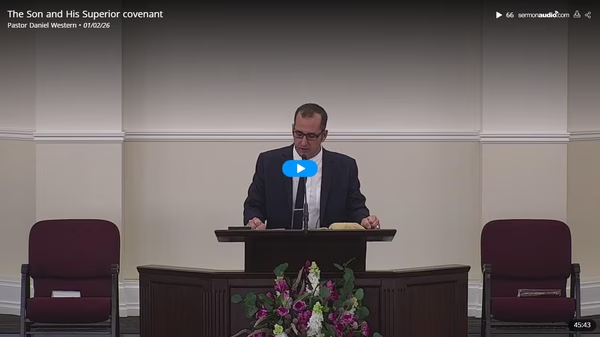
A covenant is a contract or agreement, and Scripture contains multiple covenants God has made with mankind – the Edenic, Adamic, Noahic, Abrahamic, Mosaic, Palestinian, Davidic, and the New Covenant. These covenants fall into two categories: conditional and unconditional. A conditional covenant says, “If you will do this, then I will do this.” An unconditional covenant simply declares, “I will do this.” The Mosaic covenant was conditional – God set requirements before Israel, and when they failed to meet those requirements, the blessings were withheld. The new covenant, drawn from Jeremiah 31:31-34 and quoted in Hebrews 8:8-12, is unconditional. Four times in the passage the words “I will” appear. This is what God will do, independent of human performance.
The new covenant is made specifically with the house of Israel and the house of Judah – the biological descendants of Abraham, Isaac, and Jacob. The context makes this unmistakable: it references the fathers, the exodus from Egypt, the nation’s history. It cannot be spiritualised or allegorised to mean Gentiles, and any theology that replaces Israel with the church is in error. Understanding this requires recognising the three groups identified in 1 Corinthians 10:32 – Jews, Gentiles, and the Church of God. The Church of God is made up of saved people from both Jewish and Gentile backgrounds, but it is not Israel. Confusing these groups leads to serious theological confusion and can even tend toward anti-Semitism, where the church claims Israel’s blessings while dumping the curses on the Jewish people.
Yet while the covenant is made with Israel, entrance into its blessings is opened to all through the blood of Christ. At the Last Supper, Jesus said, “This is my blood of the new testament, which is shed for many for the remission of sins” (Matthew 26:28). The Apostle John confirms that Christ is the propitiation not for believers’ sins only but for the sins of the whole world. Through faith in Jesus Christ, Gentile believers have access into this covenant – not by becoming Jewish, but by being forgiven and brought near by the blood of Christ. Ephesians 2:13 declares that those who were once far off are made nigh by the blood of Christ. The book of Acts records how God showed Peter that repentance unto life was granted to the Gentiles also.
The new covenant is future in its ultimate fulfilment with Israel. It will be established in the last days with repatriated Israel – that is, when the Jewish people are back in their land, which has already begun. The return of Israel to the land, speaking Hebrew again after it was effectively a dead language, is a remarkable modern sign of God’s plan unfolding. The Holocaust, at its very core, was Satan’s attempt to destroy God’s plan by eliminating Israel, but it backfired – the end result was Israel returning to the land. After the tribulation, at the return of Christ, all Israel shall be saved. They shall look upon the one they pierced, and there will be a national turning to Jesus Christ as the Messiah – a profound and devastating change of heart.
The old covenant, the Mosaic law, was not faulty in itself. Romans 7:12 affirms the law is holy, just, and good. But it did not contain within it the means for salvation by grace through faith. Had anyone been able to keep it perfectly in every detail, they could have been saved – but that was impossible by human standards. The law served as a schoolmaster to bring people to Christ, as Galatians 3:23-24 explains. It showed mankind’s great inability to reach God’s standard. The law encompassed every area of Jewish life – worship, farming, property, warfare, clothing, grooming, building, and the management of disease. No group of people has ever been so strictly monitored by God. And yet Israel failed from the very beginning. While Moses was on the mountain receiving the law, there was wickedness at the base. They had said, “All that the Lord hath spoken we will do” – but they did not do it. The problem was not with the law but with the people. The first step in getting right with God is admitting fault. “I have sinned” – three of the hardest words to say, whether to God, to a spouse, or to a brother or sister in Christ. Pride holds people back from salvation and from sanctification alike.
This is why the new covenant is so different and so much better. It deals with the mind – God puts his laws into the mind. Salvation changes the way a person thinks. Old thought patterns come into conflict with new ones. Things that once seemed true – evolution, worldly standards – suddenly make no sense, and biblical truth becomes clear. It deals with the heart – God gives a new heart, replacing the stony heart with a heart of flesh. Where the law could affect the heart, it could never renew it. The new covenant does what the old never could. Do you have new desires, new dislikes? Do things grieve you now that never grieved you before? Is the Holy Spirit convicting you of sin – vile thoughts, anger, covetousness, pride? If there is no change, it is not salvation.
It is better in its relationship. Under the old covenant, the vast majority could learn about God but never know him personally. At Sinai the people said, “Moses, you talk to God and tell us.” But the new covenant promises that all shall know God, from the least to the greatest. Knowing about God and knowing him are vastly different. You can accumulate facts about God your whole life and never know him. To know someone you have to have met them. When was your time of meeting God? That is salvation. And because Jesus is our high priest and has shed his blood, believers can go right into the holiest of all – into the presence of God himself.
It is better in its solution to the sin problem. The old covenant could only ever cover sin temporarily – hence the continual sacrifices, the annual offerings, year after year. Hebrews 10:4 says it is not possible that the blood of bulls and of goats should take away sins. But John 1:29 declares, “Behold the Lamb of God, which taketh away the sin of the world.” Christ does not merely cover sin; he takes it away. It really is new beginnings, a new start. And this new covenant replaces the old one forever. In AD 70, Jerusalem and the temple were destroyed by the Roman general Titus. No more sacrifices, no more of the Old Testament system. The old covenant is done away, and our only hope is in Christ.
The fundamental difference between the two covenants is this: the old said, “Do this and you will live.” The new says, “Live and you will do this.” God comes within by the Holy Spirit, living in the believer, enabling what could never be accomplished by human effort. Galatians 2:20 captures it – “I am crucified with Christ: nevertheless I live; yet not I, but Christ liveth in me.” Until Christ is central in the life, living through the life, there will be a constant struggle. Trying to perform under law will never bring joy or victory. Christ must be central in everything. So the question remains: where are you living? Who holds your next breath? God does.
Sermon Audio Id: 2126119577770