

This chapter: The altar of incense, atonement money, laver, anointing oil and incense.
Note that there are two altars in the tabernacle – the brazen altar of sacrifice and the golden altar of incense. Both have an important relationship to each other, as the coals of fire for the altar of incense were taken from the altar of sacrifice. Blood would be applied to the Golden Altar once a year on the Day of Atonement.
“Sweet incense was offered upon the Golden altar daily by the high priest (vss. 7,8). In the brazen altar, we have a type of Christ meeting the sinner’s need (Exod. 27:1-8). In the golden altar, we have a type of Christ meeting the needs of the believer, in prayer, worship and service. It typifies Christ as High Priest and Advocate.” (Typical Truth in the Tabernacle)
“At the Brazen Altar Christ died for us, shed His blood, reconciled us to God. At the Golden Altar, He lives in heaven to intercede for those for whom He has already died and who are saved. The Brazen Altar tells us of His death on the cross. The Golden Altar tells us of His resurrection, His ascension, and His Priestly intercession.”
The Altar of Incense symbolised the ministry of intercession.
- Christ’s ministry of intercession for us.
- Our ministry of intercession through Christ. In ourselves, our prayers are not acceptable, but in Christ, they are perfectly acceptable.
In these messages (part 1 & 2), we are considering 9 points about the Altar of Incense:
The Purpose of the Altar (Vs. 1)
- The Altar was a Place to Seek God (speak to God) (Vs. 1)
- The Altar was a Place to Meet God (hear from God) (Vs. 6)
The Proportions of the Altar (Vs. 2)
- The Horizontal Measurements (Vs. 2a)
- The Vertical Measurement (Vs. 2b)
The Projections of the Altar (Vs. 2b-3)
The Altar of Incense had four horns and a gold moulding/border in a crown pattern around the edge.
- The Horns of the Altar (Vs. 2b)
- The Crown of the Altar (Vs. 3)
The Poles of the Altar (Vs. 4-5)
The Rings (Vs. 4)
- Four rings were to be made for the rods. They were to be located beneath the crown border/moulding.
- Some have pointed out that a ring is a symbol of that which is eternal, as it has no beginning or end. Christ’s intercession for us is eternal and enduring.
The Rods (Vs. 5)
- Two staves (poles) were to be made out of shittim wood and overlaid with gold.
- The purpose of the rings and poles was so that the altar of incense could be carried by the priests when they moved from place to place.
The Representation
- The rings and rods speak of the provision of prayer – God’s people can always pray wherever they are. 1 Thess. 5:17 “Pray without ceasing.”
- The Hebrews prayed in Egypt. Moses prayed on a mountain top. David prayed late at night on his bed. Jonah prayed from the depths of the grave. The Syro-Phoenician woman prayed on the street. Zacharias prayed in the temple. The publican prayed outside the temple. The prodigal son prayed in a pigsty. Jesus prayed on a cross. Lydia prayed by the riverside. Peter prayed while trying to walk on water. Paul and Silas prayed in a Philippian jail. John prayed on the Isle of Patmos. Paul said, “I will therefore that men pray everywhere, lifting up holy hands, without wrath and doubting” (1 Timothy 2:8). God’s people ought to be people of prayer.” (Weaver)
- God’s attribute of Omnipresence makes prayer possible literally anywhere and at any time!
- The rings and rods speak of persistence in prayer. This altar had to be carried, which involved labour and effort. There is real spiritual labour in prayer. Col 4:12 “Epaphras, who is one of you, a servant of Christ, saluteth you, always labouring fervently for you in prayers, that ye may stand perfect and complete in all the will of God.”
- The rings and rods speak of the parameters of prayer. Notice that the rings were fastened below the crown. Our prayers are to always be in submission to our crowned Christ.
- John 15:7 “If ye abide in me, and my words abide in you, ye shall ask what ye will, and it shall be done unto you.”
- 1 John 5:14-15 “And this is the confidence that we have in him, that, if we ask any thing according to his will, he heareth us: And if we know that he hear us, whatsoever we ask, we know that we have the petitions that we desired of him.”
The Position of the Altar (Vs. 6)
The Specialness of the Position (Vs. 6a)
- It was “before the vail” and hence in front of the Ark albeit separated by the curtain. The incense altar was the central object in the tabernacle itself, signifying that prayer is the central act of worship.
- The altar of incense was the closest you could get to the presence of God in the Old Testament system, apart from the High Priest who entered the Holiest of all once a year on the Day of Atonement. The Ark was a model and representation of the throne of God in heaven. In prayer, we come before the throne of God.
- Glorious N.T. Truth! There is no longer a veil between us and the presence of God. The veil was rent when Christ died on the cross and cried, “It is finished”. Now we can have boldness to enter the holiest by the blood of Jesus (Heb. 10:19-22).
- Heb. 4:14-16 “Seeing then that we have a great high priest, that is passed into the heavens, Jesus the Son of God, let us hold fast our profession. For we have not an high priest which cannot be touched with the feeling of our infirmities; but was in all points tempted like as we are, yet without sin. Let us therefore come boldly unto the throne of grace, that we may obtain mercy, and find grace to help in time of need.”
- Heb. 10:19-22 “Having therefore, brethren, boldness to enter into the holiest by the blood of Jesus, By a new and living way, which he hath consecrated for us, through the veil, that is to say, his flesh; And having an high priest over the house of God; Let us draw near with a true heart in full assurance of faith, having our hearts sprinkled from an evil conscience, and our bodies washed with pure water.”
- It was “before the mercy seat”. We are reminded that our approach to God is always on the basis of His mercy and grace. Every answer to prayer is an act of mercy from God. Prayer and fellowship with Almighty God are made possible because of the cross.
- You need to come to the mercy seat once for salvation. Have you come to the cross for mercy, grace and forgiveness from your sin?
- You need to come to the mercy seat often in supplication.
The Sacredness of the Position (Vs. 6b)
- This was the meeting place between God and man, the place of communion and fellowship. So it is with prayer. In prayer, we meet with God, and He meets with us. In prayer, we speak to God, and in the Bible, God speaks to us.
- Challenge: Do you meet with God regularly in prayer? Do you have a prayer altar in your daily walk?
The Procedure of the Altar (Vs. 7-8)
The Repetition of the Incense (Vs. Vs. 7-8a)
Incense was to be offered in the morning (Vs. 7) and in the evening (Vs. 8) when the priest would tend to the candlestick, teaching us:
- The need for regularity (persistence) in prayer. We are exhorted in the Bible to:
- Col 4:2 “Continue in prayer, and watch in the same with thanksgiving;
- 1 Thess. 5:17 “Pray without ceasing.”
- The need to be in daily prayer. Note the “morning” and “evening” principle. Daily devotions are so vital to the Christian life.
- The need for duty and prayer. Prayer needs to be offered in connection with other forms of service. Notice that the incense was to be offered at the time of the dressing and lighting of the lamps. Prayer keeps our lives shining for Christ.
The Description of the Incense (Vs. 7a)
The incense is described as “sweet incense” 8 times in Exodus (See Ex. 25:6, 30:7, 31:11, 35:8, 15, 28; 39:38, 40:27). The ingredients for the incense are called “sweet spices” (Ex. 30:34).
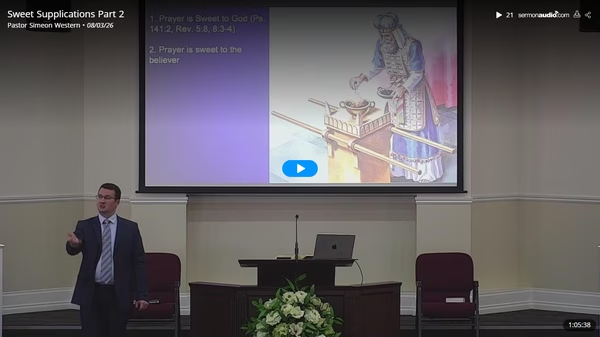
Prayer is Sweet to God (Psalm 141:2, Rev. 5:8, 8:3-4).
- Christ’s prayers are sweet to God, especially as we offer them in the name of the Lord Jesus. Offered in the name of Jesus Christ, mere human words become sweet beyond description.
- Our prayers are like sweet incense before the throne of God and are used as a part of the worship in heaven. God even uses them in the outworking of His purposes on earth. (Rev. 8:3-5). Illustration: Prayers all over the auditorium on Wednesday nights.
- Prayer is sweet to the Believer. What a privilege it is to pray! What a comfort to the soul it is to pray! Prayer also has a marvellous sweetening effect on the believer’s life. Prayer can have a sweetening effect in a marriage and a home. Prayer has a sweetening effect in the local church. “The offering of prayer to God is the sweetest thing that the believer can give him. The perfumed smoke which rose from the altar was not only sweet to God, it was also sweet to the one who offered it.” (Weaver)
- Illustration: William W. Walford was a blind English preacher of lowly birth. Although he did not have a formal education, people called him ‘the walking Bible’ for his ability to quote Scripture with great precision. Although he was unable to see the beauty of this world, the glories of heaven were opened to him through the privilege of prayer. Spending many sweet hours in the throne room of intercessory prayer, he was moved to pen these words in 1842:
Sweet hour of prayer, sweet hour of prayer
That calls me from a world of care,
And bids me at my Father’s throne
Make all my wants and wishes known.
In seasons of distress and grief,
My soul has often found relief,
And oft escaped the tempter’s snare,
By thy return, sweet hour of prayer”
The Representation of the Incense (Vs. 8b)
- Typically, the incense points to Christ’s intercession for us, particularly to its ongoing aspect. It is sweet before the Father and prevails. It is continuous and everlasting. Note that the incense is described as “perpetual incense before the LORD throughout your generations.” Christ ever lives to make intercession for us (Heb. 7:25).
- Practically, the incense speaks of the believer’s prayer life as we have discussed.
The Prohibitions of the Altar (Vs. 9)
There were some clear prohibitions in relation to what was not to be offered upon the altar of incense.
No Strange Incense (Vs. 9a)
- “The incense burned on the altar was to be holy according to the recipe given by God (Vs. 8-9, 37-38). Prayer and worship must be made up of the right ingredients. We cannot mix the impure and worldly in our worship of a Holy God. We are to worship God according to His Divine instructions as found in His Word. There must be no strange incense (Ex. 30:9), no strange oil (Ex. 30:31- 32), no strange fire (Lev. 10:1-2). God requires worship in truth (Jn. 4:24)” (Cloud)
- We are reminded that worship is to be done in God’s way as revealed in God’s Word. We do not approach God on our terms, but on His. We need submission in worship, not innovation in worship.
- Aaron’s sons violated this command and paid the price with their lives. Lev. 10:1-2 “And Nadab and Abihu, the sons of Aaron, took either of them his censer, and put fire therein, and put incense thereon, and offered strange fire before the LORD, which he commanded them not. And there went out fire from the LORD, and devoured them, and they died before the LORD.”
- We are all for passionate prayer and heartfelt worship in the church, but let us beware of the danger of false fire! Let us beware of imitation incense, something that may look genuine but is spurious.
- Beware of false fire creeping into prayer – e.g., babbling in gibberish (tongues falsely so called), contemplative prayer, Catholic prayer practices (e.g., praying the Rosary). Take the Rosary, for example, which is seeing a rapid growth in popularity in our day. It includes a blasphemous prayer to Mary as follows: “Hail, Holy Queen, Mother of Mercy, our life, our sweetness and our hope, to thee do we cry, poor banished children of Eve; to thee do we send up our sighs, mourning and weeping in this vale of tears; turn, then, most gracious Advocate, thine eyes of mercy toward us, and after this, our exile, show unto us the blessed fruit of thy womb, Jesus. O clement, O loving, O sweet Virgin Mary! Pray for us, O holy Mother of God, that we may be made worthy of the promises of Christ.”1
- Beware of false fire creeping into praise – e.g., the rock and roll music style that is in rebellion to God’s Divine blueprint for music and worship in the church (John 4:23-24; Eph. 5:18-19, Col. 3:16, James 5:13). Beware of “will worship” (Col. 2:23) which is worship according to man’s will instead of God’s will. Beware of worship in the soul rather than worship in the spirit.
- Challenge: Is it going to be Christianity on your terms or on Christ’s terms?
No Sacrificial Offerings (Vs. 9b)
- “No sacrifice was to be offered on the golden altar. it stood as a reminder of the work of the brazen altar and the blood shed on it. it sets forth the work of Christ as priest after his death.” (Weaver)
- These offerings were to be offered on the Altar of Sacrifice. The principle is that there was to be no confusion in worship. Things were to be done decently and according to the Divine order.
- Illustration: The blasphemous Catholic doctrine of Transubstantiation, where a prayer from the priest in Latin is supposed to turn the wafers into the literal body of Christ and the wine into the literal blood of Christ. No sacrifice of Christ is made in prayer. Prayer is made on the basis of Christ’s sacrifice!
The Priest of the Altar (Vs. 10)
Aaron’s ministry at the golden altar of incense points us to Christ’s High Priestly ministry before the golden altar in heaven. The mediatorial ministry of Christ and His shed blood is in view, without which our prayers would never reach heaven!
Christ is our Advocate (Vs. 10a)
- Aaron’s presence at the altar in the Tabernacle reminds us of our Saviour’s presence before the altar in heaven.
- Aaron was to apply the blood once a year to the altar, and he typifies Christ as our Mediator. Christ is our High Priest.
- 1 Tim. 2:5 “For there is one God, and one mediator between God and men, the man Christ Jesus;”
- We offer our prayers in Christ’s Name, as He is the One who mediates them to the Father.
Christ is our Atonement (Vs. 10b)
- Note that the word ‘atonement’ appears 3 times in the verse. The word contains the idea of a covering and an appeasement.
- The blood provided that atonement!
- Heb. 10:19 “Having therefore, brethren, boldness to enter into the holiest by the blood of Jesus…”
The Principles of the Altar
Let’s summarise the key practical principles we have learned about prayer through our study of the altar of incense:
- Prayer is a place where we meet with God.
- Prayer is a high and holy exercise that brings us into the very presence of Almighty God.
- Prayer is powerful (horns of the altar).
- Prayer must be within the parameters of God’s will as revealed in the Word of God.
- Prayer is available to us at any time and in any place.
- Prayer brings us into the very throne room of heaven and is on the basis of God’s mercy and grace.
- Prayer needs to be a part of our daily walk.
- Prayer is sweet to God and has a sweetening effect on our lives.
- Prayer is possible because of our Lord Jesus’ ministry as our Mediator.
Conclusion
Do you have a prayer altar in your life? How important is prayer to you in:
- Your personal life.
- Your family life.
- Your church life.
References
- 1 Tim. 2:5 – The man Christ Jesus is our mediator, not Mary!
Sermon 53 in Exodus Series
Sermon Audio Id: 3726106583331