

Introduction and overview of the Book of Exodus to prepare for expository series.
Exodus is the second Book in the first five Books of the Bible commonly called the Pentateuch. The word ‘Pentateuch’ comes from a compound Greek word made up of ‘penta’ meaning “five” and ‘teuchos’ meaning “scroll” or “book” hence it literally means “five books”. These are also called “the books of Moses” as Moses was the author, and the “book of the law” as they detail the Mosaic law. The Jews refer to these five Books as the Torah.
Exodus continues naturally from the Book of Exodus. Note the conjunction ‘Now’ in Ex. 1:1. Exodus is the continuing story of Genesis. Robert Boyd writes, “Exodus assumes the existence of a previous record. Its first six verses are a summary of the last five chapters in Genesis. There are references to creation (20:11, 31:17); to God’s covenant with the patriarchs (2:24, 6:3, 4, 8; 13:5, 11; 32:13; 33:1). The twelve sons of Jacob are frequently spoken of (e.g., 6:14-25, 24:4). Genesis 50:25 is directly quoted in Exodus 13:19.
Regarding the connection between Genesis and Exodus, Graham Scoggie writes, “The connection between Genesis and Exodus is intimate. In the one the divine purpose is revealed, and in the other the divine purpose is exhibited. In the one are human effort and failure, and in the other are divine power and triumph. In the one is a word of promise, and in the other is a work of fulfillment. In the one is a people chose, and in the other is a people called. In the one is God’s electing mercy, and in the other God’s electing manner.”
Concerning Exodus, Dr. R.G. Lee writes, “This Book commences by telling how God came down in grace to deliver an enslaved people and ends by telling how God came down in glory to dwell in the midst of a redeemed people.”
Exodus has 40 chapters, 1213 verses, and 32, 692 words. It covers approximately 145 years of Biblical history.
Overview (contents): “Exodus is the continuing record of God’s plan of the ages “that in the dispensations of the fullness of times he might gather together in one all things in Christ” (Eph. 1:10). Exodus is about the beginning of Israel as a nation. It is the record of how God multiplied Israel into a nation in Egypt and brought Israel out of Egypt with a mighty hand to establish Israel as a light to the nations. Israel’s purpose was to give the world the law, the Scriptures, Christ, and the eternal kingdom which is promised to David and which will be ruled by Christ. Exodus documents Moses’ birth and call, the 10 supernatural judgments on Egypt, the Passover, the crossing of the Red Sea, and the 11 months at Sinai where God gave the law, the Tabernacle, the priesthood, and the Levitical offerings.”1
In this introductory message we will consider 6 introductory points that will aid our study of the Book of Exodus.
The Title of the Book
The Hebrew Title
- Apparently, the Jews refer to the second Book of the Torah by the title ‘Shemot’ meaning “names” which appears in the first verse of the Book – “Now these are the names of the children of Israel which came into Egypt…”
- This was in keeping with their ancient practice of designating the Holy Books from one or more of the opening words.
The Christian Title
- The Christian Bible takes the title from the New Testament Greek word ‘exodus’. Hebrews 11:22 “By faith Joseph, when he died, made mention of the departing (exodus) of the children of Israel; and gave commandment concerning his bones.” The same Greek word is also translated ‘decease’ in relation to Christ’s impending death (Lk. 9:31) and Peter’s anticipated death (2 Pet. 1:15).
- The Greek word is made up of ‘ex’ (out of) and ‘hodos’ (road, way). Hence it means “the way out”, “a going out” or in one word, ‘departure’. “Exodus is the story of the biggest escape in history. Over two million slaves from one of the most highly fortified nations in the entire world.” (Lyle)
Exodus is the Book of Departure from Egypt
There is a powerful message in the title of the Book! Exodus outlines the true story of Israel’s departure from Egypt. Think of their departure as it pictures:
- Salvation
- Egypt is called “the house of bondage” 10 times in the Bible (the first three occurrences are found in Exodus).2 There were some temporary pleasures in Egypt (e.g., the leeks, garlics and flesh pots) but these were not lasting. Egypt was all about pain, torture, slavery and bondage.
- In fact, the word ‘bondage’ is used 9 times in Exodus in reference to Egypt (Ex. 1:14, 2:23, 6:5, 6, 9, 13:3, 14, 20:2).
- The word ‘oppress’ is also used – Exodus 3:9 “Now therefore, behold, the cry of the children of Israel is come unto me: and I have also seen the oppression wherewith the Egyptians oppress them.”
- The blood of the Passover Lamb set the people free from Egyptian bondage. The children of Israel left Egypt the night of the Passover. They were set free and departed, never to return!
- Egypt is always a picture of the world in the Bible. Pharaoh as the cruel dictator of Egypt pictures the devil who is the “god of this world” (2 Cor. 4:4) and the “prince of the power of the air” (Eph. 2:2). Only the blood of the Lamb of God Jesus Christ can set us free from the bondage of sin and Satan.
- Like generations of Jews in Egypt, we are born as slaves in Satan’s world system. Acts 26:18 “To open their eyes, and to turn them from darkness to light, and from the power of Satan unto God,”
- Just as the blood of the Passover lambs set the children of Israel free from slavery in Egypt, so the blood of God’s Perfect Lamb Jesus Christ can set us free from slavery to sin and Satan. John 8:31-36 “Then said Jesus to those Jews which believed on him, If ye continue in my word, then are ye my disciples indeed; (32) And ye shall know the truth, and the truth shall make you free. (33) They answered him, We be Abraham’s seed, and were never in bondage to any man: how sayest thou, Ye shall be made free? (34) Jesus answered them, Verily, verily, I say unto you, Whosoever committeth sin is the servant (‘doulos’, bondslave) of sin. (35) And the servant abideth not in the house for ever: but the Son abideth ever. (36) If the Son therefore shall make you free, ye shall be free indeed.”
- The day you applied the blood of the Lamb to your heart by faith was the moment you escaped Satan’s torture house of bondage. Eph. 1:7 “In whom we have redemption through his blood, the forgiveness of sins, according to the riches of his grace;”
- Separation – Exodus 12:11 “And thus shall ye eat it; with your loins girded, your shoes on your feet, and your staff in your hand; and ye shall eat it in haste: it is the LORD’S passover.” When we get saved, we are saved to a pilgrim life which involves separation from the world unto our God.
The Author of the Book
- The Divine Inspiration of the Book (2 Tim. 3:16-17)
The Human Instrument for the Book
- 2 Pet. 1:21 “For the prophecy came not in old time by the will of man: but holy men of God spake as they were moved by the Holy Ghost.”
- A good KJV Bible has at the top of the page “The second Book of Moses, called Exodus”. We hold unashamedly to the Mosaic authorship of Exodus. Moses’s education in the palace in God’s providence would have prepared him for this scholarly work. Acts 7:22 “And Moses was learned in all the wisdom of the Egyptians, and was mighty in words and in deeds.” In fact, it is highly likely that Moses developed early written Hebrew. He would have written between 1446-1406 B.C.3
- “In the 19th century, theological liberals did not believe that Moses could read and write since writing was allegedly not yet invented. Archaeologists have since unearthed entire libraries that date to the time before Moses was born. They have learned that ancient Egypt and the Mesopotamian nations conducted business in multiple trade languages.”4
- Commitment to evolutionary theory on the part of a large percentage of modern academia, often leads them to make false assumptions about ancient civilizations.
- We offer four solid, Bible proofs for Moses’ authorship:
- The Pentateuch Affirms Mosaic Authorship
- After the book of Exodus, the remaining books of the Pentateuch begin with a conjunction. This makes the Pentateuch one single book, written by one single author, Moses. Moses followed God’s instructions and “wrote all the words of the Lord” (Ex. 24:4).
- Exodus 17:14 “And the LORD said unto Moses, Write this for a memorial in a book, and rehearse it in the ears of Joshua: for I will utterly put out the remembrance of Amalek from under heaven.”
- Exodus 24:3-7 “And Moses came and told the people all the words of the LORD, and all the judgments: and all the people answered with one voice, and said, All the words which the LORD hath said will we do. (4) And Moses wrote all the words of the LORD, and rose up early in the morning, and builded an altar under the hill, and twelve pillars, according to the twelve tribes of Israel. (5) And he sent young men of the children of Israel, which offered burnt offerings, and sacrificed peace offerings of oxen unto the LORD. (6) And Moses took half of the blood, and put it in basons; and half of the blood he sprinkled on the altar. (7) And he took the book of the covenant, and read in the audience of the people: and they said, All that the LORD hath said will we do, and be obedient.”
- Exodus 34:27 “And the LORD said unto Moses, Write thou these words: for after the tenor of these words I have made a covenant with thee and with Israel.”
- Numbers 33:1-2 “These are the journeys of the children of Israel, which went forth out of the land of Egypt with their armies under the hand of Moses and Aaron. And Moses wrote their goings out according to their journeys by the commandment of the LORD: and these are their journeys according to their goings out.”
- Deut. 31:9, 22, 24-26 (9) “And Moses wrote this law, and delivered it unto the priests the sons of Levi, which bare the ark of the covenant of the LORD, and unto all the elders of Israel…(22) Moses therefore wrote this song the same day, and taught it the children of Israel (24) And it came to pass, when Moses had made an end of writing the words of this law in a book, until they were finished, (25) That Moses commanded the Levites, which bare the ark of the covenant of the LORD, saying, (26) Take this book of the law, and put it in the side of the ark of the covenant of the LORD your God, that it may be there for a witness against thee.”
- Other O.T. Books affirm Mosaic Authorship
For example:- Josh. 1:7-8 “Only be thou strong and very courageous, that thou mayest observe to do according to all the law, which Moses my servant commanded thee: turn not from it to the right hand or to the left, that thou mayest prosper whithersoever thou goest. This book of the law shall not depart out of thy mouth; but thou shalt meditate therein day and night, that thou mayest observe to do according to all that is written therein: for then thou shalt make thy way prosperous, and then thou shalt have good success.”
- Judg. 3:4 “And they were to prove Israel by them, to know whether they would hearken unto the commandments of the LORD, which he commanded their fathers by the hand of Moses.”
- 1 Kings 2:3 “And keep the charge of the LORD thy God, to walk in his ways, to keep his statutes, and his commandments, and his judgments, and his testimonies, as it is written in the law of Moses, that thou mayest prosper in all that thou doest, and whithersoever thou turnest thyself:”
- Ezra 6:18 “And they set the priests in their divisions, and the Levites in their courses, for the service of God, which is at Jerusalem; as it is written in the book of Moses.”
- Neh. 8:1 “And all the people gathered themselves together as one man into the street that was before the water gate; and they spake unto Ezra the scribe to bring the book of the law of Moses, which the LORD had commanded to Israel.”
- Dan. 9:11 “Yea, all Israel have transgressed thy law, even by departing, that they might not obey thy voice; therefore the curse is poured upon us, and the oath that is written in the law of Moses the servant of God, because we have sinned against him.”
- N.T. writers affirm Mosaic Authorship
- John 1:17 “For the law was given by Moses, but grace and truth came by Jesus Christ.”
- 1 Cor. 9:9 “For it is written in the law of Moses, Thou shalt not muzzle the mouth of the ox that treadeth out the corn. Doth God take care for oxen?”
- 2 Cor. 3:15 “But even unto this day, when Moses is read, the vail is upon their heart.”
- Heb. 10:28 “He that despised Moses’ law died without mercy under two or three witnesses:”
- Jesus Christ affirmed Mosaic Authorship
- Matt. 8:4 “And Jesus saith unto him, See thou tell no man; but go thy way, shew thyself to the priest, and offer the gift that Moses commanded, for a testimony unto them.” A reference to the Book of Leviticus.
- Mark 7:10 “For Moses said, Honour thy father and thy mother; and, Whoso curseth father or mother, let him die the death:” Reference to the 10 commandments in Exodus.
- Mark 12:26 “And as touching the dead, that they rise: have ye not read in the book of Moses, how in the bush God spake unto him, saying, I am the God of Abraham, and the God of Isaac, and the God of Jacob?
- Luke 24:27, 44 “And beginning at Moses and all the prophets, he expounded unto them in all the scriptures the things concerning himself. (44) And he said unto them, These are the words which I spake unto you, while I was yet with you, that all things must be fulfilled, which were written in the law of Moses, and in the prophets, and in the psalms, concerning me.”
- John 7:19 “Did not Moses give you the law, and yet none of you keepeth the law? Why go ye about to kill me?”
- The Pentateuch Affirms Mosaic Authorship
The Main Character of the Book
Not only is Moses the author of Exodus, he is the main character of the Book. Moses is a giant in Scripture. His name appears 848 times (by my search on eSword).5 His name is intimately connected with the dispensation of the law. Moses lived for 120 years (Deut. 34:7) and his life divides into three 40-year periods:
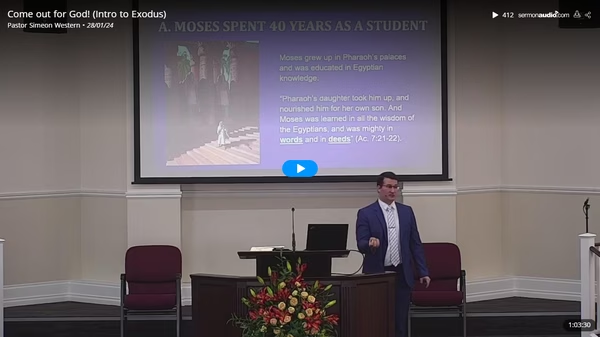
Moses spent 40 years as a Student (Acts 7:22).
- Moses was brought up at court and given the best education at the Egyptian university. This made him far better educated than any of the Hebrew slaves and this enabled him to write the first books of the Bible. This was all a part of Moses preparation for what God had for Him in the future.
- What is your view of education? Education, especially in the Word of God, an essential part of being equipped to serve the Lord (2 Tim. 2:15).
Moses spent 40 years as a Shepherd (Ex. 3:1, 7:7)
- Moses needed to learn humility before he would be ready for his life’s calling. He needed these years of obscurity before he would be ready for the public ministry God had for him.
- This was important training for the huge task ahead of being a shepherd to the nation of Israel. Before he could shepherd the nation, he had to learn to shepherd a much smaller flock of sheep. Faithfulness in little things is God’s appointed way to bigger things.
- Numbers 12:3 “(Now the man Moses was very meek, above all the men which were upon the face of the earth.)”
Moses spent 40 years as a Servant
- He is described as “Moses the servant of the Lord” (Duet. 34:5).
- There is no higher honour and privilege than being a servant of the Lord.
- Deut. 34:7 “And Moses was an hundred and twenty years old when he died: his eye was not dim, nor his natural force abated.”
- “It has been said that Moses spent 40 years in the court of Pharaoh learning to be something. Then he spent 40 years in the desert of Midian learning to be nothing. Then he spent 40 years on the road to Canaan proving God to be everything (See Acts 7:23, 30 & 36).”6
- Moses was “drawn out” of the water to “draw out” God’s people from the world – Egypt.
The Outline of the Book
Denis Lyle’s Outline7
Outline by Geographical location:
- ISRAEL IN EGYPT: SUBJECTION (Chap. 1 to Chap 12:36)
- ISRAEL TO SINAI: LIBERATION (Chap. 12:37 – 18:27)
- ISRAEL AT SINAI: REVELATION (Chap. 19 – 40)
Richard Hester’s Outline8
- Oppression (Vs. 1-3) – Bondage of the children of Israel described as well as Moses’ birth, early years, flight from Egypt and call at the burning bush.
- Confrontation (Vs. 4-12) – Moses and Aaron confront Pharaoh and demand that he “let my people go”. God sends the 10 plagues upon Egypt.
- Liberation (Vs. 12-18) – Israel is set free from Egypt, crosses the Red Sea and journeys to Mount Sinai.
- Organization (Vs. 19-40) – the giving of the law, instructions for and construction of the tabernacle and its organisation.
John Grant’s Outline9
Chapters 1-18: Redemption from Egypt
-
- Preparation for Deliverance (1-4)
- Chapter 1 – The scene is set.
- Chapter 2 – The birth and early life of Moses
- Chapter 3-4 – The call of Moses
- Confrontation with Pharaoh (5-10)
- Chapter 5 – Persecution increases.
- Chapter 6 – Promises from the Lord re-stated.
- Chapters 7-10 – Plagues on Egypt (Three cycles of three plagues then tenth and final plague in chapter 12)
- Salvation through the Blood (11-14)
- Chapters 11-13 – The Passover and flight from Egypt.
- Chapter 14 – The crossing of the Red Sea.
- Education in God’s ways (15-18)
- Chapter 15:1-21 – Praise – the Song of Redemption
- Chapters 15:22-18:27 – Problems on the Journey (e.g., no water in wilderness of Shur, bitter water at Marah, battle with Amalek)
- Preparation for Deliverance (1-4)
Chapters 19-40: Relationship With Jehovah
- The giving of the law (19-23)
- Chapter 19 – The prelude to the giving of the Law
- Chapters 20-23 – The precepts (10 commandments and sundry laws)
- The presentation of the law (24). The Covenant is read to the people and the glory of the Lord appears.
- The sanctuary for the people (25-40)
- Chapters 25-31 – Instructions on the consecration of the Tabernacle and the consecration of the priests (received by Moses while on the mount with God).
- Chapter 32 – Idolatry in the camp (Moses breaks the two tablets of the Law)
- Chapters 33-34 – The covenant is confirmed.
- Chapters 35-39 – The construction of the tabernacle.
- Chapter 40 – The Tabernacle is reared and is filled with the glory of the Lord.
Boyd’s Outline
Robert Boyd divides the Book under two simple headings:
- Israel’s Deliverance from Egypt (Chap. 1-18)
- Israel’s Separation to God (Chap. 19-40)
The Theme of the Book
Redemption
- Redemption is a key word in Exodus – ‘redeem’ (8), ‘redeemed’ (2).
- We could also use the word ‘deliverance’ to express the theme. Exodus is all about God’s deliverance of His people from Egyptian bondage.
Separation
- God separated His people from Egypt unto Himself.
- Exodus 19:4 “Ye have seen what I did unto the Egyptians, and how I bare you on eagles’ wings, and brought you unto myself.”
- Exodus 19:6 “And ye shall be unto me a kingdom of priests, and an holy nation. These are the words which thou shalt speak unto the children of Israel.”
- It was important not only to get Israel out of Egypt but to get Egypt out of Israel! Someone observed that it took only one night to get Israel out of Egypt but it took 40 years to get Egypt out of Israel! It is clear from Joshua 24:14 that some of the Israelites were caught up in idolatry in Egypt. “Now therefore fear the LORD, and serve him in sincerity and in truth: and put away the gods which your fathers served on the other side of the flood, and in Egypt; and serve ye the LORD.”
Consecration
God wanted a people who would:
- Serve Him – Exodus 8:1 “And the LORD spake unto Moses, Go unto Pharaoh, and say unto him, Thus saith the LORD, Let my people go, that they may serve me.”
- Obey Him – the law.
- Worship Him – the tabernacle.
The Typology of the Book
Christ is seen as:
- God – “I AM THAT I AM: 3:14 with John 8:58
- Our Passover: 12:5 with 1 Cor. 5:7b
- Manna: 16:14-22 with John 6:35
- Rock: 17:1-7 with 1 Cor. 10:4
- Veil: 26:31-35 with Hebrews 10:19-20
- Note: Christ is also pictured multiple ways in the tabernacle (e.g., bread of life, light of the world, sacrifice for sin)
Conclusion
Have you applied the blood by faith? Are you saved? Are you living a consecrated Christian life? You may have gotten out of Egypt (the world) but are you allowing God to get Egypt out of you?
References
- D Cloud, Mastering the English Bible, pp. 139-140.
- Exodus 13:3, 14; 20:2; Duet. 5:6, 6:12, 8:14, 13:5, 10; Josh. 24:17; Jdg. 6:8.
- H. Richard Hester, Old Testament Bible History, p. 17.
- D Cloud, Mastering the English Bible, p. 141.
- For comparison, the name ‘Jesus’ occurs 983 times, David 1139 times, Abraham 250 times, Isaac 132 times and Jacob 377 times.
- D Lyle, A Journey through the Bible: Genesis to Esther, p.50.
- Ibid, pp. 47, 51, 56.
- Old Testament Bible History course by R.K. Hester.
- What the Bible Teaches Commentary by J. Grant.
Sermon 1 in Exodus Series
Sermon Audio Id: 127242155582455