

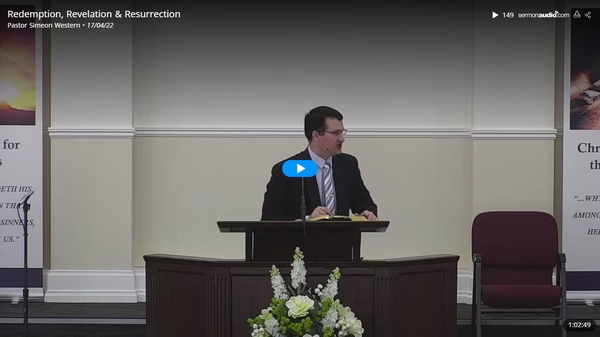
Easter Sunday Gospel message and practical challenge to believers to live in the light of Christ’s death, burial and resurrection.
Peter writes to encourage believers scattered through the Roman empire (v.1), calling them to practical Christian living amid trials. This section of 1 Peter 1 opens the epistle’s first practical exhortations – a call to holiness grounded in the believer’s experience of redemption.
Beginning with verses 18-21, the message traces Christ’s redemption, revelation and resurrection before returning to the practical challenges of verses 13-17. Four words frame the study:
- Redemption (Vs. 18-19)
- Revelation (Vs. 20)
- Resurrection (Vs. 21)
- Revival (Vs. 13-17)
Redemption (Vs. 18-19)
In these verses (Vs. 18-21), “Peter portrays the priceless means of our redemption (Vs. 18-19), the supernatural nature of the Redeemer (Vs. 20), and the resultant characteristics of the redeemed (Vs. 21).” (Hiebert)
The Past before our Redemption (What we are Redeemed From) (Vs. 18)
Without Christ, all we have are:
- Empty Lives – “vain conversation”
- ‘vain’ = empty, fruitless. “Trying to do something, trying to attain to something but always failing.” (J. Thackway) Like someone chasing a rainbow. They feel they get close but can never reach it.
- ‘conversation’ = our manner of life.
- “The whole course of a man’s life out of Christ is nothing but a continual trading in vanity, reaping no benefit of all.” (Robert Layton)
- Erroneous Traditions – “received by tradition from your fathers
- ‘vain’ = empty, futile, unprofitable, void of positive results.
- ‘tradition’ = something inherited, handed down. E.g., oral traditions, religious traditions.
- Context: It seems Peter has a Jewish audience in mind but this would apply to both Jewish religion (e.g., the Pharisees’ sect) or Gentile religion (pagan worship)
- Enslaved Existences – ‘redeemed’ (bought back from slavery)
- Sin’s slavery: John 8:34 “Jesus answered them, Verily, verily, I say unto you, Whosoever committeth sin is the servant of sin.”
- Satan’s tyranny
- Dominated by Satan’s spirit: “Wherein in time past ye walked according to the course of this world, according to the prince of the power of the air, the spirit that now worketh in the children of disobedience.” Eph. 2:1
- Blinded by Satan’s deceit: “In whom the god of this world hath blinded the minds of them which believe not, lest the glorious gospel of Christ, who is the image of God, should sine unto them.” 2 Cor. 4:4
- Imprisoned in Satan’s darkness: “Who hath delivered us from the power of darkness…” Col. 1:13
The Price of our Redemption (What we are Redeemed By) (Vs. 18- 19)
- What Cannot redeem the sinner (Vs. 18a)
- Treasure cannot redeem us – “silver and gold”. The word ‘corruptible’ refers to that which is perishable, subject to decay or destruction. “Silver or gold” names two of the best and most highly treasured means that belong to the category. Silver and gold could set a slave free in the Roman empire but no amount of wealth has the power to redeem a sin enslaved soul. If it were possible for you to place all of the world’s wealth on one side of the weighing scales and your sin on the other side, your sin would far outweigh the wealth.
- Tradition cannot redeem us – “tradition from your fathers”. Some hope that religion and good works provides the answer to their sin slavery but man’s traditions are also powerless to set the soul free.
- What Can Redeem the Sinner (Vs. 19)
- Precious blood – “precious blood”. The word ‘precious’ has a two-fold meaning. It means ‘costly’ in the sense of value, and “highly esteemed or held in honour.” The blood of Christ is costly, essentially and intrinsically precious because it is God’s blood (Acts 20:28), for Deity became incarnate in humanity. (Wuest)
- Powerful blood – ‘redeemed’. The word means to set someone free by the payment of a ransom. In the ancient world, the word was used to describe the ransoming of prisoners of war and the manumission (liberation/emancipation) of slaves.” (Hiebert) Col 1:14 “In whom we have redemption through his blood, even the forgiveness of sins:” Christ paid the price sufficient for our freedom, delivered us from the slave market of sin and set us free! John 8:36 “If the Son therefore shall make you free, ye shall be free indeed.”
- Perfect blood – “as of a Lamb without blemish and without spot”. The Sinless Nature of Christ guarantees the sinlessness of His blood. “…in him is no sin.” (1 Jn. 3:5)
Revelation (Vs. 20)
In this verse “two aspects of Christ’s nature are discussed. The first looks back to His transcendent origin; the second focuses on His redemptive appearance in history.” (Hiebert)
The Foreordination of the Son (Vs. 20a)
- The word ‘foreordained’ means to mark or designate beforehand. It comes from the Greek word ‘foreknowledge”. “God foreknew the whole program of redemption, and His foreknowledge rested with affectionate favour upon the Christ who had already been chosen as man’s Redeemer before the foundation of the world. (See Rev. 13:8 – Christ the Lamb slain from the foundation of the world).” (Hiebert)
- This verse takes us back to the heart and source of our redemption, long before time began. It reminds us that salvation was not an afterthought on the part of God but rather was a part of His eternal, all-wise plan. We cannot begin to comprehend this truth with our tiny minds but we can accept it by faith. Salvation is the outworking of the eternal councils of the Godhead. What security and assurance this brings to us to remember our redemption was planned before the world even began!
- There are a number of other verses that speak of this truth.
- The kingdom was prepared before the foundation of the world (Matt. 25:34).
- Believers are chosen in Christ before the foundation of the world (Eph. 1:4; 2. Tim. 1:9).
- Believers’ names are written in the book of life before the foundation of the world (Rev. 13:7).
- Christ is the Lamb slain from the foundation of the world (Rev. 13:8)
The Manifestation of the Son (Vs. 20b)
The pre-existent, eternal Christ was revealed in God’s perfect time to a sinful and needy world.
- The period of Christ’s revealing – “in these last times”. Galatians 4:4 refers to it as “the fulness of time”.
- The purpose of Christ’s revealing – “for you”. What a wondrous truth is contained in those two simple words. Guilty, hell deserving sinners were the focus of Christ’s eternal, redemptive plan and the reason Christ came to this sin cursed earth. Jesus Himself said, “For the Son of man is come to save that which was lost.” (Matt. 18:11)
Resurrection (Vs. 21)
The God of Christ’s Resurrection (Vs. 21a)
- “God, that raised him up from the dead” = a reference to God the Father. Interestingly, all three members of the Trinity are said to have been involved in the resurrection. The resurrection is attributed to Christ the Son (John 2:19-22); to the Spirit (Rom. 8:11) and to the Father (Acts 2:32; 3:36, 4:10, 5:30; 10:40; 17:31; Rom. 6:4; Rom. 10:9; Eph. 1:20; 1 Thess. 1:10). The overwhelming emphasis of the New Testament is on the Father’s raising of Christ from the dead.
- Read Luke 24:1-8.
- The resurrection guarantees our justification (Rom. 4:25).
- The resurrection is essential for salvation (Rom. 10:9-10).
- Paul faces the implications of no resurrection head on in 1 Corinthians 15:12-20:
- No resurrection means Christ is still dead! (Vs. 13, 16).
- No resurrection means the Apostle’s preaching was vain (empty) (Vs. 14a).
- No resurrection means our faith is vain (empty) (14b; 17a).
- No resurrection means the Apostles were liars (Vs. 15).
- No resurrection means we are still in our sins (Vs. 16-17).
- No resurrection means departed Christians have perished (Vs. 18).
- No resurrection means a life of misery and hopelessness (Vs. 19).
- Vs. 20 – Paul forces us to stare this dreadful idea in the face that we might see it in all its blackness. Then he deals it a fateful blow with a powerful assertion of the truth.
- The whole of the Christian faith hinges on the truth of the resurrection. Remove the resurrection of Christ and Christianity crumbles. Kenyon aptly remarks, “There is no such thing as ‘faith’ in the New Testament thinking apart from resurrection because everything meaningful that God promised the Christian finds fulfillment in the living Christ…a crucified Christ is not enough. The cross is only part of the plan. The “empty tomb” is the basic symbol of Christianity.” Christ’s resurrection validates the Word of God and every Christian doctrine and belief we hold dear:
- How do we know the Word of God is true and trustworthy? Because Jesus Christ rose from the dead.
- How do we know the Genesis account of creation is true? Because Jesus Christ rose from the dead.
- How do we know the Bible is historically accurate and trustworthy? Because Jesus Christ rose from the dead.
- How do we know all the claims of Christ are true? Because Jesus Christ rose form the dead.
- How do we know there is a heaven and a hell? Because Jesus Christ rose from the dead.
- How do we know the virgin birth is real? Because Jesus Christ rose from the dead.
- How do we know Christ is the only way to heaven? Because Jesus Christ rose from the dead.
- How do we know the blood of Christ has power to save from sin? Because Jesus Christ rose from the dead.
- How do we know that Jesus Christ is the Son of God? Because Jesus Christ rose from the dead.
- How can we know that salvation from sin is real and possible? Because Jesus Christ rose from the dead. We are not offering you some religious figure from history who died like everybody else and is still in the grave.
- How can we be sure that Jesus Christ will come again as He promised? Because He’s alive, He’s alive, He’s alive…Jesus Christ lives!
- Is it any wonder that after defending the truth of the resurrection in 1 Corinthians 15, the Apostle Paul concludes that section of the Epistle with such words of power and victory – 1 Cor. 15:57-58 “But thanks be to God, which giveth us the victory through our Lord Jesus Christ. Therefore, my beloved brethren, be ye stedfast, unmoveable, always abounding in the work of the Lord, forasmuch as ye know that your labour is not in vain in the Lord.”
The Glory of Christ’s Resurrection (Vs. 21b)
- Having gone through the shame and reproach of the cross, Christ was mightily glorified by the Father upon His resurrection. This is further described in passages such as:
- Ephesians 1:19-23 – “And what is the exceeding greatness of his power to us-ward who believe…”
- Philippians 2:5-11 – “Let this mind be in you…”
The Goal of Christ’s Resurrection (Vs. 21c)
This verses also highlights God’s Divine objective in the resurrection as it relates to us as believers. It was so that:
- Our faith would be in God. Faith refers to trust. In light of the Almighty Power of God displayed in the resurrection of Christ, how can we not trust in God with all of our hearts?
- Our hope would be in God. Christian hope is a confident expectation, a confident assurance. The world talks a lot about hope but it is a vague, “hope so” kind of hope with no real certainty. But hope for the Christian is a “know so” hope.
- Note: Of recent years a concerning trend has developed amongst a lot of Christians – there has been way too much hope placed in government and not enough faith placed in God!
Revival (Vs. 13-17)
The phrase “forasmuch as ye know” in verse 18 links these truths concerning redemption with the previous subject. The Apostle Peter writes of the great truth of the believer’s redemption in order to add further weight and authority to the preceding exhortations to godly living. This is the highest motive for holy living. In this paragraph, Peter reminded his readers of their salvation experience. A sense of our duty to holy living springs out of this knowledge. How then should we live as God’s children in the light of our redemption? How should we live in light of the cross and the empty tomb? We are to live as:
Sober Children (Vs. 13)
- The Figure of Sober Mindedness (Vs. 13a)
- The background to the figure – “gird up the loins”. This figure of speech that would have been very familiar to Paul’s readers. It is a figure of speech taken from Peter’s Day when men would bind up their robes with a girdle or belt to allow unhindered movement (i.e., for work or running).
- The application of the figure – “of your mind”. Peter is exhorting them to cultivate a disciplines mind. For there to be progress in the Christian life, the mind needs to be uncluttered and unhindered by the things of this life. Wuest provides a helpful definition of the word ‘sober’: “It speaks of the proper exercise of the mind, that state of mind in which the individual is self- controlled, and is able to see things without distortion cause by worry, fear and their related attitudes.”
- Wiersbe writes, “Gird up the loins of your mind” simply means “pull your thoughts together! Have a disciplined mind!” “A Christian who is looking for the glory of God has a greater motivation for present obedience than a Christian who ignores the Lord’s return.”
- The Focus of Sober Mindedness (Vs. 13b)
- “hope to the end…the revelation of Jesus Christ” = a forward expectancy of Christ’s return is a characteristic of the sober mind. A sober mind is one that has an eternal perspective; it is a mind focused on Christ and His return.
- “the grace that is to be brought unto you” = what a touching and precious picture. Christ brought grace at His first coming and we have experienced his grace in salvation. Christ will also bring grace at His coming for His saints and we will experience grace in glorification!
Submissive Children (Vs. 14)
- The Designation of God’s Children (Vs. 14a). Obedience is a mark and a fruit of genuine salvation. The call of the Gospel to repentance and faith is to be submitted to/obeyed (2 Thess. 1:8). This marks the beginning of a whole life of obedience to the Lordship of Christ. The new nature gives us a desire to submit to the Saviour.
- The Duty of God’s Children (Vs. 14b). As God’s children, we are to not allow our lives to be shaped and conformed in the model of our former lives. Two words describe our pre-salvation lives:
- Lust – Walking according to sinful lusts was a feature of our unsaved lives as children of disobedience. Eph. 2:2-3 “Wherein in time past ye walked according to the course of this world, according to the prince of the power of the air, the spirit that now worketh in the children of disobedience: Among whom also we all had our conversation in times past in the lusts of our flesh, fulfilling the desires of the flesh and of the mind; and were by nature the children of wrath, even as others.”
- Ignorance – our lusts found expression in the environment of spiritual darkness and ignorance that characterised our unsaved lives. 1 Cor. 2:14 “But the natural man receiveth not the things of the Spirit of God: for they are foolishness unto him: neither can he know them, because they are spiritually discerned.”
- We are exhorted not to “fashion” ourselves according to the ignorant lusts of our former life. The word “refers to the act of assuming an outward appearance patterned after some certain thing, an appearance or expression which does not come from and is not representative of one’s inmost and true nature. It refers here to the act of a child of God assuming as an outward expression the habits, mannerisms, dress, speech, expressions, and behaviour of the world out from which God saved him, thus not giving a true expression of what he is, a cleansed, regenerated child of God, but instead, hiding the Lord Jesus who should be seen in the life of the Christian. It is the believer masquerading in the costume of the world.” (Wuest)
- The same word is translated ‘conform’ in Romans 12:2. The root word is ‘schema’ from which our English word ‘scheme’ is derived. The compound participle denotes the practice of adopting for oneself a pattern or mould. Considering these two exhortations together (Rom. 12:1-2 & 1 Pet. 1:14), we are reminded that as Christians we are not to allow our lives to be shaped by:
- The world system without.
- The wicked lusts within.
Sanctified Children (Vs. 15-16)
The conjunction ‘but’ provides the contrast, positive alternative to living in conformity to the world.
- The Standard of the Believers Holiness (Vs. 15a).
- “God is the Model of all holiness. Close association with Him who is holy can only awaken in us a sense of our need for holiness. As holy, God is separated from all that is morally impure and evil (1 John 1:5).” (Hiebert)
- The Scope of the Believers Holiness (Vs. 15b). “All manner of conversation” reveals the scope of Peter’s demand for ethical conduct. “There should be no part of our life which is not to savour of this good odour of holiness.” (Hiebert)
- The Scripture calling for the Believers Holiness (Vs. 16) Peter appeals to the Old Testament to support his call to holiness in the lives of the believers. The words quoted occur three times in Leviticus (11:24, 19:2, 20:26).
Separated Children (Vs. 17)
- The motivation to separated living (Vs. 17a & 17c)
- Accountability to God (Vs. 17a)
- Awe of God (Vs. 17c).
- This attitude of ‘fear’ “is not the craven, cringing dread of a slave before an offended master, but the reverential awe of a son toward a beloved and esteemed father, the awe that shrinks from whatever would displease and grieve him…It is the mark of a tender conscience and is the safeguard against carelessness toward danger.” (Hiebert)
- “This fear is self-distrust; it is tenderness of conscience; it is vigilance against temptation; it is the fear which inspiration opposes to high-mindedness in the admonition, “be not high- minded but fear.” It is taking heed lest we fall; it is a constant apprehension of the deceitfulness of the heart, and of the insidiousness and power of inward corruption. It is the caution and circumspection which timidly shrinks from whatever would offend and dishonour God and the Saviour” (Vincent, quoting Wardlaw on Proverbs).
- The illustration of separated living (Vs. 17b)
- Peter employs the figure of a sojourner to illustrate the kind of separated, pilgrim lifestyle we are called to as believers. The compound noun ‘paroikias’ basically means “alongside the house”, having the position of an outsider and not a member of the household. (Hiebert) ‘Sojourning’ comes “from a word meaning literally “to have a home alongside of”, and refers to a person living in a foreign land alongside people who are not of his kind.” (Wuest)
- The same word is used in Acts 13:17 to describe the sojourn of the Israelites in Egypt. Believers are called upon to live as foreigners and pilgrims residing in a strange land.
- 1 Peter 2:11 “Dearly beloved, I beseech you as strangers and pilgrims, abstain from fleshly lusts, which war against the soul;”
Conclusion
- Have you been redeemed? Will you allow Christ to cleanse you in His precious blood right now?
- In what is our faith and hope as Christians? Is it in the resurrected, all-powerful God who raised the Lord Jesus? How thankful are we for our redemption? What kind of lifestyle are we living in light of our redemption?
Sermon Audio Id: 416221221301945