


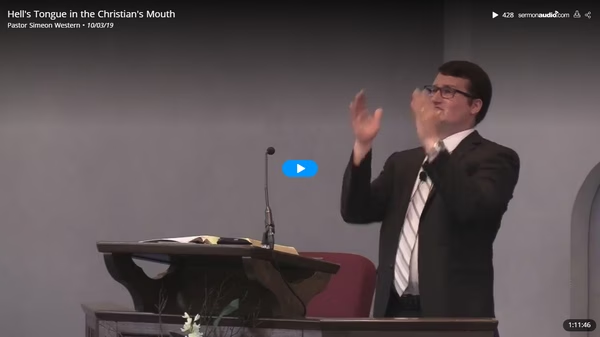
In James chapter 1 the Bible reveals that a mature Christian exercises patience in trials. In chapter 2 he shows that a mature Christian practices the truth. In chapter 3, he reveals that a mature Christian has power over his tongue. “James outlines another test of living faith. A living faith must demonstrate its vitality by exercising control over the tongue.” (Hiebert) In this sermon, we look at three powerful warnings about the tongues potential for evil.
The Book of James deals with practical Christian living. The theme is faith works. We are saved by grace (Eph. 2:8-9) but a genuine, saving faith will result in a changed life (James 2:17-18)
The Christian’s tongue is of major concern to James as he deals with some aspect of the tongue in each of the 5 chapters.
Someone said, “The tongue is in a wet place so it can easily slip.”
In the passage before us, we will note 3 warnings about the tongue’s potential for evil.
The Power of the Tongue (Vs. 1-5a)
Admonition (Vs. 1-2)
- “my brethren” = James is speaking to Christians (See also Vs. 10). That means the even the Christian’s tongue has the destructive potential described in these verses.
- “be not many masters” = caution against those who were ambitious to become teachers in order to gain honor for themselves. Those who are teachers of others must remember that they will be more accountable before God – “shall receive the greater condemnation”.
- “perfect man” = someone who is mature. The maturity of a believer is revealed by how much control he has over his tongue, not by how many years he has been a believer. You can be old in the Lord but still in babe in maturity if your tongue isn’t under God’s control!
- “able also to bridle the whole body” = this reveals that the tongue, out of all the members of the body, is the hardest to bring under control. If with God’s power, you can control your tongue, you can exercise self-control over the rest of the body.
- Prov. 16:32 “He that is slow to anger is better than the mighty; and he that ruleth his spirit than he that taketh a city.”
Illustration (Vs. 3-4)
- The illustration of the horse (Vs. 3)
- A fitting illustration since he has just mentioned the principle of a bridled tongue in the previous verse.
- Picture is that a small bit in a horse’s mouth wields control over the horse’s entire body.
- The illustration of a ship (Vs. 4)
- Further reinforces the picture. Something great and powerful being controlled by something small.
- “withersoever the governor listeth” = means the direction of the ship is determined by will of the steersman. The word ‘listeth’ is an old English word meaning “to please or choose”.
Application (Vs. 5a)
- “even so” = in a similar way
- “the tongue is a little member” = the tongue is small but like the bit and the rudder, it exerts tremendous influence over the life.
- “Death and life are in the power of the tongue…” (Prov. 18:21)
- Illustration: It is said that for every word in Hitler’s book, Mein Kampf, 125 lives were lost in WWII.
The Perversity of the Tongue (Vs. 5b-8)
The Tongue is Destructive (Vs. 5b-6)
- The Symbol of its Destructive power (Vs. 5b)
- James now employs the illustration of a fire to help us to understand how devastating and destructive the tongue can be. Note the following words: “
- “how great a matter” = the word ‘matter’ comes from the Greek word meaning forest or wood.
- “a little fire kindleth” = Huge sweeping fires, consuming vast tracks of land, destroying everything in their paths, can be started with only a tiny flame.
- Fire has the amazing capacity to reproduce itself in an almost unlimited way. It feeds on itself so long as it has sufficient flammable material and enough oxygen. That is why fire fighters will go ahead of fires and try to make a fire break so that it will run out of fuel and burn out. “Where no wood is, there the fire goeth out: so were there is no talebearer, the strife ceaseth. As coals are to burning coals, and wood to fire; so is a contentious man to kindle strife.” (Prov. 26:20-21)
- Illustration: The Great Chicago fire of 1871 – On October 8, 1871 at about 8:30pm in the evening, a lantern in Mrs. O’Leary’s barn, presumably kicked over by a cow, ignited the great Chicago fire. Before it could be contained, 17,500 buildings were destroyed, 300 people died, and 125,000 others were left homeless.
- Illustration: When I lit the grass at our home as a child
- REMEMBER! Once you have started a fire, you very soon lose control over it, how far it will spread and what damage it will do.
- Quote by Hiebert:“It is a common observation that an unconsidered, slanderous report can set a whole community on fire; a whole nation can be aroused by some vicious propaganda, setting different classes of men into ruinous conflict; and wild, passionate words of national hatred can stir international conflicts whose flames may need to be quenched with rivers of blood. Likewise, ‘vicious moral teaching, popular religious and doctrinal errors, rage like vast conflagrations, leaving countless victims in their wake.’ Truly an uncontrolled tongue can produce the same destructive effect among men that an uncontrolled spark has on a vast forest.”
- The Scope of its Destructive power (Vs. 6a)
- “a world of iniquity” = “a vast system of iniquity” (Hiebert)
- “defileth the whole body” = it has a damaging effect upon the whole life
- “setteth on fire the course of nature” = the whole course of our lives and that of others is affected
- Examples of evil uses of the tongue
- A Slanderous tongue – Slander is “a false report maliciously uttered and intending to injure the reputation of another by lessening him in the esteem of his fellow citizens.” (Webster) Another biblical term for a slanderer is ‘whisperer’. Absalom an example of this.
- A talebearing tongue – another Bible word for this is ‘tattler’ (1 Tim. 5:13) Look up these verses on the talebearer (Lev. 19:16; Prov. 11:13; 18:8; 20:19; 26:20,22). Illustration: Tongue too big for altar (Wiersbe Pg. 89)
- A complaining tongue – God views murmuring and complaining very seriously! Consider His dealings with the nation of Israel. (Phil. 2:14)
- A harsh tongue – God’s Word has something to say not just about the content of our speech, but also the spirit and tone of our speech (Col. 4:6; Eph. 4:29)
- A dirty tongue – dirty words and stories (Eph. 4:29; Col. 3:8)
- An excessive tongue – an inability or unwillingness to listen more than speak (Prov. 10:19; 17:28; Ecc. 5:3; James 1:19)
- The Source of its Destructive power (Vs. 6b)
- “set on fire of hell” = reveals the fuel source of a carnal, destructive tongue in the believer. The word is a present/passive/participle. Picture is of a fire that is being fueled by another source. “It is being set on fire by hell.” A tongue “set on fire of hell” is a tongue being used as Satan’s tool to accomplish his purposes to pollute, corrupt and destroy.
- The word ‘devil’ literally means ‘slanderer’.
- The Apostle Peter, Ananias and Saphira, are examples of people whose tongues were used for Satanic purposes.
- Rather than having a tongue set on fire from hell, accomplishing Satan’s purposes, how much better to have a tongue set on fire from heaven, accomplishing the Saviour’s purposes! Illustration: In April 21, 1855, Edward Kimball, a humble Sunday School teacher with a burden for his students, went into a Boston shoe store and lead D.L. Moody to Christ. That’s using one’s tongues for heaven’s purposes!
The Tongue is Disorderly (Vs. 7-8a)
- ‘for’ = James gives further evidence of what he has just stated.
- “every kind of beasts…hath been tamed of mankind” = man has demonstrated his God-given dominion over the animal kingdom by taming the wildest of beasts.
- “but the tongue can no man tame” = shows just how unruly the tongue is! A man can tame a lion or a bear, but he cannot control his own tongue. Note: It does not say “no one can tame the tongue” but no ‘man’ can tame the tongue. Man can’t but God can through the work of the Holy Spirit in the regenerated heart.
The Tongue is Deadly (Vs. 8b)
- ‘poison’ = works quietly and secretly then kills! Allusion is to serpent’s poison. Satan, with a lying and crafty tongue, plunged the whole human race into the darkness of sin.
- Read the description of the tongue in Rom. 3:13-14 as Paul unfolds the truth concerning the depravity of man.
The Paradox of the Tongue (Vs. 9-12)
Its Inconsistency Contrasted (Vs. 9-10)
- The problem of the tongue’s duplicity is discussed.
- We use our tongue for blessing God – e.g. prayer, praise
- We use our tongue for cursing man – e.g. slander, harshness etc…
- James 1:26 “If any man among you seem to be religious, and bridleth not his tongue, but deceiveth his own heart, this man’s religion is vain.” ‘vain’ means empty, useless, of no purpose.
- Illustration: Praying a spiritual sounding prayer at a church prayer meeting then venting carnal words in a church business meeting.
- “these things ought not so to be” = “ought not” is a strong negative. This sort of behavior simply should find no place in the Christian’s life.
Its Inconsistency Illustrated (Vs. 11-12)
James cites 3 main illustrations from nature to drive home his point. He offers no answer to these questions as they call for a strong negative reply. These illustrations reinforce his admonition in the previous verse that “these things ought not so to be”
- The fountain illustration (Vs. 11 & 12b)
- The fig tree illustration (Vs. 12a)
- The vine illustration (Vs. 12b)
Conclusion
- Is your tongue being used for hell or heaven, Satan or the Saviour? Are there sins of the tongue we need to put right with God and our fellow brothers and sisters in Christ?
- May God help us to be like David of old who could testify, “The Spirit of the LORD spake by me, and his word was in my tongue.” (2 Sam. 23:2)
Sermon Audio Id: 391922187795