


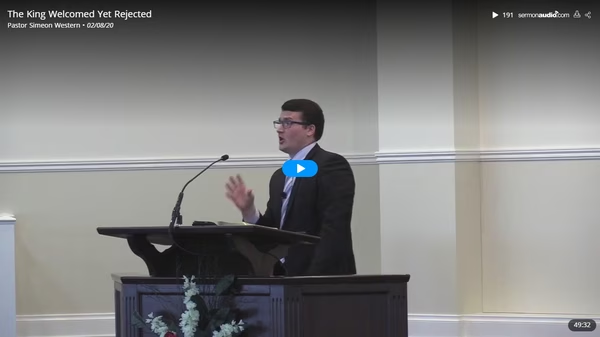
Exposition of what is commonly referred to as the Triumphal Entry or Palm Sunday. A powerful challenge to those who welcome Christ in a superficial and surface way without true repentance of heart.
Let’s endeavour to paint the scene for this event.
The Timeline: In this chapter we enter the final week of the Lord’s life before He was crucified. Christ and His disciples have been traveling to Jerusalem and have now arrived in Bethany from Jericho and are staying at the home of Lazarus and his two sisters Mary and Martha (John 12:1-2).
The Topography: In Vs. 1 we have mention of Jerusalem, Bethphage, Bethany and the Mount of Olives.
- The village of Bethany was a short distance of 15 furlongs (approx. 2 miles or 3.2 kms) from Jerusalem according to John 11:18 situated on the Eastern slope of the Mount of Olives. It was about a mile in distance from the summit of the Mount of Olives.
- The exact location of the village of Bethphage is unknown but it was also close to Bethany and the Mount of Olives. It was likely a village on the road from Bethany to the Mount of Olives to which Christ sent the two disciples to fetch the donkey.
- The Mount of Olives is east of and adjacent to Jerusalem’s old city. Alongside Mount Sinai and Mount Calvary, the Mount of Olives is one of the most significant mountains in Biblical history. From this Mount Palm Sunday procession commenced. From this Mount Christ ascended after His resurrection and to this Mount He will one day return at His Second Coming.
We will now study this momentous event commonly known as Palm Sunday or the Triumphal Entry under 4 headings.
The Preparation for the King (Vs. 1-6)
There are two key aspects to the preparations for the Lord’s procession:
An All-Knowing Instruction (Vs. 1-4)
- The Omniscience of the Command (Vs. 1-3)
- Christ’s foretelling of these events is a testament to His Divine nature. Christ is exhibiting the Divine Attribute of Omniscience (all knowing) in this event.
- This is further proof of the Divinity and Deity of Christ. He was more than just a good man, He was the God Man, God incarnate, God come in human flesh.
- The Obedience to the Command (Vs. 4)
- “And they went their way” = they were obedient to Christ’s command. Matthew puts it this way “And the disciples went, and did as Jesus commanded them,” (Matt. 21:6).
- Obedience is at the heart of discipleship and obedience requires faith; faith that God will come through and fulfill what He has said would happen.
- One of the great blessings of being an obedient disciple is the privilege of seeing God do marvellous and miraculous things as we walk in obedience.
- What a privilege that God allows us to participate and play a role in the unfolding of His grand, eternal plan!
An Available Instrument (Vs. 5-6)
Consider for a moment the unnamed owners of the donkey (Lk. 19:33) and his availability for the Lord to use:
- The Surrender in their Obedience (Vs.6)
- Initially the taking of the colt was questioned (Vs. 5) but at the mention of the Lord’s Name (Vs. 3), the owners were willing to release it for the Master’s use. Evidently, they were disciples of Christ since the Lord’s Name meant something to him. Clearly their attitude was that their possessions were at the Lord’s disposal to use as He pleased.
- “the Lord hath need of him” = what a striking thought that the Lord would need me for His work! Christ does not need us in the sense that we need to provide something He lacks or in the sense that He cannot do His work without us. But He needs us in the sense that He has ordained in His perfect wisdom that His work be done through us.
- Challenge: Are you and your possessions available for the Lord to use? Is your donkey available for the Lord?
- The Speed of their Obedience (Vs. 3)
- ‘straightway’ = the response would be immediate. Imagine what would have happened if they had hesitated and delayed? They would have missed the greatest honour of his life.
- Challenge: Are we delaying our obedience to the Lord in some area?
- Maclaren: “Many possibilities of joy and blessing are lost by us through not yielding on the instant to Christ demands…As soon as I know what Christ wants from me, without delay let me do it; for if I begin with delaying, I shall probably end with declining.”
The Prediction of the King (Vs. 7; Matt. 21:4-5)
Christ’s riding on a donkey into Jerusalem on this particular day in history was very significant prophetically, a significance the Jews missed. There are 3 clear O.T. prophecies concerning this event:
Jacob’s Prophecy (Gen. 49:10-11)
- Gen. 49:10-11 “The sceptre shall not depart from Judah, nor a lawgiver from between his feet, until Shiloh come; and unto him shall the gathering of the people be. Binding his foal unto the vine, and his ass’s colt unto the choice vine; he washed his garments in wine, and his clothes in the blood of grapes:”
- ‘Shiloh’ means “peaceful and prosperous one” (Matthew Henry) and is a title of Messiah.
Daniel’s Prophecy (Dan. 9:25)
- Dan. 9:25-26 “Know therefore and understand, that from the going forth of the commandment to restore and to build Jerusalem unto the Messiah the Prince shall be seven weeks, and threescore and two weeks: the street shall be built again, and the wall, even in troublous times. And after threescore and two weeks shall Messiah be cut off, but not for himself:”
- From the decree of Artaxerxes in 445 B.C. (Neh. 2:1-8) to restore and rebuild Jerusalem there would be 483 prophetic years until Christ was presented to the Jewish Nation as their Prince. Sir Robert Anderson in his excellent book “The Coming Prince” demonstrates that this prophecy was fulfilled to the very day when Jesus Christ rode into Jerusalem from the Mount of Olives.
- John Phillips summarizes this position as follows: “Probably the most convincing attempt to calculate the countdown from the signing of the decree to the death of Christ is that of Sir Robert Anderson. He put the edict for the rebuilding of the city as the first of Nisan, 445 B.C. From that date to Messiah the Prince was to be 69 x 7 of years = 483 years. The Hebrews used a 360-day calendar, so 483 years x 360 days = 173,880 days. Sir Robert’s calculations show that from the tenth of Nisan, 445 B.C., to the end of the 173,880 days brings us to the tenth of Nisan in the eighteenth year of Tiberius, the day when the Lord made His public Triumphal Entry into Jerusalem and presented Himself to the nation as “Messiah the Prince.” Sir Robert Anderson contends that this prophecy of Daniel was fulfilled to the very day.”
- As Daniel’s prophecy predicted, Messiah the Prince would be cut off which is exactly what happened when Christ was crucified within a few short days.
Zechariah’s Prophecy (Zech. 9:9)
- This prophecy is quoted in both Matthew’s and John’s accounts:
- Matthew 21:4-5 “All this was done, that it might be fulfilled which was spoken by the prophet, saying, Tell ye the daughter of Sion, Behold, thy King cometh unto thee, meek, and sitting upon an ass, and a colt the foal of an ass.”
- John 12:14-15 “And Jesus, when he had found a young ass, sat thereon; as it is written, Fear not, daughter of Sion: behold, thy King cometh, sitting on an ass’s colt.”
- Zechariah 9:9 “Rejoice greatly, O daughter of Zion; shout, O daughter of Jerusalem: behold, thy King cometh unto thee: he is just, and having salvation; lowly, and riding upon an ass, and upon a colt the foal of an ass.” Christ came to bring salvation to His people and He still brings salvation to needy hearts today. Matthew 1:21 “And she shall bring forth a son, and thou shalt call his name JESUS: for he shall save his people from their sins.” Significantly, Christ entered Jerusalem the same day that the Passover Lambs were being selected. Christ entered Jerusalem as the Perfect Lamb, chosen by the Father as the perfect sacrifice for sin (John 1:29, 36).
The Presentation of the King (Vs. 8-10)
The Honours Shown to the King (Vs. 8)
- Garments Spread (Vs. 8a)
- This was “a customary way of expressing submission to a monarch. It acknowledged that the king was elevated above the common people, and symbolically affirmed that they were under his feet.” (Macarthur) “It was an ancient practice of welcoming a new sovereign.” (Hiebert)
- Illustration: Jehu’s Coronation – “Then they hasted, and took every man his garment, and put it under him on the top of the stairs, and blew with trumpets, saying, Jehu is king.” (2 Kings 9:13)
- Palms Strawed (Vs. 8b)
- John 12:13 “Took branches of palm trees, and went forth to meet him, and cried, Hosanna:”
- Palm branches were a symbol of joy and victory (See Rev. 7:9). According to Jewish History as recorded in First Maccabees, when the Jews recaptured Jerusalem from the Syrians during the intertestamental period they “entered it with praise and palm branches.” (1 Macc. 13:51) (Macarthur)
- While these outward displays of homage did not go far enough as we shall soon see, they were appropriate and fitting the Kingly position of our Lord Jesus Christ. How much honour do we show our King?
The Hosannas Shouted to the King (Vs. 9-10)
- Matthew notes that there was “a very great multitude” (Mt. 21:8). Luke notes that the rejoicing and praise from the multitude commenced on Christ’s descent from the Mount of Olives and was largely motivated by the miracles they had seen (Lk. 19:37).
- ‘Hosanna’ = based on a Hebrew word meaning “save now we pray.” Interestingly, this same Hebrew word is the root of the name ‘Jesus’ (J.A. Alexander). It was “probably an appeal for Divine help to bring about the expected messianic deliverance through Jesus.” (Hiebert) The phrase “Hosanna in the highest” was a reference to this prayer being presented in the highest places (heaven itself).
- “Blessed is he that cometh” = another Messianic reference. Literally means “the one coming”. Luke says, “Blessed by the King that cometh in the name of the Lord…” (Lk. 19:38)
- “Blessed by the kingdom of our father David” = a reference to the Messianic kingdom which had long been anticipated by the Jews. This brings us to the heart of the crowd’s expectation and hope. They had not thought of a crucified Messiah who would take away their sin. Their thoughts were of a political Messiah who would deliver them from their Roman oppressors.
The Lamentation of the King (Lk. 19:41-44)
What a startling and touching scene! While the crown was shouting and rejoicing, the Lord Jesus was weeping. Christ saw beneath the surface; He saw beneath the superficial acts of rejoicing to the reality of their hearts condition. Christ wept over the blindness of the people. They were…
Blind to the Day that was Unfolding (Vs. 42 & 44b)
- “in this thy day” = this was Israel’s day and yet she missed it. They didn’t know what time it was. This was the day for them to repent of their sins and receive Christ as Saviour from sin. In just a few short days this same crowd would shout “crucify him, crucify him!” Are you blind to how crucial this moment is in your life? “…now is the accepted time; behold, now is the day of salvation.” (2 Cor. 6:2)
- The problem was that they wanted deliverance from their suffering (problems) not deliverance from their sin. They cried out, “Hosanna”, God save us, but it was not the cry of a repentant heart desiring salvation from sin. “The people were not pleading for salvation from sin but for blessing, prosperity, and deliverance from Roman rule and oppression.” (Macarthur)
- Illustration: The cursed fig tree (Vs. 12-13). This was a picture of Israel. Outwardly they looked promising (leaves) and yet there was no fruit of genuine repentance.
- Challenge: Many today are the same. They want deliverance from their problems but not deliverance from their sin!
Blind to the Doom that was Coming (Vs. 43-44)
- Christ predicts the judgment that would come upon Israel for rejecting Him as their Messiah. This was literally fulfilled in A.D. 70 when the Roman General Titus sacked the city of Jerusalem and the Jews were slaughtered in horrific numbers with shocking brutality.
- Challenge: To reject Christ and retain your sinful ways has serious, eternal consequences. God’s judgment awaits all those who reject His offer of salvation. Rev. 21:8 “But the fearful, and unbelieving, and the abominable, and murderers, and whoremongers, and sorcerers, and idolaters, and all liars, shall have their part in the lake which burneth with fire and brimstone: which is the second death.” Are you blind to the doom that is coming to you if you die without Christ?
Conclusion
- Sinner, will you receive Christ today as your Saviour from sin?
- Saint, will you be an available instrument for God to use?
Sermon 43 of 59 in Mark Series
Sermon Audio Id: 81202022265451