

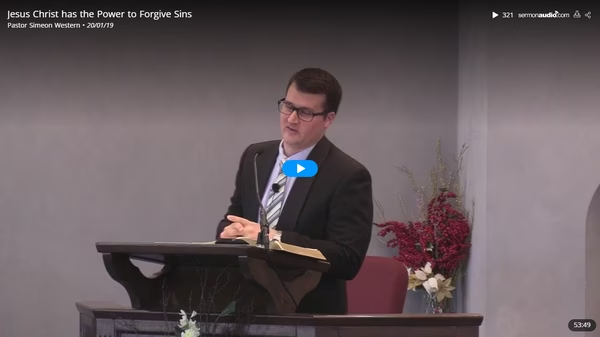
This passage records one of the miracles of Christ He performed in healing a paralyzed man. His Deity is powerfully demonstrated in this miracle. Christ has the authority to forgive sinners because He is God manifest in the flesh!
Christ’s conflict with the religious leaders comes into focus in chapter 2 & 3. In this chapter they will issue a direct challenge to His Divine right to forgive sins.
This account records one of the miracles of Christ He performed in healing a paralyzed man. Christ’s Deity is powerfully demonstrated through this miracle. It also provides a wonderful illustration of salvation.
Let’s look at this miracle under five divisions
The Context of the Miracle (Vs. 1-3)
The Multitude (Vs. 1-2a)
- “it was noised” = word soon spread that the Saviour was in town
- “in the house” = Likely Peter’s house (Mk. 1:29). Matthew mentions Christ “came into his own city” (Matt. 9:1). So, Capernaum and Peter’s house had become a base of operations for the Lord. What a good example Peter was to open his home for the Master’s use! What blessings came to that home on account of Christ’s presence being there!
- “many were gathered together” = a large crowd arrives. The house quickly fills to capacity and many more stand outside the door.
The Message (Vs. 2b)
- “he preached the word unto them” = Christ seizes the opportunity to proclaim the truth to the gathered crowd.
- Luke uses the word ‘teaching’. So, it was more of a conversational, teaching style of preaching in this context.
- The truth was always the priority with the Saviour, not healing! The greatest need men have is for the Word of God.
The Man (Vs. 3)
- “sick of the palsy” = he was a paralytic (paralyzed). Palsy is, “The loss or defect of the power of voluntary muscular motion in the whole body, or in a particular part; paralysis.” (Webster’s)
- Obviously, his condition was severe as he had to be carried by four men on his bed.
- Picture: This man’s lame condition is a picture of the sinner before salvation – totally helpless and unable to do anything to save himself. “For when we were yet without strength, in due time Christ died for the ungodly.” (Rom. 5:6) The four men could represent the ministry of soul-winning. We have no power cure men of their sin condition, but we can seek with all our hearts to bring them to the One who can!
The Confidence for the Miracle (Vs. 4-5)
The faith of these men had some wonderful qualities. Consider…
The Compassion of their Faith (Vs. 3)
- These men were clearly driven by a spirit of compassion for this poor, suffering man. Do we have any compassion for men and women, paralyzed by the disease of sin?
- God uses human instruments to bring souls to Christ. Illustration: Ethiopian eunuch – “How can I, except some man should guide me?” (Acts 8:31)
The Action of their Faith (Vs. 4)
- “uncovered the roof” = houses had flat roofs in Bible times. Flat roof design still used in some parts of the world.
- “broken it up” = to dig up or through. Luke adds “they let him down through the tiling” (Lk. 5:19)
- Description by Hiebert:
The flat roof of an ordinary house would be constructed by laying beams about three feet apart from wall to wall. Short sticks were laid closely together across the beams and covered with a thick matting of thorn bushes. At other times, as seems the case here, stone slabs or plates of burnt clay were laid across the beams. A coat of clay was spread on top of this and rolled hard to keep out the rain. They would be readily able to dig out a hole large enough for the purpose without damaging the rest of the roof. Having cleared away the clay, they lifted the tiles to make the opening. - Their faith in the power of Christ to heal drove them to overcome the obstacles that stood in their way. They overcame the obstacle of the crowd and the ceiling that stood in the way to getting this man to the Lord Jesus. Any attempt to bring a soul to Jesus will be met with difficulty and opposition.
- To bring a soul to Christ, requires effort and labor (e.g. prayer, time, sacrifice). Paul used birthing language to describe it – “My little children, of whom I travail in birth again until Christ be formed in you.” (Gal. 4:19) And as this account shows, it often takes more than one person! To get this man to Christ required 4 sets of hands!
- True faith is expressed in our works – “…I will shew thee my faith by my works.” (James 2:18)
The Attention of their Faith (Vs. 4)
- Christ was the focus of their faith. They believed in His power to transform this man’s life!
- True faith is directed to the Person of Christ.
The Commendation of their Faith (Vs. 5a)
- Christ was pleased with the faith of these men. Faith moves the hand of God.
- “their faith” = this would include the faith of the paralytic as well as the faith of the four men who carried him there.
The Cleansing of the Miracle (Vs. 5b)
The Release of Forgiveness – “thy sins be forgiven thee”
- ‘forgiven’ = means to send away, to pardon. Word used in Matt. 18:27 of the forgiving of a debt.
- Illustration of forgiveness: The two goats on the day of atonement (Lev. 16:7-10; 15-22). The first goat sacrificed as a sin offering. The second goat bears the sins of the nation away into the wilderness. Reveals two aspects to Christ’s redemptive work on the cross. His blood was shed for the payment of our sin (pictured in the first goat) and as a result, our sins can be sent away, forgiven (pictured in the second goat).
- Col. 1:14 “In whom we have redemption through his blood, even the forgiveness of sins.”
- Psalm 130:3-4 “If thou, LORD, shouldest mark iniquities, O Lord, who shall stand? But there is forgiveness with thee, that thou mayest be feared.”
- Would you be free from your burden of sin, there’s power in the blood!
- Illustration: Pilgrim’s progress – burden came off his back at the cross.
The Relationship from Forgiveness – “Son”
- Through salvation, we become a child of God.
- “Behold, what manner of love the Father hath bestowed upon us, that we should be called the sons of God: therefore the world knoweth us not, because it knew him not.” (1 John 3:1)
The Rejoicing from Forgiveness – “be of good cheer” (Matt. 9:2)
- Joy is the consequence of being released from the weight of sin.
- Obviously, this man was weighed down with his sin and was the foremost thing in his mind. He was coming to Christ for more than physical healing and there appears to be some connection between his condition and his sin.
The Criticism of the Miracle (Vs. 6-9)
The Scribes Reasoning (Vs. 6-7)
- The Pharisees and doctors of the law present from “every town of Galilee, and Judaea and Jerusalem.” (Luke 5:17)
- The scribes believed that only God could forgive sins. Their logic was sound on this point!
- The scribes believed that Christ blasphemed by claiming a prerogative of Deity. On this, they were wrong! Christ is “God manifest in the flesh” (1 Tim. 3:16), co-equal and co-eternal with the Father.
- A genuine work of God will meet opposition, particularly from those steeped in religious pride.
The Saviour’s Rebuttal (Vs. 8-9)
- The Lord immediately sensed the spirit of hostility and resistance, though the religious leaders didn’t speak any words. Jesus knew their thoughts (Matt. 9:4) and categorizes their thoughts as ‘evil’ (Matt. 9:4)
- Note: The attitudes and thoughts you harbor towards the preaching of the Word of God have an affect on the atmosphere of the house of God, even if you don’t say a single word! Let’s not forget Who is walking in our midst, observing the attitudes of our heart with His all-seeing, all knowing eyes (Rev. 2:1)
- Christ exhibits another attribute of Deity – Omniscience
- Vs. 9 – Whether Christ said “thy sins be forgiven thee” or “arise and walk” amounted to the same thing as the religious leaders believed sickness was a result of sin, so in order to be able to heal someone, the sin had to be forgiven. So, if Christ healed the man, it would demonstrate His power and authority to forgive.
- In verse 9 He “states the test as a challenge to his critics…Jesus implied that neither is to be said without authority to do so. The scribes might insist that His claimed right to forgive sins was easier to declare since it was an inner matter which could not be verified by outward observation. But His authority to say “Arise, and take up they bed, and walk” could at once be validated by the visible test of success or failure.” (Hiebert)
The Completion of the Miracle (Vs. 10-12)
The Lord’s Claim (Vs. 10)
- “Son of man” = one of our Lord’s favorite designations of Himself. Appears at least 15 times in Mark’s Gospel. This title comes from Daniel 7:13-14. Christ used this title predominately in connection with two themes:
- His suffering & death (e.g. Mark 8:31; 9:9-13,31; 10:33,45; 14:21,41)
- His future return in glory (Mark 8:38; 13:26, 32; 14:62)
- This title is precious as it reveals our Saviour’s connection to the human race. He is both Son of Man (humanity) and Son of God (Deity)
- “hath power…to forgive sins” = Forgiveness of sins the rightful exercise of His Sonship. ‘power’ speaks of two things:
- Authority
- Ability
The Lord’s Command (Vs. 11)
The Lord gives this man a threefold, impossible command:
- Get up – Christ is in the business of lifting people up (1:31)
- Pack up
- Go home – We are sent back as transformed people to be a light in our homes.
The Lameman’s Compliance (Vs. 12)
- The power of his obedience – the Word of Christ imparted the power to do the impossible. Christ’s Word brought healing and strength to his paralyzed body.
- The perfection of his obedience – he obeyed all of the three command implicitly. He didn’t go out the same way he came in!
- The people’s response to his obedience – they were amazed and glorified God
- The praise in his obedience – he “departed to his own house, glorifying God.” Praise is our response to the healing of Christ.
Conclusion
- Challenge to the saved: Are we seeking to bring sin sick souls to the Saviour?
- Challenge to the lost: Have you come to Christ in faith for healing from the disease called sin? Christ has the power to forgive sins!
Sermon 10 of 59 in Mark Series
Sermon Audio Id: 116190144862