


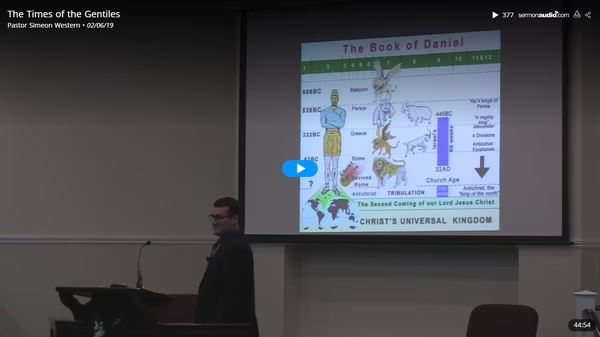
Daniel 7 marks the start of the second major section of the Book – Prophetical. In the first half of Daniel (1-6), Daniel interprets the dreams of others. Now he receives his own visions directly from God. This chapter is a parallel to chapter 2, giving another overview of what Christ referred to as the “times of the Gentiles” (Luke 21:24) with additional details, particularly in relation to the rise of Antichrist.
In Daniel 2 the Gentile kingdoms are seen from man’s point of view – glorious, majestic and powerful. In Daniel 7, these same kingdoms are seen from God’s point of view as vicious, warring beasts that devour one another in order to gain supremacy.
We will divide the chapter under 3 headings for our study as follows:
- The Introduction to the Vision (Vs. 1-3)
- The Information of the Vision (Vs. 4-14)
- The Interpretation of the Vision (Vs. 15-28)
- Note: We will cover the final point in our next lesson.
The Introduction to the Vision (Vs. 1-3)
The Period (Vs. 1)
- This vision came to Daniel in “the first year of Belshazzar’s reign”. This was approx. 14 years before Belshazzar was killed by the Medes and Persians (Dan. 5:30-31) and approx. 50 years after the dream of Nebuchadnezzar in chapter 2.
- This means chronologically, Daniel 7 comes between Daniel 4 and 5. No wonder Daniel was not interested in Belshazzar’s trinkets. He knew by the Revelation of God’s Word through this vision that the Babylonian kingdom would end and with the rise of the Medo- Persian kingdom.
The Place (Vs. 2a)
- The dream came to Daniel “at night” when he was “upon his bed”
- Even though it appears that at this time Daniel was no longer a prominent part of the Babylonian court, he was still walking with God and an available channel for God to use to communicate His Word.
The Picture (Vs. 2b-3)
- The Blowing of the Sea (Vs. 2b)
- “the great Sea” = this is the Old Testament name for the Mediterranean Sea (Josh. 1:4). The Mediterranean Sea was an important part of each of these four kingdoms. The sea symbolizes the earth (See Vs. 17) and is uses elsewhere in Scripture to symbolize the restless mass of humanity (Isaiah 17:12, 13; 57:20; Rev. 13:1; 17:1, 15)
- “the four winds” = the four winds stir up the sea and give rise to the four beasts (Vs. 3) The winds probably signify the warring of the nations inspired by the “prince of the power of the air” (Eph. 2:2)
- The Beasts from the Sea (Vs. 3)
- The size of the beasts – “four great beasts” These represent powerful kingdoms that ruled the known world at that time.
- The diversity of the beasts – “diverse one from another”
The Information of the Vision (Vs. 4-14)
The Earthly Kingdoms (Vs. 4-8)
- The First Beast: Lion with Eagles Wings (Vs. 4) – Babylonian Empire
- The Lion is the king of the beasts and the eagle is the king of the birds. This picture corresponds with the head of gold in Chapter 2.
- The eagle’s wings speak of the speed of the Babylonian conquests.
- Archeologists have discovered numerous “winged lion” sphinxes among the monuments of ancient Babylon (Sargent).
- The “wings plucked” and the giving to it of a “man’s heart” is likely a reference to the conversion of Nebuchadnezzar recorded in Daniel 4.
- The Second Beast: Bear (Vs. 5) – Persian Empire
- The bear is a slower, ponderous beast but has great strength. It is also depicted with 3 ribs in its mouth and is told to “devour much flesh”.
- The Medo-Persian armies were slow moving, but crushed their opposition through weight of numbers. Phillips writes, “When Darius marched through Scythia…he mobilized nearly three- quarters of a million men, not counting his fleet of six hundred ships. When Xerxes marched against Greece, he took two and a half million troops with him; the movement of this mass of men looked more like a migration than an army.”
- The Third Beast: Leopard with four wings (Vs. 6) – Grecian Empire
- The leopard is one of the swiftest and most agile of wild animals. The conquests of Alexander the Great (332-323 B.C.) are noted for their swiftness. He conquered the known world in 13 years (Sargent). The four wings also speak of speed.
- The “four heads” represent the division of the empire after Alexander’s death. Alexander’s four generals divided the kingdom into Thrace, Macedonia, Syria and Egypt.
- The Fourth Beast: Dreadful, Terrible, Strong & Diverse (Vs. 7-8) – Roman Empire
- Particular attention is given in this chapter to this fourth kingdom. Bible students refer to this as a “non-descript beast”. It is so ferocious and terrible that, unlike the other kingdoms, there are no beasts in the animal kingdom that can adequately illustrate it. There are two stages to this kingdom.
- The Fulfilled Stage – ancient Rome (Vs. 7). Described as having “great iron teeth” The iron teeth correspond with the legs of iron in Daniel 2. Iron is stronger than the other metals. Rome was a fierce and brutal kingdom that ruled the world with a rod of iron. Resistance was brutally stamped out. Rome crucified Christ and ten Caesars from Nero to Diocletian persecuted the church ruthlessly (Phillips).
- The Future Stage – 10 kingdom confederacy from which antichrist will rise (Vs. 7-8).
- The 10 horns – “and it had ten horns” This corresponds with the 10 toes of the statue in Daniel 2.
- The little horn – “there came up…another little horn” This little horn rises up out of the 10 horns. It gains power by destroying 3 of the other horns. It is clearly speaking of a man – “in this horn were eyes like the eyes of man, and a mouth speaking great things.”
The Everlasting Kingdom (Vs. 9-14)
- The scene abruptly switches from this little horn boasting great things to the throne room of heaven.
- David Jeremiah says, “It’s like sitting in a darkened room, watching his vision on a motion picture screen that is split horizontally into two parts. On the lower half of the screen the four beasts are revealed, coming out of the sea of humanity one after another. As we watch with horror and fascination, the fourth beast appears on the screen, devouring and breaking in pieces all of the nations. With the last gasp of the Roman Empire on earth, suddenly the upper level of the screen lights up and we have a glimpse into the throne room of heaven. What an awesome contrast to the turmoil on earth.”
- Observe the exaltation of the King (Vs. 9-10) Look at what Daniel saw! (adapted from outline by Denis Lyle)
Daniel saw…- The Eternality of God – “the Ancient of days” (Vs. 9a). This depicts God the Father as Christ comes to Him in Vs. 13 to receive the kingdom. This is the only place in the Bible where this title of God is used. “Before the mountains were brought forth, or ever thou hadst formed the earth and the world even from everlasting to everlasting thou art God.” (Psalm 90:2)
- The Purity of God – “whose garment was white as snow” (Vs. 9b) What a picture of absolute purity and holiness.
- The Beauty of God – “And the hair of His head like the pure wool” (Vs. 9c) Another picture of His purity and also His eternality.
- The Majesty of God – “his throne was like the fiery flame…” (Vs. 9d-10a) Look at how closely fire is associated with the Divine Presence of God. “For our God is a consuming fire.” (Heb. 12:29)
- The Company of God – “thousand thousands ministered unto him” “This is hundreds of millions. Countless elect angels and redeemed men serve God and delight in His ways and in His business.” (Cloud)
- The Sovereignty of God – “the judgment was set and the books were opened” The court is in session! Perfect justice will be done based on a perfect record.
- Observe the destruction of the antichrist (Vs. 11-12)
- In Daniel 2, the destruction of the Empire is detailed in Vs. 44-45 where the stone “cut out of the mountain without hands” pulverises the image, grinding it to powder.
- Here in Daniel 7, the beast is slain and burnt with fire.
- Observe the inauguration of the kingdom (Vs. 13-14)
- If all of the first four kingdoms were literal, so will there be a literal kingdom of Christ! It is completely inconsistent to interpret the first four empires in a literal manner and then switch to spiritualize the coming Millennial Kingdom.
- “the Son of man” = one of Christ’s favourite terms for Himself. It appears 85 times in the Gospels.
- Christ claimed this prophecy of Daniel for Himself when we was on trial before the Jewish leaders – Matt. 26:64 “Jesus saith unto him, Thou hast said: nevertheless I say unto you, Hereafter shall ye see the Son of man sitting on the right hand of power, and coming in the clouds of heaven.”
The Interpretation of the Vision (Vs. 15-28)
This point to be covered in the next lesson in the series.
Conclusion
Are we living for Christ’s return?
Sermon 13 of 23 in Daniel Series
Sermon Audio Id: 62197462012